A pretty Venetian chandelier featuring delicate pink flowers and cascading blue leaves hangs from a ceiling. A hazy, warm light radiates from its tulip bulbs. Suddenly, a woman reaches up and snaps off one of the flower stems, giggling as she begins to nibble it. Welcome to the weird and wonderful world of Laila Gohar. The Egyptian-born, New York-based artist is part of a new wave of culinary artists blurring the lines between sustenance and spectacle, and this troupe have quickly become a firm fixture at fashion parties and design fairs, turning dining into a phenomenon and delight.
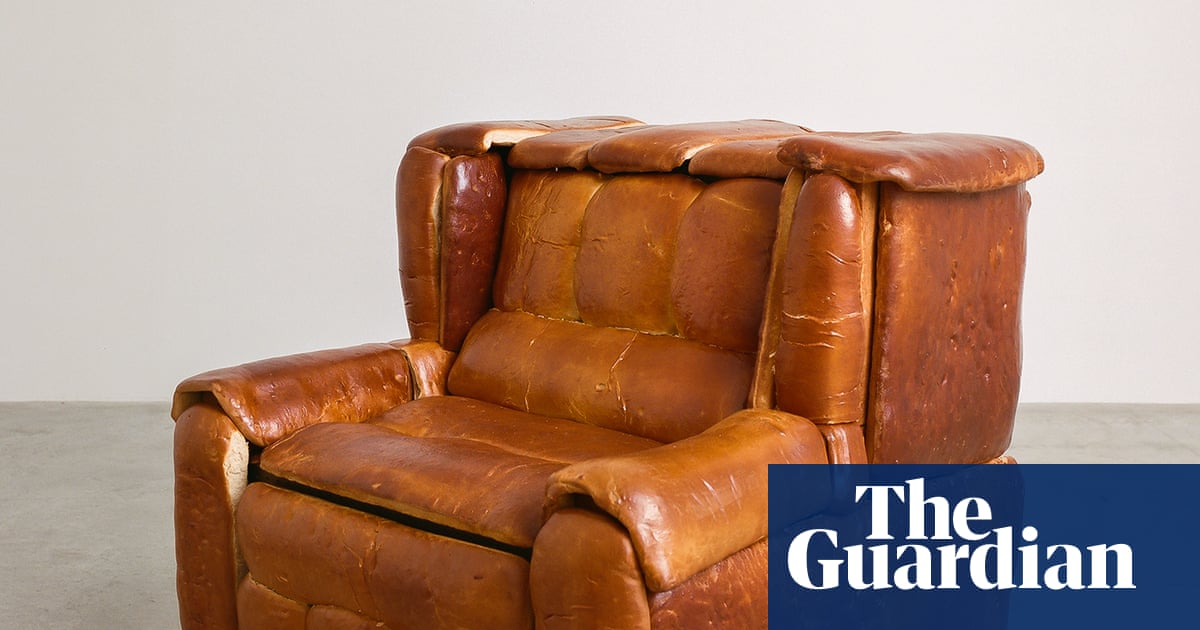
Gohar describes the chandelier, made entirely from hand-spun sugar (including the silver chain that suspended it) as her “favourite thing she has done in recent history”. It joins a long list of extravagant yet still edible installations she has created, including lifesize armchairs made of brioche, an entire room constructed with Belgian chocolate and a four-metre-long mortadella that had to be lifted into the party’s venue using a crane.
“I am interested in the rituals around eating and gathering, and in the way an ordinary thing can become something strange or theatrical when you change its scale, material or context,” says Gohar, who has worked with brands including Prada, Hermès and Sotheby’s. “Food is one of the materials I work with, but I don’t really think of what I do as being separated into food, art or design. They all feed into each other.”
This hand-spun sugar chandelier is an installation by culinary artist Laila Gohar.
Surrealist food has a long history in culture. The nursery rhyme Sing a Song of Sixpence was inspired by medieval banquets, where live birds and frogs were placed in hollow crust pies. Tudor banquets featured gold leaf covered swans and quivering jelly castles, and depictions of Macchina della Coccagna show fountains filled with wine and cakes hung in trees. Salvador Dalí’s cookbook, meanwhile, featured a recipe for a pie featuring a firework-like exploding leek and a string of mussels designed to snap open and shut.
When Gohar first started creating giant butter sculptures and towering langoustine pyramids, more than 15 years ago, she was something of an anomaly. Now, there’s a whole group of artists again toying with the idea of food and spectacle. Like any artist, their practice and style depends on the individual – some take a bacchanalian approach to feasting, others strip it back to a core ingredient.
It could be something as simple as a single fresh fig placed on a lace doily, a giant silver platter of gleaming cherries or whole walnuts on a mirrored plate. Or perhaps, a trompe l’œil, such as a mound of moss that is, in fact, butter to a scallop shell that is on closer inspection a biancomangiare made from milk. Then there’s the more extreme: a rounded tiramisu the size of a mid-century dining table; a kinetic mobile featuring tablespoons of roe; a swinging lacquered table featuring charred plums and pecorino.
Some, such as Imogen Kwok, are Michelin-trained chefs, others, including Gohar, are self-taught. Elena Petrossian, who, along with Verónica González co-founded the LA-based studio AnanasAnanas in 2019, describes their work as at the intersection of food, art and design.
“Our practice goes beyond the traditional idea of catering or food styling,” says Petrossian. “We create edible installations, objects, and experiences that challenge how people interact with food and the spaces around them. We’re interested in taking something familiar and presenting it in a way that feels unfamiliar, playful, and sometimes even a little absurd.”
At events, this new vanguard serves as an ice-breaker, an instant conversation starter among guests as they question if something is in fact edible. On social media, their creations are catnip, sparking joy for those without a seat at the table. Some regularly show the step-by-step process, revealing both the ingredients and wizardry behind their process.
As a result, the trend is trickling down to home dining tables, too. You can see it in the widespread appeal of tablescaping, where mixed glassware and clashing napkins are a mood. Not everyone can or wants to create a raspberry tart the size of a car wheel, but using a silicone shell butter mould or serving olives in an ice-cream coupe is a satisfying entry-level take.
Nil MutluerWedding installation by culinary artist Nil Mutluer.
Mutluer’s work varies from bite-size to colossal. From dice-sized jelly cubes to monumental marzipan cakes, the Turkish-born, London-based chef has worked with everyone from Miu Miu and Jonathan Anderson to Mubi. She has carved out a niche for captivating canapes. Think an asparagus and butter olive tartlet no bigger than a 50p coin. A baby potato filled with Japanese potato salad topped with a pea-size blob of creme fraiche. And a glossy stuffed cabbage, the size of a bottle cap, filled with girolles.
She thinks of “food as a material, something you can fold, stack, drape or carve”. For an exhibition highlighting the work of furniture designer Christopher Kurtz, she served cheese that resembled rope and a hazelnut candy floss that could have been mistaken for spools of cashmere wool.
Fascinated by how scent can become a flavour, she regularly works with perfume brands. At the launch of the British fragrance house Ffern’s autumn fragrance, she served fennel granola with fragola grapes finished with a mist of tonka bean.
“The most challenging projects are usually those where I’m creating something for the first time, which is most of my work,” she says. “Something can look beautiful on paper or in your imagination, but food has its own behaviour. There’s a lot of testing and adapting to make something feel effortless when people finally encounter it.”
Idan GilonyA sweet table installation by nous.dining (chefs Fabian Saalfeld and Paula Weitzel) for an exhibition by Idan Gilony at the Livie Gallery in Zürich, Switzerland.
Gilony originally worked in fashion design before pivoting to food in 2024. His gargantuan grazing-style tables have become his signature. For a Netflix premiere he created installations made of tables modelled as sand dunes, into which he inserted hundreds of forks, each holding an individual langoustine or chocolate truffle. His sweet table at a Jimmy Choo party featured index finger-sized eclairs and ping-pong-ball-sized bonbons scattered among slender-stemmed safflowers. Vividly coloured cocktails spanning everything from an Yves Klein blue to Pepto-Bismol pink are also a hallmark. Toying with performance art, he rarely uses plates for his creations. Instead, something like a pistachio matcha tiramisu is served down the middle of the table, studded with spoons for guests to help themselves with. “I try to incorporate that in my work as much as I can, transforming the audience into the performance itself,” he says. “It’s fascinating to see how people behave around an installation – how they interact with it, unintentionally shaping it.”
AnanasAnanas
LA-based Elena Petrossian and Verónica González have created edible mushroom lamps, stacked rotating chandeliers with umeboshi sticky rice, threaded hundreds of blueberries on to stainless steel spikes and placed polished apples on huge motorised stainless steel vessels.
AnanasAnanas (AKA artists Elena Petrossian and Veronica Gonzalez).
For Petrossian, the visual elements and ingredients influence each other. “Sometimes an ingredient inspires an entire installation, and other times we begin with a sculptural idea and explore what food belongs within it,” she says. “We don’t believe that something has to be visually elaborate to be interesting, just as we don’t believe food should be beautiful at the expense of its taste.”
Hanna Hurr
The founder of the Brooklyn-based studio Figwaspe describes her style as having “a reverence for nature’s design in conversation with artful human intervention”. She cites wandering outdoors and visiting galleries as regular sources of inspiration – but “in terms of importance, taste always comes first,” she says. “Food art is unique in that it accesses this visceral sense of taste that other mediums can’t. And even if the taste itself is a discovery or arrives in a different format, it has to be compelling, well-crafted and the core of the experience. Otherwise, why work with food?”
Scallop Biancomangiare tablescape by Hanna Hurr Photograph: Culinary Installation Artist: Hanna Hurr
Ideas that have made the “leap from dream to reality” include bowls moulded from candied blackcurrant leaves, tulips featuring a yuzu-cured scallop, pickled petals and poached lobster and a “transparent edible garden of botanicals” featuring scented sweets and rocks. Hurr often grows elements that feature in her work. “In those cases I am on the plant’s timeline,” she says. Foraged seeds resulted in a 12ft-long bed of nasturtium vines that Hurr studded with tartlettes made from the flowers and leaves of the plant.
Hurr, who previously worked as a chef in Michelin-starred restaurants, enjoys watching people encounter her work. “Can I touch this? Can I eat this? How does the piece change once I’ve interacted with it? They’re discovering a new way of experiencing food and taste,” she says.
Louis Thompson
One of the young Australian’s most challenging projects was a metre-long blackberry custard tart he created for a wedding party. After multiple tests and a consultation with his mum and brother, who are both architects, Thompson decided to approach the construction as “a gingerbread house – except, instead of a house, a trough of custard topped with blackberries”.
Thomson trained under Skye Gyngell at Spring, a farm-to-table-inspired restaurant in London. He also “subscribes to the school of seasonal, ingredient-led cooking”, citing chef Alice Waters and artist Judy Rogers as references.
A ‘mega’ cherry and almond cake made for Stefan Cooke’s AW25 presentation, created by artist and baker Louis Thompson. Photograph: Louis Thompson
He says: “Style and substance have long been thought of as diametrically opposed, particularly in food, but to attend to both is to make food that is inviting and intriguing.”
Born in Melbourne, Thompson moved to London in 2019 and has quickly become one of fashion’s most in-demand pastry chefs, particularly for his bicycle-wheel-sized cakes and tarts. A cherry and almond cake he made for designer Stefan Cooke took a week of preparation including “making batches and batches of butter cream”.