Published: 10:21 GMT, 23 November 2026 | Updated: 10:21 GMT, 23 November 2026
The idea of a creature that's part hamster and part algae sounds like something cooked up in Dr Frankenstein's lab.
But it has become a reality in Japan, where scientists have created a so-called 'planimal'.
The hybrid cells were developed by fusing together hamster and algae DNA.
'Plants and animals cannot reproduce with each other, so their chromosomes are never combined through mating,' explained Professor Sachihiro Matsunaga, senior author of the study.
'Yet, we have succeeded in creating hybrid chromosomes containing genetic material from both an alga and a mammal, and have shown that this genetic material can be stably passed on to daughter cells through repeated cell divisions.
'Remarkably, our planimal cells retained nearly an entire algal genome over many generations.
'This demonstrates that even the vast evolutionary divide between plants and animals can be crossed at the level of chromosomes, without reproduction.'
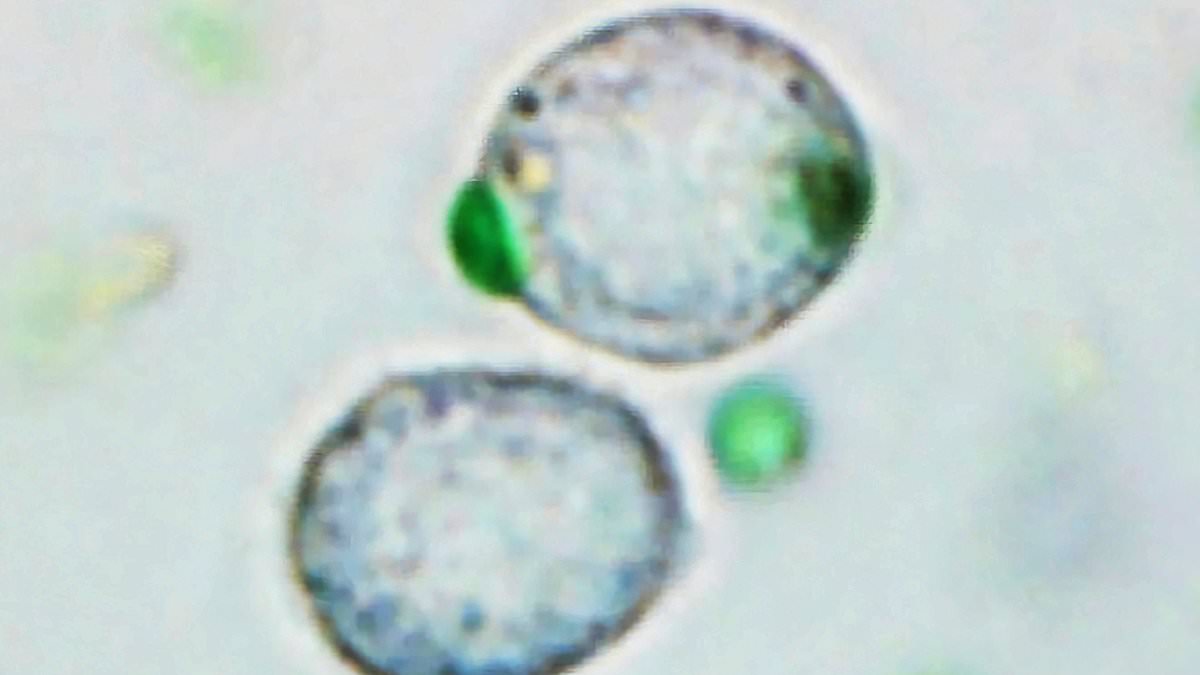
The idea of a creature that's part hamster and part algae sounds like something that would be cooked up in Dr Frankenstein's lab. But it has become a reality in Japan, where scientists have created a so-called 'planimal'
In their study, published in Nature Communications, the team set out to understand if it's possible to fuse mammal cells with DNA from algae - something that has never been done before.
Professor Matsunaga, from the University of Tokyo, explained: 'We wanted to understand whether entire chromosomes could cross the enormous evolutionary divide between algae and animals and whether animal cells could stably maintain and pass on such foreign genetic material to their daughter cells.
'We also wanted to discover how animal cells accommodate DNA from such a different organism without losing their ability to survive and divide.
'These questions are fundamental to understanding how genetic material can move across species boundaries and contribute to evolution.'
The researchers tested two methods as they tried to create the planimal.
Firstly, they fused photosynthetic algal cells with cells taken from a hamster.
As an alternative, they also allowed the hamster cells to engulf the algae - but found that the fusion method was more effective.
Amazingly, they found that the algal DNA was passed on through more than 150 cell divisions. However, about 96 per cent of the transferred algal genes were inactive, suggesting the hamster cells were using a form of 'gatekeeping' to supress the foreign genes
Having created the planimal, the team used live-cell imaging and genome sequencing to track how it acted as it reproduced.
Amazingly, they found that the algal DNA was passed on through more than 150 cell divisions.
However, about 96 per cent of the transferred algal genes were inactive.
According to the researchers, this suggests the hamster cells were using a form of 'gatekeeping' to supress the foreign genes.
The team now plans to carry out follow-on studies to understand how selected genes might be switched back on.
'Our next challenge is to selectively switch on the genes we need and make them work inside animal cells,' Professor Matsunaga said.
'The red alga we use has a remarkably compact genome containing genes for metabolic functions that animal cells do not possess.
'Our ultimate goal is to activate these biological pathways and give animal cells some of the unique abilities of plants and algae.
'Imagine animal cells that could sustain photosynthesis for long periods, producing oxygen while using carbon dioxide to make useful organic compounds.'