Challenger Deep, located near the southern end of the Mariana Trench, is the deepest point on Earth and one of the strangest locations ever explored.
Now, scientists have made a baffling discovery on the flanks of this 6.8–mile–deep (10.9km) chasm that could explain why it plunges so far beneath the surface.
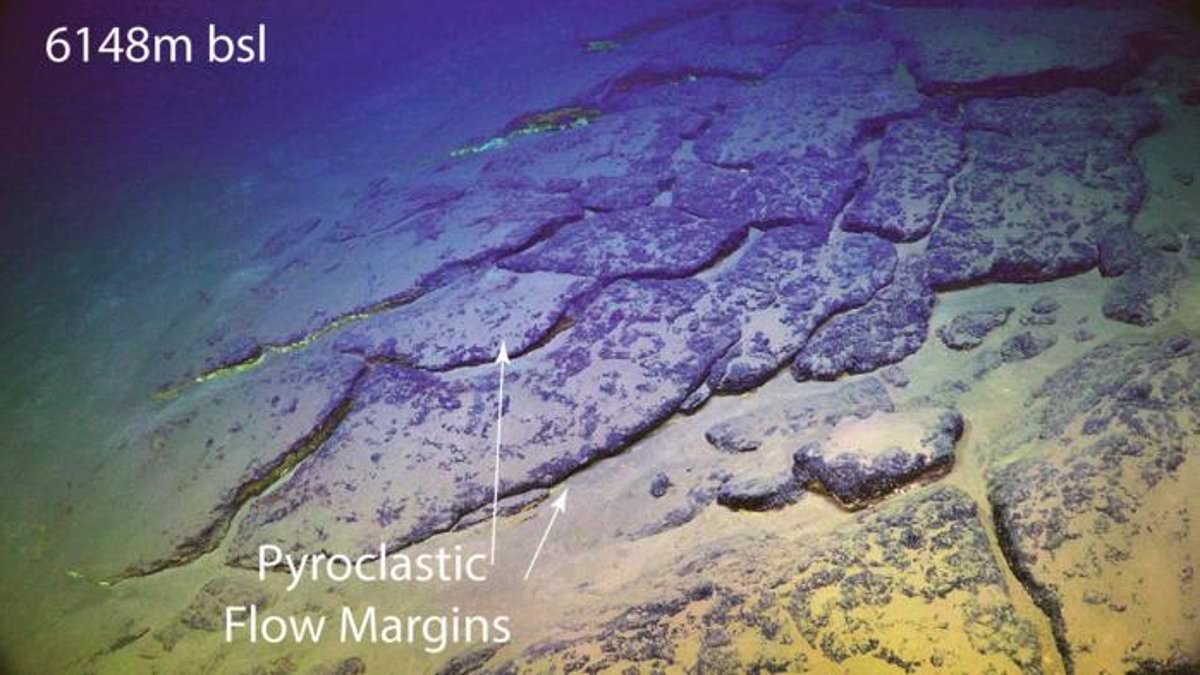
Using a deep–sea remotely operated vehicle (ROV), researchers discovered thin sheets of pyroclastic rocks, created by cooling lava flows.
That is evidence for the deepest underwater volcanic activity ever discovered.
Although this 'unprecedented' volcanic activity might help explain how the Mariana Trench formed, it is also highly unexpected.
This part of the ocean floor is part of a tectonic boundary where the rocky mantle isn't hot enough to melt, making young lava flows extremely rare.
Likewise, the enormous pressure at these staggering depths makes any kind of volcanic activity exceptionally strange.
Lead author Dr Robert Stern, of the University of Texas at Dallas, says: 'Explosive volcanism near trenches is unusual, so we were very surprised.'
Using a deep–sea remotely operated vehicle (ROV), researchers discovered 'unprecedented' volcanic activity near the bottom of Challenger Deep, the deepest point on Earth
The Mariana Trench stretches roughly 1,580 miles (2,550km) from near Japan's south coast down to the island of Guam in the western Pacific.
Challenger Deep, the trench's deepest point, extends so far below the surface that normal submarines and robotic explorers are unable to survive the pressure.
In their study, published in Frontiers in Earth Science, the researchers used the ROV Jason/Medea, which can dive down to four miles (6.5km) below sea level.
Although that doesn't actually allow it to reach the bottom of the trench itself, it does allow scientists to visit Challenger Deep's wall in a region known as the forearc.
Ocean trenches are formed when one tectonic plate is pushed under another, with the steep dip at their meeting point creating the trench.
The forearc is the region of the crust that sits between the trench itself and the nearby range of volcanoes created by the tectonic activity.
The researchers sent Jason/Medea down to study a 340–mile–long (550km) section of the forearc near Challenger Deep, which is where they found the baffling signs of volcanic activity.
Dr Stern says: 'These are the deepest pyroclastic rocks documented to date from anywhere in the ocean.
The researchers used a Remote Operated Vehicle (ROV) to study an area called the 'forearc', which sits between the trench and the nearby volcanic chain
Mariana Trench: The deepest trench on Earth
The Mariana Trench is the deepest part of the world's oceans, located in the western Pacific Ocean, to the east of the Mariana Islands.
The trench is 1,580 miles (2,550 km) long but has an average width of only 43 miles (69 km).
The distance between the surface of the ocean and the trench's deepest point, the Challenger Deep, is nearly 7 miles (11 km).
Director James Cameron became the first solo diver to reach the bottom of Challenger Deep in 2012.
'The intense pressures at the depths that these submarine volcanoes erupted makes the eruption style different than it would be on land or in shallow water, where the pressures are much lower.
'The explosive eruptions observed on land cannot be as powerful under these high–pressure conditions because the gases in the magma cannot expand so much.'
Although the researchers haven't found the eruption sites yet, they know that the lava flowed down slopes and that it didn't move very far.
The rocks retained enough heat to weld themselves into very hard rocks, which they wouldn't have done if they travelled great distances.
This survey also revealed that the forearc is being stretched from east to west along the seafloor by powerful tectonic forces.
However, this stretching is being caused by different forces at the east and west ends.
Older rocks at the eastern end indicate that the segment is being stretched by mechanical forces from the tectonic plates, like a soft toffee being pulled apart.
In the west, meanwhile, younger volcanic rocks suggest that this section is being extended by magma escaping to the surface from the mantle.
This volcanic material suggests that the semi–liquid mantle has pushed through to near the edge of the trench, producing a steeper drop and explaining why Challenger Deep extends so far below sea level
According to the researchers, these discoveries could help explain why Challenger Deep is so much deeper than any other ocean trench.
Challenger Deep is formed where the Pacific Plate sinks beneath the smaller Mariana Plate.
The presence of volcanic rocks near the trench suggests that the semi–molten part of the mantle has penetrated exceedingly close to the trench, just west of Challenger Deep.
This means that the two tectonic plates are only very weakly attached, allowing the bottom Pacific Plate to slide down more easily.
Since this plate is also narrow and short, it bends at a tighter angle than normal, creating a very steep dip as it vanishes beneath the Mariana Plate.
The steeper that angle is, the deeper the trench will be.
However, scientists say that there is still a lot more work to be done before Challenger Deep can truly be understood – mainly because they still can't reach the bottom.
Dr Stern says: 'We were unable to study the seafloor between the depths of 6,500 meters and 11,000 meters, the depth of the Challenger Deep.
'Only Chinese scientists and some wealthy entrepreneurs now have research tools capable of working down to the bottom of the Challenger Deep.'