The great British holiday a century ago bore little resemblance to what it does today.
International jet-setting was firmly a pursuit from the future with day trips often more likely than whole weeks away.
A new book, Britain in the 1930s, offers insight into just how British tourists enjoyed their hard-earned breaks during a period when the country was on the cusp of enormous change – with the Second World War looming.
Above all, the 1930s marked the start of the Golden Age of the British Seaside break.
Up and down the country, seaside resorts, with pleasure piers and elegant Victorian-era hotels, welcomed holidaymakers seeking leisure and escape – with beaches and promenades often bustling.
In the south, families enjoyed day trips to Brighton and Margate, while Blackpool and Morecambe became synonymous with summer holidays in northern England.
Holidaymakers on the sea front despite gale-force winds in Blackpool, Lancashire
Popular beaches were rammed during the warmer months, such as Bognor Regis, pictured in 1933 during a heatwave
Camping, walking and boating holidays also grew in popularity, while lidos, dance halls and pavilion theatres reflected a new culture of recreation and entertainment.
Co-author Steven Brindle says the book helps to paint a picture of holidays – and life – in what was a difficult period in British history, with the Great Depression and mass unemployment making life difficult for ordinary people.
Historian Steven, who wrote the book with Maureen Hill, told the Daily Mail holidays weren't a given.
'There was no statutory right to a paid holiday from work until the Holidays with Pay Act of 1938.
'Most families, working-class families, lower-middle-class families, lived at a much lower level of material comfort than people do now.
'So, holidays were rarer, apart from Christmas, which would always be spent at home, and the Easter holidays.'
The 1930s were the veritable golden age of British seaside holidays
Holidaymakers enjoying the summer sunshine on Ryde Beach, Isle of Wight, in 1936
He says most people might look forward to 'one big holiday away' and it would almost certainly be on home soil.
'Holiday overseas was for the rich and would be undertaken by boat. This might mean going to a resort townlike Bath or Brighton - but these were really middle-class things.
'Overwhelmingly, for the bulk of middle-class, working-class people, holidays meant the seaside, and this was really the golden age of the British seaside resort.
'Popular mass seaside resorts included Skegness, or Blackpool, or Morecambe, or in the south Margate and Southend and Ramsgate, and they really catered mainly to working class people.'
Great Yarmouth with its long sandy beach was another top choice
And it could get very busy, says the historian.
'The beaches were full. Seaside resorts had a wide range of entertainment, possibly more than they do today, with Punch and Judy shows, and donkey rides. Seaside piers were focuses for entertainment.'
Piers would have concert halls, or small theatres, with a regular programme of concerts and recitals, the author says – live performers were far more prominent than they are today.
Lidos popped up too, in the Art Deco style, at resorts such as Morecambe.
'Upper-class and upper-middle-class people now, they go abroad. But in the past, until mass air travel, going abroad was a lengthy as well as expensive business, because it took, at least a day to get to France. And then you had to travel by boat or train, which is inherently so much slower.
'So, upper and upper-middle class holidays on the continent were for quite long periods of time.'
Camping was also generally for wealthier travellers, as you usually needed to be able to afford a car to reach some campsites.
Pier entertainment was paramount, for instance at Eastbourne Pier, pictured in August 1933
People enjoying the view from the West Cliff at Whitby in 1935 in Yorkshire
Tales of UK holidays a century ago feature in the new book, Britain In The 1930s
This explains the rise of the seaside resorts, which sprang up initially also for wealthier families, but as soon as the railways were established in places such as Scarborough (in 1845) and Whitby (in 1836), smarter hotels arrived on the scene.
'Upper-class and upper-middle-class people went for holidays in well-appointed hotels, either in little towns, or Bath, Buxton and Harrogate.'
Where did Britons stay 100 years ago?
'What you absolutely had to have was big hotels,' Steven reveals.
For instance the Grand Hotel in Scarborough, which 'was built for the Victorian upper middle classes' – construction was completed in 1867. It remained popular until the 1960s, when overseas travel began to grow.
Costs differed greatly, too. Steven says working-class incomes would have been around £200 a year – so expensive holidays were out of the question.
For instance, a week's holiday at Caister-on-Sea in the Great Yarmouth district cost two guineas (£2.10) per week, according to one report.
Steven added: 'It sounds as remote as ancient Greece now, but people would dress very properly, and take walks on promenades and listen to bands on bandstands.
'They would drink tea in drawing rooms and on terraces and go for excursions in motor cars, or take dance lessons.
'They would dress for dinner, sit on terraces and read novels and enjoy winter gardens and concept pavilions.
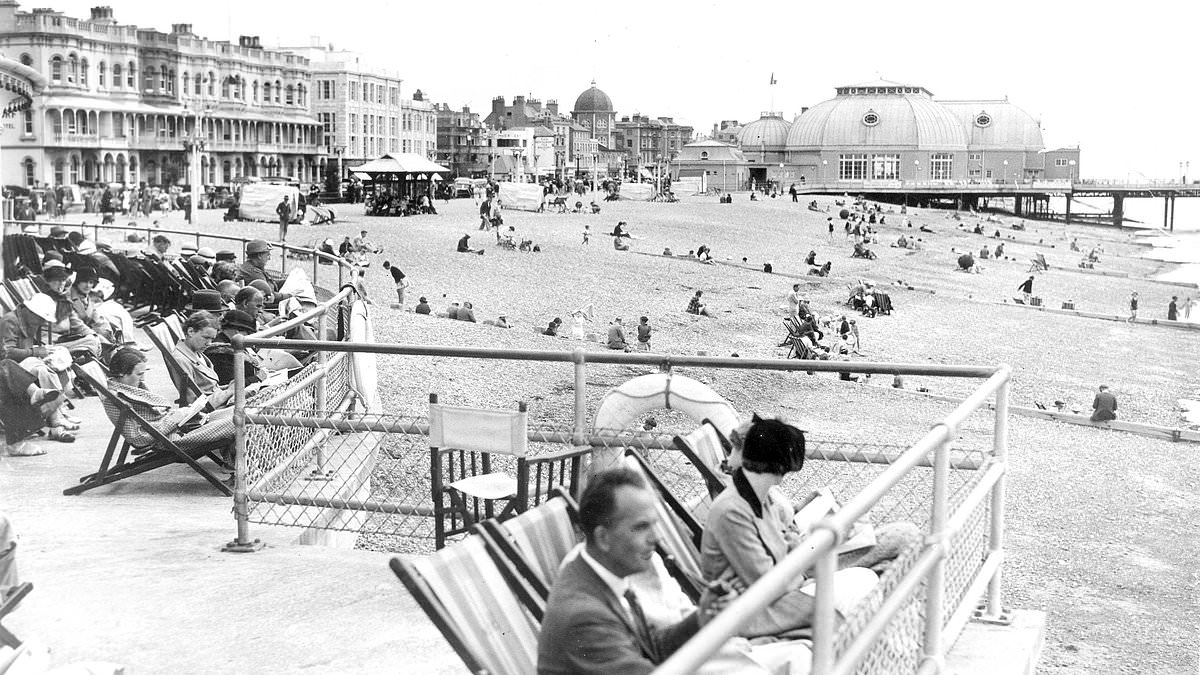
Seabathing was common, with holidaymakers enjoying the views here at Worthing, Sussex
It was standard to dress respectably and smartly on holiday
Some places had a hidden significance.
'Brighton, for some reason, became associated with illicit affairs,' Steven reveals – 'being taken by a gentleman to Brighton almost certainly' meant there was adultery occurring.
It was even used in 'staged' divorces, when a couple would need to fabricate grounds for divorce – for example, a fake affair to permit it.
As for the working classes, boarding houses would have been the accommodation of choice.
He explains: 'The landlady is a fixture of the Victorian seaside resort - it's one of the great staples of music hall comedy. A lot more women were widowed a lot earlier back then, in the industrial age.'
They would obviously be very concerned to maintain a reputation for respectability, of their house not being thought of as a 'knocking shop'.
'Boarding houses were quite strict. A lot more women were widowed a lot earlier back then, in the industrial age.'
The Grand Hotel in Scarborough is a key landmark from the period
It's not just the shape and form of trips that was different – how did holiday outfits look back then?
Holiday attire was a far cry from the flamboyant Hawaiian shirts and colourful bikinis you'd see in the streets of Spanish coastal towns and UK beach resorts today.
Being seen as 'respectable' was paramount.
'If you dressed casually, that's probably because you were a tramp, or you were a labourer at work, Steven says.
'A huge range of working class people habitually wore ties. Quite often, if they were going to the seaside, they would wear a tie and a hat to show that they were respectful, they were powerful members of society.
'Skirts were almost always quite long, at least to knee length for women. Knee length to mid-calf length would be typical.'
What about food?
'Fried fish and chips was rather more of a treat,' Steven says – although it very much still existed.
'Rock candy most definitely existed then.'
You wouldn't get Indian, Chinese or Italian food as you would today in most UK towns, and 'the food would have been far more of the boiled or mashed potato, and two vegetables, and a piece of fish or meat variety'.
'Picnics would have been heavily dependent on sandwiches, pork pies and sausage rolls.
'But people did eat less. Food was relatively more expensive. You see very few overweight people in this book.'
The staples of holiday cuisine were similar, from ice cream to fish and chips
As for souvenirs, you might buy a postcard while away in a seaside town.
He explains a 'glass ornament, china ornaments, a little cup saying the "souvenir from Eastbourne"', were also possible.'
Overall, 100 years ago holidays weren't quite as ubiquitous as they are today – it was very much not a given.
The importance – and sentimentality – of them is summed up gloriously through one souvenir tradition that has lost its prominence today.
It was the norm to send a postcard to loved ones while on holiday, a special way to tell someone you were thinking of them – Steven says memorabilia is evident online, with vintage postcards all over Ebay from £10 (a far cry from the one penny you could easily buy one for in the 1930s).
Perhaps the sentimental angle holidays are missing today?
Britain in the 1930s by Steven Brindle and Maureen Hill (Atlantic Publishing £50) is out now and available here.