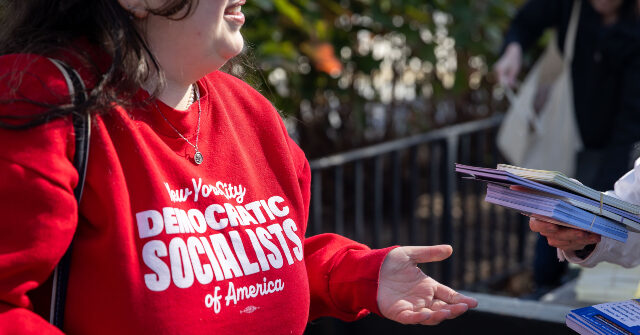
A post-election memo from the Republican State Legislative Committee (RSLC) said 58 candidates aligned with the Democratic Socialists of America (DSA) were elected on November 3 to state legislatures nationwide, a sign of the movement’s quick rise to power since the election of candidates such as New York City Mayor Zohran Mamdani in 2025.
Three of the DSA-identified candidates toppled Republican incumbents in Florida and Pennsylvania, the memo states.
The memo, from Edith Jorge-Tuñón, president of RSLC, says:
Beyond their electoral gains, these results offer a lesson about the changing political environment and the growing appeal of candidates who position themselves outside traditional establishment politics. Many of these candidates successfully tapped into voter frustration with the political status quo, emphasizing populist economic messages, affordability, and a willingness to challenge entrenched interests. They maintained a consistent message throughout their campaigns and demonstrated an ability to energize younger voters, their party’s base, and unaffiliated voters.
The RSLC also warns that Democrats are spending much more at the state level than Republicans. The group says it faces a rising financial disadvantage that has grown since 2020.
“Major liberal outside groups spent more than $98 million in 2020, more than $175 million in 2024, and are projected to have spent more than $200 million in 2026,” the memo continued. “RSLC invested $44 million in 2020, $49 million in 2024, and $75 million in the 2026 cycle. We are facing an increasingly significant financial disadvantage as Democrats continue to ramp up their investments in state legislative races.”
The group says Democrats have invested more in state legislative elections for four cycles in a row and unless Republicans begin raising and investing the resources necessary to match that spending, “we will remain at a disadvantage in one of the most consequential political fights shaping our party’s future.”
Democrats flipped 11 state legislative chambers in 2026, RSLC said, which previews major races in 2028 and 2030, and control over redistricting is at risk in many states. RSLC says redistricting is no longer simply a once-a-decade exercise and instead is “an ongoing political reality that demands attention, preparation, and engagement in every election cycle.”
Follow Matt Mercer on X: @mattmercer.