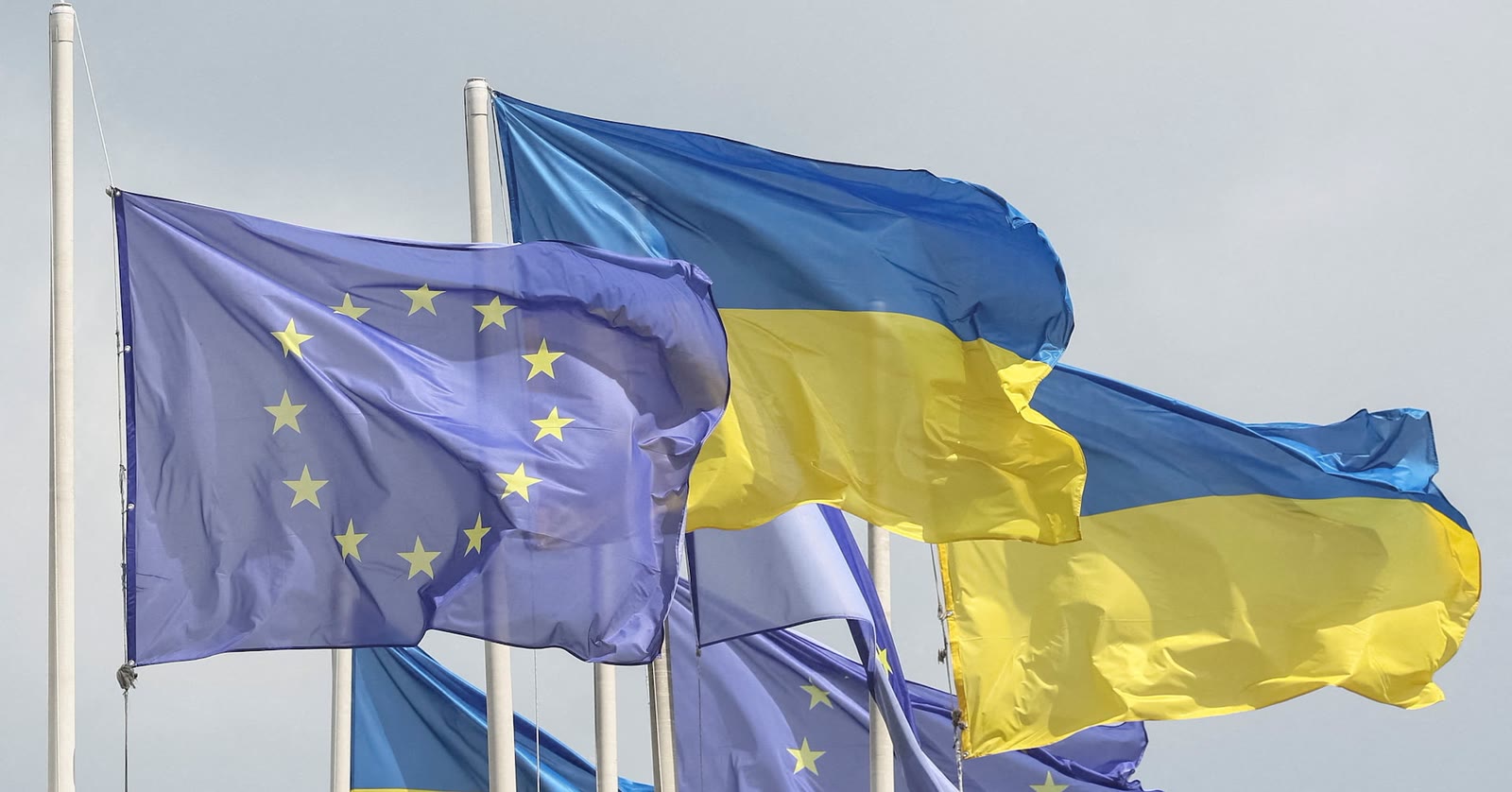
Ukrainian and European flags fly, amid Russia's attack on Ukraine, in central Kyiv, Ukraine August 11, 2025. REUTERS/Gleb Garanich/File Photo Purchase Licensing Rights, opens new tab
BERLIN, Nov 23 (Reuters Breakingviews) - Europe must rush to boost its aid to Ukraine. Kyiv needs some €70 billion to cover its financial needs until the end of 2027. The European Commission is proposing to borrow €45 billion to cover part of that sum. However, the initiative requires unanimity among the bloc’s 27 members, which will prove challenging. Support for Ukraine from some European capitals may also wane in the coming months. More reason for the EU to hurry up and lock in a multi-year support package to bolster Ukraine’s defence against the Russian invasion.
Europe’s electoral calendar next year will not help advocates for helping President Volodymyr Zelenskiy’s government. Opinion polls show French far-right leader Marine Le Pen is for now the favourite to win the country’s presidency next spring. Regional elections in four important German states in April and May could confirm the increasing influence of the nationalist Alternative for Germany.
The Misinformation Monitor newsletter rounds up international misinformation narratives, with a "Real or Fake?" quiz in every edition. Sign up here.
Le Pen poses the most immediate threat to Ukraine. She has already warned Zelenskiy’s ambassador in Paris that she would stop French aid to the country. Cancelling bilateral support would only do limited damage. Despite President Emmanuel Macron’s flowery proclamations of support, France has been among the least generous donors to Kyiv, providing less than €8 billion of bilateral aid between January 2022 and August 2026, according to the Kiel Institute’s
Ukraine Support Tracker, opens new tab
. That equates to just 0.3% of French GDP.
Compare this to the €31 billion spent by Germany or the €23 billion spent by the UK - the equivalent of 0.9% of annual economic output for both countries. Indeed, the French contribution is smaller in absolute terms than the €12 billion provided by tiny Denmark.
Le Pen has said that she would honor France’s previous commitments, notably its share of the €90 billion joint EU loan extended to Kyiv last year. That is reassuring for French diplomatic continuity, but does not mean she will sign up to further joint financial efforts to help Kyiv defend itself if she becomes president. The risk is that the EU’s new €45 billion borrowing proposal gets lost in an acrimonious debate among the bloc’s 27 members, and that a new French president kills it off.
The
facility, opens new tab
proposed by Brussels is weakened by its structure. It envisages the European Commission borrowing from financial markets and passing the funds on to Kyiv. The loan would be backed by the current EU budget headroom - defined as the difference between what the EU states can be asked to pay and what the Commission spends.
The proposal can be adopted by the European Parliament and by a simple majority of heads of government at the European Council. But the change required to the current budget can only be modified by a unanimous vote, notes economist Lucas Guttenberg, head of the Europe’s Future programme at the Bertelsmann Foundation, a think tank.
German Chancellor Friedrich Merz has threatened to withdraw his support for the next EU budget - due to cover the years 2028 to 2034 - unless all the 27 members support the new Ukraine aid package. Countries including Slovakia, Bulgaria, the Czech Republic and even Hungary are currently resisting further support for Kyiv. But as net recipients of EU funds, they are susceptible to fiscal pressure.
Even so, negotiations about the €45 billion package could drag on for months. Ukraine may also need more money if the coming winter proves even tougher than expected, and if Russia steps up its relentless bombing of the country's energy grid or logistics centres. In any case, Ukraine is likely to need financial help well beyond the end of next year.
A
proposal, opens new tab
to mobilise some €210 billion of frozen Russian funds by switching their custody from Belgium to the EU would help finance Ukraine over the long term.
The scheme has been
endorsed, opens new tab
by four former EU defence or finance ministers. But it does not meet the speed requirement, because the move also requires unanimity and would need to address the objections of Belgium and others, including France.
To avoid endless disputes, bargaining and messy compromises while time is of the essence, European governments should seek ways to put their support for Ukraine on a stable, long-term footing before next year’s potential political upheavals. That may require going outside the European Commission framework by assembling a so-called “coalition of the willing”.
An ad hoc financial vehicle, financed by paid-in and callable capital from willing countries, could be resurrected on the model of the first bailout funds imagined by EU members at the height of the euro zone crisis 16 years ago. The instrument could borrow from financial markets and be structured along the same model as the Commission’s recent loan proposal, where Ukraine only pays back the principal if it receives reparations from Russia. One big advantage is that the vehicle could include the United Kingdom, thereby showing Russian President Vladimir Putin that Europeans remain united in their support of Kyiv.
European governments have shown in the past that they can act swiftly when needed. Back in May 2010 they took only a month to set up the European Financial Stability Facility, the first version of a euro zone bailout fund. They could act in a similarly swift way to help Kyiv defend itself against Putin’s missiles before the Ukrainian winter. All that is needed is a stronger sense of urgency.
Editing by Peter Thal Larsen; Production by Oliver Taslic
Breakingviews
Reuters Breakingviews is the world's leading source of agenda-setting financial insight. As the Reuters brand for financial commentary, we dissect the big business and economic stories as they break around the world every day. A global team of about 30 correspondents in New York, London, Hong Kong and other major cities provides expert analysis in real time.
Follow us on X @Breakingviews and at www.breakingviews.com. All opinions expressed are those of the authors.
Pierre Briancon is a Breakingviews columnist, writing on European business and economics. He was previously a writer or editor at Barron’s, Politico, and Breakingviews for a first stint as Paris correspondent and European editor. For the first part of his career he was a foreign correspondent and editor at Libération, the French newspaper. He was also an economics columnist for Le Monde and for French public radio.