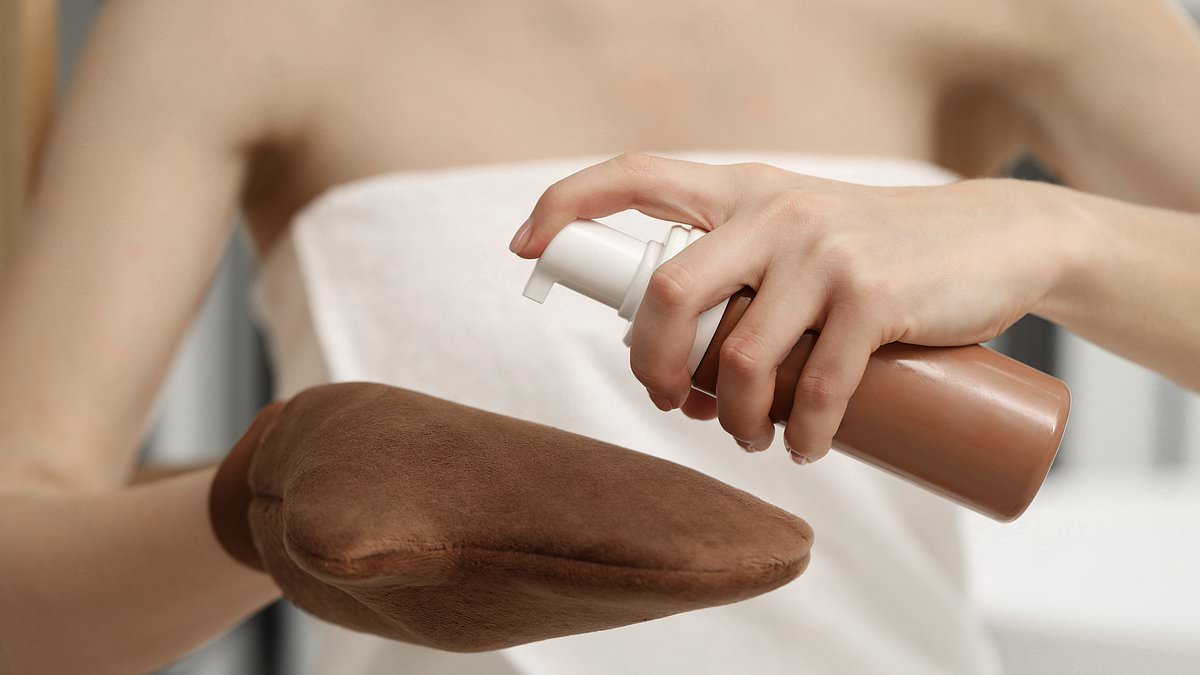
Britain's reputation for relentless sun-worshipping has resulted in a public health nightmare.
Diagnoses of skin cancer in the UK reached record highs in the latest analysis - totalling above 20,000 for the first time ever in 2022.
In recent years, charities and doctors have reignited their efforts to remind the public of the dangers of UV rays, including adding sun-safe labels to millions of sunscreen products across the UK, advising Britons to 'seek shade, cover up and apply sunscreen.'
While the public health benefits are yet to be seen, the self-tanner industry has seen a healthy boost, with the market said to reach £746.3 million by 2027 - a rise of around 28 percent from today.
But how much safer is it? Concerningly, a collection of skin experts have recently taken to social media to warn of the surprising risks of a tan-in-a-bottle.
Speaking to The Daily Mail, dermatologist and owner of London-based clinic Libi and Daughters said: ‘There is no such thing as a healthy tan.' This includes fake-tan, she added which, 'isn't entirely harmless'.
‘Both types of UV rays can damage cellular DNA and increase the risk of skin cancer, including melanoma.’
So what exactly are the risks - and which products pose the most danger? Here, some of the UK's top skin doctors explain everything you need to know.
Self-tanner is 'not entirely harmless', according to top dermatologist Dr Inna Szalontay
How much safer is self-tanner than the sun?
There is no doubt that UV rays - either from the sun or sunbeds - are far riskier for your health than dousing your skin in a bottle of fake tan.
Dermatologist Dr Inna Szalontay said both UVB and UVA rays can increase cancer risk. The UVB rays cause sunburn, while UVA rays penetrate deeper into the skin, causing a breakdown of proteins collagen and elastin.
This, over time, can also cause wrinkles, pigmentation and premature ageing of the skin.
‘Both types of UV rays can damage cellular DNA and increase the risk of skin cancer, including melanoma,' she added.
'But there's an ingredient in fake tan called dihydroxyacetone (DHA), which isn’t an entirely harmless ingredient.'
DHA is a sugar molecule and the chemical that gives most self-tanners their colour.
‘DHA reacts with the amino acids in the outermost layer of your skin to produce brown-pigments that create the appearance of a tan,’ said Dr Szalontay.
This is known as the Maillard reaction - the same type of chemical reaction that causes food to turn brown when heated, such as with toast.
But DHA is thought to react with sunlight to produce compounds that are potentially damaging to the skin and could even raise cancer risk, according to some research.
A 2007 study, published in the Journal Photochemistry and Photobiology, found that DHA-treated skin samples produced more than 180 per cent more harmful compounds - known as free-radicals - during sun exposure, compared with untreated skin.
‘The findings sound striking, but need context,’ said Dr Bernard Ho, consultant dermatologist and spokesperson for the Skin Health Alliance.
‘The researchers did not measure wrinkles or skin cancer in people using fake tan,' he said.
'They measured samples that have been extracted and tested in a lab. Although the findings raise a potential concern, they do not tell us how much additional harm, if any, occurs with an individual who uses these products.’
Consultant dermatologist Dr Sidra Khan believes spray tans may pose more of a concern.
‘DHA should not be inhaled or come into contact with the mucous membranes of the eyes, nose and mouth,' she added.
In the US, the Food and Drug Administration (FDA) do not approve tanning products with DHA for inhilation due to a lack of evidence regarding what happens when the substance is breathed into the lungs.
Some laboratory studies have identified potentially cancerous changes to the mucous membranes after inhaling products containing DHA.
The graphic shows the science behind fake tan and how it works to change the skin's colour
However, according to the The UK’s Scientific Advisory Group on Chemical Safety in Consumer Products (SAG-CS), concentrations up to in spray tanning booths are safe for adults.
Having said this, many safety regulators - including the Chartered Trading Standards Institute - strongly advise against using tanning products that could be sprayed up the nose. Some urge the public to use safety equipment over the eyes, nose and mouth.
‘When applied on skin however, DHA is generally considered safe and doesn't penetrate deeply,' said Dr Khan.
Should anyone avoid fake tan?
Dr Khan said an allergy to DHA itself or to botanical extracts that feature in some products 'is possible but rare’.
‘Reactions show up as irritant or allergic contact dermatitis - an itchy, red, sometimes flaky rash.
'Fake tan can also aggravate eczema.'
If you have the skin condition erythropoietic protoporphyria, a rare genetic condition that makes people extremely sensitive to sunlight; or vitiligo, where patches of skin lose their pigment, DHA could actually offer benefits.
A 2026 review published in the Journal of Cutaneous Medicine and Surgery noted that DHA can temporarily darken lighter patches, so the contrast between affected and unaffected skin is less noticeable.
There’s other allergens in fake tan to be aware of, however.
A 2024 study published in the International Journal of Women's Dermatology examined 44 self-tanning products from 17 brands.
The researchers found that each product contained an average of 11.86 common ingredients that are known to trigger skin reactions - including propylene glycol, linalool, d-limonene, benzyl alcohol and fragrances.
The researchers warned that these ingredients could trigger allergic symptoms in some such as itching, redness, dryness and rashes.
‘A lot of self-tanning products include additional ingredients which contain fragrances, alcohol, preservatives and botanical extracts,’ says Dr Szalontay.
‘These can trigger contact dermatitis - an itchy rash caused by direct contact with a substance or an allergic reaction to it.
Studies have found that 86 per cent of melanoma cases are preventable
'If you spot redness, itching, burning, swelling or blistering, stop using the product immediately and seek professional advice.’
How to choose the right fake tan and use it safely
Although most fake tans are fairly well tolerated, it’s best to be selective about the products used, the experts advise.
At the very least, this reduces the risk of the compounds disrupting the delicate skin barrier and potentially resulting in irritation.
‘Before using a new self-tanning product, I’d recommend doing a small patch test on the skin,’ said Dr Szalontay. Place some product on your inner arm, where any skin irritation will be hidden.
'Allergic reactions can take a few days to appear, so wait before using a new product.
‘It’s worth checking labels for perfumes - usually labelled as ‘parfum’ - as well as essential oils and the preservative methylisothiazolinone,’ warns Dr Khan.
‘This is one of the more potent compounds and it caused an epidemic of contact dermatitis across the UK and Europe over recent years.’
‘Those who react badly to this ingredient typically suffer an itchy, red, eczema-like rash, which can be quite severe - often on the face or eyelids.'
Methylisothiazolinone is now banned in products designed to be left on the skin, like masks and overnight tan, in the UK and EU.
'If you’re prone to sensitive skin or eczema, it’s still worth scanning the label for it,' said Dr Khan.
‘If you have a spray tan, choose a salon with a well-ventilated booth with extraction, use nose filters, keep your eyes closed or wear goggles and put balm on your lips.'
Otherwise, she advised looking for fragrance-free formulas, ideally labelled as suitable for sensitive skin or dermatologically tested, with a clear, short ingredient list.
DHA-free fake tan is available, however these tend to not be on the shelves in high street stores.
BeautyLab DHA-free Skin Tanning Lotion (£35) has been formulated for sensitive skin and people allergic to DHA, instead using a blend of tan-inducing peptide, erythrulose and natural actives. Utan Instant Tan Concentrate (£15) also offers DHA-free tanning for the face.
‘The main realistic alternative to DHA is erythrulose - another sugar that works in a very similar way but develops more slowly and gives a softer, longer-lasting colour,’ Dr Khan said.
'Beyond that, your options are really just temporary wash-off cosmetic bronzers that sit on top of the skin and rinse away.’
Dr Khan urged tan-lovers to stay well clear of injectable products like melanotan, which are unlicensed and unsafe.
Experts are concerned that tanning injections may stimulate changes in pigment cells and moles that could raise melanoma risk, or at least make cancerous moles more difficult to spot.
The most vital message, according to Dr Ho, is not to assume that any sort of skin colouring adds protection against cancer.
‘A tan does not provide sun protection, whether freshly applied or fully developed.
'Keep using your usual sun-protection measures rather than letting the colour give you a false sense of security.’