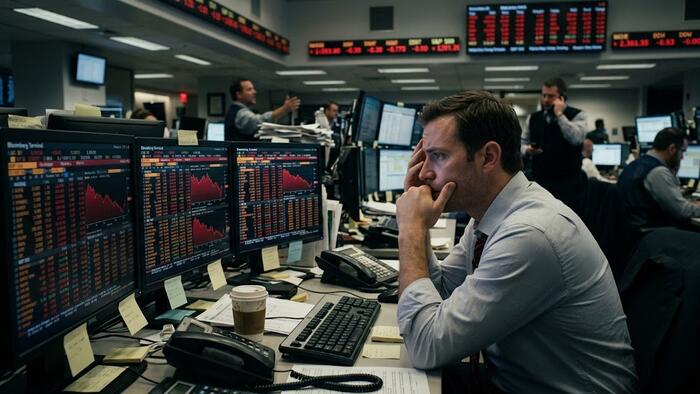
US futures are sharply higher as the market claws back some of last week's carnage, the worst week for the S&P since Liberation Day, after the Trump administration threw Nvidia a lifeline over the weekend (Scott Bessent drew a line between selling compute to China and supplying the Chinese military, while Trump publicly backed Jensen Huang's reinstatement), Asian authorities from Seoul to Taipei to Beijing rolled out a fresh round of plunge protection, and Bessent warned the Fed risks jeopardizing the economy by overtightening; as a result the VIX has tumbled from near 40 to about 30. As of 6:20am ET, S&P futures are 2.9% higher at [x] while Nasdaq futures jump 3.5% and Dow futures rise 2.1%. On Friday, the S&P slumped 3.7% to 6,910 and the Nasdaq 5.3%, capping an 8.6% weekly drop for the S&P and a 10% weekly drop for the Nasdaq. Premarket, the Mag 7 is rebounding hard from Friday's 5.2% rout, led by Nvidia which jumps 8% after its worst week since the GFC; AI-linked names from AMD to CoreWeave and Vertiv rip, Anthropic gains about 4%, and Zscaler soars double digits after CrowdStrike agreed to buy it in an all-stock deal. The day's driver is the "Trump put" (again): whether it sticks is another matter, with Goldman's Rich Privorotsky warning not to confuse a rhetorical pivot with regulatory relief. Treasuries slide as the haven bid fades, with the curve bear flattening as 2Y yields rise 4bps to 4.69% and the 10Y edges up to 4.95%. The dollar is flat, the yen is the weakest G10 currency with USDJPY back above 159, and the Aussie leads. Oil is lower, with Brent down 1.5% near $91, even as drones and missiles knocked another Russian refinery offline; gold and silver rebound more than 2% after last week's margin-call liquidation, and copper is back above $12,000. Bitcoin is trading around $61K after briefly sliding to $55K over the weekend. US economic data slate includes the October Chicago Fed national activity index (8:30am) and the November preliminary S&P Global PMIs (9:45am). Fed speaker slate includes Williams (4pm), the last scheduled Fed communication before the December blackout. Treasury auctions include $95BN of 13-week and $82BN of 26-week bills (11:30am) and $69BN of 2-year notes (1pm). US markets are closed Thursday for Thanksgiving.
In premarket trading, Mag 7 stocks are all higher: (Nvidia (NVDA) +7%, Alphabet (GOOGL) +5%, Tesla (TSLA) +4%, Amazon (AMZN) +3%, Meta Platforms (META) +3%, Microsoft (MSFT) +3%, Apple (AAPL) +1%)
AI-linked names jump, from chipmaker AMD (AMD +3%) to computing company CoreWeave (CRWV +6%) and electrical equipment supplier Vertiv (VRT +4%)Health insurers are lower after the US government proposed significant changes to measures for quality Star ratings in 2030 that threaten to reduce industry payments for firms with Medicare Advantage plans. TD Cowen says the proposed rule is more significant than expected, in both revenue impact and scope. Among insurers with exposure to Medicare Advantage plans moving: UnitedHealth (UNH) -5%, Humana (HUM) -4%.Anthropic (ANT) gains about 1%, pointing to a rebound from Friday’s decline.Arm ADRs (ARM) jump 8% after CEO Rene Haas affirms his long-term commitment to lead the company, with a new agreement extending his tenure through 2033.Dollar General (DG) rises 2% as Piper Sandler raised the recommendation on the retailer to overweight, citing its view of the company’s “solid path to steady, high-teens EPS growth.”EagleRock Land (EROK) gains 11% as Texas Pacific Land Corp. (TPL) agreed to acquire the company in an all-stock deal valued at about $3 billion. Texas Pacific gains 2%.Zscaler (ZS) surges 18% after CrowdStrike agreed to acquire the cybersecurity company in an all-stock deal valued at about $43.9 billion. CrowdStrike (CRWD), which also announced third-quarter financial results, drops 8%.
In other corporate news, CrowdStrike agreed to buy Zscaler in an all-stock deal valuing the company at about $43.9 billion, the latest multibillion-dollar takeover reshaping cybersecurity (and a reminder that when AI offense outpaces defense, the defenders consolidate); Zscaler jumps about 12% while CrowdStrike slides 7-9%, and Fortinet, SentinelOne, Cloudflare and Okta all rise. Texas Pacific Land agreed to buy EagleRock in a stock deal valued at about $3 billion. Var Energi is buying ConocoPhillips' Norway and UK assets. ABB will buy Ziehl-Abegg for an equity value of $2.22 billion. Eli Lilly is buying LoQus23 Therapeutics for up to $725 million. Brookfield Asset Management is acquiring Indian glass packaging maker PGP Glass from Blackstone for $1.7 billion, while Clariant and CD&R are in talks to buy Ashland. AI coding startup Cognition AI is in funding talks at a $75 billion valuation, two months after its last round, and Anthropic's IPO drew roughly $115-120 billion of retail demand, more than SpaceX's debut. Compass Group plans to move its primary listing from London to New York, according to the FT. Capricor collapses about 71% after the FDA again rejected its muscular dystrophy drug.
Stocks are rebounding after the S&P 500's worst week in more than 18 months, but as Bloomberg notes, sentiment is still very fragile: traders want to see chip stocks stop underperforming, volatility gauges retreat and breadth improve, and thin Thanksgiving liquidity won't help. Last week's slump came even as earnings season wrapped up with a second straight quarter of profit growth above 30%, which means a strong earnings season is no longer the support it once was. Meanwhile, the panic was textbook: Goldman's Vol Panic Index hit a record 9.8, hedge funds launched the biggest single-stock short wave since 2022, and junk bonds suffered their biggest blowout of 2026. And with the S&P now down 11.6% from its early October peak and only about 1% higher on the year, Hartnett's quickest way to stop the Fed is just a few points away.
“There will necessarily be a technical rebound given the violence of the drop last week, but I don't think it will last,” said Pierre-Yves Gauthier at AlphaValue. The weakness will persist for a while “as valuations need to come down further.”
Morgan Stanley's Michael Wilson thinks the selloff has created a buying opportunity too good to miss, with fundamentals and earnings growth still positive. RBC strategists agree that stocks have priced in plenty of bad news and argue strong growth and earnings can offset more multiple compression and Fed hikes. Ed Yardeni, on the other hand, cut his S&P year-end target for the second time in about two months.
Others are more cautious. Panmure Liberum's Mark Taylor says trading at times like these is more about positioning and margin calls than fundamentals, and that some big questions need answering before sentiment can reset, noting that fear gauges have repriced a darker backdrop in a matter of days. In Asia, Pepperstone's Dilin Wu says the weekend's market interventions may stabilize prices near term but can't reverse a broader reassessment of AI valuations or bring foreign investors back on their own.
History is on the side of the bulls, at least for now: only four of the 13 S&P corrections since 1990 turned into bear markets, each after a major shock.
Goldman's Rich Privorotsky says the weekend's Asian support measures (lower margin requirements in China, looser buyback limits in Korea, tighter short-selling rules in Taiwan) help on the margin but are the kind of sticking plasters you don't want to see marking the bottom. More meaningful were the administration's comments on Nvidia: Bessent drew a distinction between selling compute to China and arming the Chinese military, left the door open to Jensen's return pending the compliance probe, and Trump's public backing for reinstatement looks entirely purposeful, leaving some wondering whether the Trump market put is back. Still, for now this is an Nvidia trade, Bessent still defends the remote access restrictions and the investigations remain active; the real test is whether licenses are granted for offshore data centers. On positioning, prime brokerage data show nets cut aggressively and shorts added in size: fundamental L/S net leverage fell 3.1pts to 42.3% (1st percentile over a year), beta-adjusted net dropped to a 5-year low of 48.2%, and last week's shorting was the largest since April 2025. With the VIX kissing 40, CNN Fear & Greed around 10, put/call near the 95th percentile and the steepest VIX curve inversion since April 2025, he concludes the setup for a bear market rally is glaringly obvious; the only question is whether to sell into it or let it breathe.
Privorotsky also thinks the Fed is mispriced: the market is pricing a growth shock and an AI capex slowdown, commodities have collapsed, inflation expectations sit near their lows of the year and real rates look far too high for this environment. His hope rests with Kevin Warsh, historically attentive to financial conditions, and he predicts the first FOMC member to acknowledge the tightening will provoke an outsized reaction. The parallels with November/December 2018 are increasingly clear, and credit is the tell: if Nvidia rallies while neocloud spreads stay under pressure, it is probably just short covering. His verdict: we have moved beyond a routine correction into something resembling a bear market in parts of AI, but extreme positioning, elevated vol, a potential Nvidia policy pivot and a more visible Trump put add up to a compelling tactical setup, with the holiday-shortened week capable of amplifying a squeeze.
“The market is likely going to be extremely grateful we are coming into Thanksgiving week, and this could give investors a much-needed pause,” said Kathleen Brooks at XTB. “PCE, especially core PCE, will be important as the market starts to question the wisdom of further Fed rate hikes into a stock market downturn.”
Elsewhere on the Goldman desk, Tony Pasquariello notes Nvidia shed $2.7 trillion of market cap in six weeks, the GS AI leaders basket is now down for the year after being up 53% five months ago, and the S&P multiple has compressed from 22x to 16x; his instinct is that the high in volatility has been seen for this episode. Brian Garrett adds that in comparable VIX spikes the S&P averaged a 5.1% gain the next day and 5.9% over three months, while Lee Coppersmith warns that in hiking regimes, panic readings above 9 have been followed by an average 3-month return of only 0.4%, as everyone except hedge funds is still long. Goldman economists, meanwhile, calculate that financial conditions have tightened about 100bps this year, all since early September, the equivalent of 100bps of rate hikes, though they still see a December hike as a near certainty with a third in March.
“It would be a significant tightening of financial conditions, with consequences well beyond the bond market,” said Manish Singh at Crossbridge Capital. “The market's repricing of the Fed's reaction function may itself deliver a substantial tightening of financial conditions, potentially doing some of the Fed's work without requiring the full 50 basis-point move.”
JPMorgan's Market Intel desk under Andrew Tyler is moving back to Tactically Cautious, admitting it whiffed on the tactical bullish call: a bounce looks likely given the aggressive nature of the selloff, but 2018, when the late-year tactical bounce was faded, appears to be the best historical comp. The desk prefers a market-neutral approach, with the Mag 7 and security software the safest areas within tech, equal-weight over the S&P or Nasdaq, Europe and the UK over the US, and Value over Beta and Momentum. JPM's Jason Hunter sees the S&P finding its footing near 7,000, with initial resistance at 7,350-7,415. On the macro spec sales desk, Marissa Gilter says the drawdown is fear-led, not credit-led, with the Fed a convenient scapegoat for de-grossing, and that credit is the key tell: if it rolls over, the de-gross becomes a growth scare, and that is when the market may find a Fed put.
In Europe, French bonds outperform after Emmanuel Macron told Le Figaro he would consider a "golden rule" to rein in budget deficits, with the OAT-Bund spread opening 4bps tighter at 153bps; the rally came even as France's November composite PMI fell to 46.2, raising the odds of a technical recession in Q4, while Germany's composite jumped to 55 against expectations of 53.3.
In Europe, the Stoxx 600 rises 0.8% to 630.55, on course for its first gain in six days, with 439 members up and 156 down as investors dip back into technology shares after a bruising run. Tech and industrials lead, while autos, media and food & beverage lag; ASML jumps 5% and ASM International 3%. JPM notes the Euro Stoxx 50 leads with Italy the biggest laggard, and Beta and Growth outperform Value. Here are the biggest European movers:
Abivax shares are up as much as 11%, the most since June, after the French biotech firm said the report from Scorpion Capital last Friday, alleging its experimental drug obefazimod was a toxin, contains numerous factually inaccurate and misleading statements.Drax jumps 8.2% after firm predicts FY26 adjusted Ebitda will come in significantly above current consensus in an update of targets to 2031.Entain shares rise as much as 5.8% after Sky News reported that the gambling operator is in advanced talks to sell the remaining stake in its central and eastern Europe business to CVC Capital Partners.Sandoz shares rise as much as 2.4% after Deutsche Bank upgraded the Swiss pharmaceutical company to buy from hold, citing opportunity in the biosimilar market.Bayer reverses brief gain in Frankfurt after a Missouri judge on Friday approved the German firm’s proposal to pay as much as $7.25b to resolve US lawsuits by people who blame its Roundup weedkiller for their cancers.Vodafone shares slip as much as 3.4%, to the lowest since July 9, as Citi downgrades the telecom carrier to sell from neutral and says “news flow looking ahead is now more challenging.”Julius Baer shares decline as much as 4.9%, after the Swiss wealth manager saw client inflows slow in the first ten months of the year.Thyssenkrupp Nucera shares drop as much as 8.1% to a record low after the industrial technology company warned late on Friday that its loss before interest and tax will be wider than guided this year due to additional project costs in its green hydrogen arm.Nemetschek drops as much as 8.9% to the lowest since Feb. 2023, after JPMorgan double-downgrades to underweight, assigns a new Street-low price target and removes from its Analyst Focus List due to “an increasingly complex equity story.”Capita shares plunge as much as 75% as the London-based IT services firm said it plans to raise about £190 million through an equity raise in the first half of 2027, and announces that CEO Adolfo Hernandez will step down as chief executive.
Asian stocks trimmed losses after authorities across the region rolled out support measures, with the MSCI Asia Pacific ex-Japan Index down 0.3% after sliding as much as 1.9% to the lowest since April. Korea's Kospi closed 3.3% lower after plunging as much as 5.8%, as Seoul readied its market stabilization fund and eased buyback limits; Taiwan's Taiex swung from a 1.6% loss to a gain of more than 2% after authorities tightened short-selling curbs, with MediaTek soaring 10% per Goldman's Asia desk. Hong Kong's Hang Seng was little changed, though the Hang Seng Tech index fell for a 9th straight session and southbound investors net sold HK$9.6 billion; China's CSI 300 ended roughly flat after Beijing cut margin requirements. Australia's ASX 200 slipped 0.3% for an 8th straight decline, and Japan was closed for a holiday.
In FX, the Bloomberg Dollar Spot Index is flat, as is the DXY which trades in a 103.47-103.85 range. The yen is the weakest of the G10 currencies, falling 0.4% with USDJPY at 159.1 as haven demand fades, while the Australian dollar and euro lead gains; EURUSD is at 1.0994. Goldman's FX desk keeps a tactical long USD bias, mainly against G10, and sees value building in EM (ZAR, COP).
In rates, Treasuries drop across the curve, led by the front end, as the rebound in equity futures pulls investors out of havens; 2Y yields rise 4bps to 4.69% and the 10Y is up about 1bp at 4.95%, bear flattening the curve, after last week's flight to safety cut 2Y yields by almost 20bps. Bessent's overtightening warning notwithstanding, markets still assign a 96% chance of a 25bps December hike. Bunds are also under pressure after a stronger German PMI, while ECB's Simkus said a 25bp December hike may not be enough; gilts are flat after UK composite and services PMIs beat. Today's $69BN 2-year auction kicks off $183BN of coupon supply this week (5s and 7s follow), with the 2Y WI at [x] vs [x] prior stop; IG issuance slate [x]. Williams speaks at 4pm in what is set to be the last Fed communication before the blackout, and after he pushed back on "dramatic action" last week, traders will look for any sign he is giving weight to the tightening in financial conditions (spoiler: Deutsche doubts his hawkish core message will change).
In commodities, WTI is down 1.3% at $82.31 and Brent is down 1.5% at $91.16, fading early gains to session lows (Brent traded in a $91.46-93.12 range per Newsquawk) as traders weigh continued hostilities in the Persian Gulf against Trump signaling more time for Iran diplomacy and robust exports. Russia's 150k b/d Novoshakhtinsk refinery halted operations after a six-hour drone and missile attack and oil tanks near Almetyevsk were hit, while Libya's Sharara pipeline reopened; meanwhile an Iranian tanker with no track record claimed to have sailed past the US blockade outside Hormuz. Dutch TTF jumps to a 10-day high on colder weather forecasts, with European gas storage at 69.2%, 3.1ppts below the previous historic low for the time of year. Spot gold rebounds above $3,600 from Friday's 14-month low and silver rises 3.5%; Goldman blames last week's 8% gold drop on equity-driven margin calls and CTA selling and expects a reversal, though more slowly around year-end. Copper recovered above $12,000, and Privorotsky notes the broader commodity collapse has left inflation expectations near their lows for the year.
US economic data slate includes the October Chicago Fed national activity index (8:30am) and November preliminary S&P Global manufacturing, services and composite PMIs (9:45am). Fed speaker slate includes Williams (4pm). HPE, Agilent and Zoom report after the close; Dell follows Tuesday.
Market Snapshot
Top Overnight News
US President Donald Trump indicated to Fox News that he might resume the war on Iran next year if talks fail to yield a diplomatic resolution, blaming his party’s election loss for what he says are Tehran’s increasingly aggressive policies. Iranian officials are like “professional tap dancers,” Trump told Fox in an interview on Sunday, accusing the Islamic Republic of dragging out the indirect talks underway: BBGDemocrats on Sunday secured the largest House majority in a national election in three decades, capturing at least 258 seats in the chamber in a sweeping backlash to rising prices and President Trump’s tumultuous second term: NYTUS Senator Schiff reportedly plans to introduce a resolution opposing taxpayer-funded bailouts for AI companies and wealthy investors in the event of an industry downturn, according to Semafor: SemaforTaiwan is considering lowering the margin requirement ratio for stock investors using borrowed funds as it tries to stem a selloff after the benchmark equity index’s worst week in 35 years. The Taiwan Stock Exchange said it held an emergency meeting with 10 local brokerages Sunday to discuss the potential move, which would cut the minimum margin maintenance ratio to 120% from the current 130%: BBGSouth Korea announced phased measures to calm markets amid rising volatility, including ensuring a stock stabilization fund is in place to respond when needed, top financial officials said after an emergency meeting on Sunday: BBGChina’s three local bourses said on Sunday that the minimum margin requirement for investors buying securities with borrowed funds will fall to 80% from 100% on Nov. 30. The exchanges had raised the ratio to 100% from 80% in January to curb leverage risks: BBGThe building of AI data centers has lifted the UK’s manufacturing output to a 27-month high, according to survey data that shows the economy as a whole continuing to grow: BBGBessent won't oppose Jensen Huang's return to Nvidia, a week after calling on company to look "outside" for new leadership: FTBessent warned that further Fed tightening in response to the latest inflation data could put the economy at risk, and stated that many believe additional tightening could prove to be a policy mistake, according to CBS: CBSCrowdStrike Holdings Inc. will acquire Zscaler Inc. in a deal that would be among the largest-ever in the cybersecurity sector: BBGAustralia’s flash PMIs for Nov saw M/M weakness, with the composite number falling to 46.1 (down from 48.2 in Oct): BBGEurozone flash PMIs: the headline composite number for Nov was flat M/M, with an uptick in manufacturing offset by a modestly downtick in services, but the underlying numbers were modestly net positive, with a slight rise in new orders while inflationary pressures eased (looking at individual countries, Germany is performing quite well while France falters). S&P: GSUK flash PMIs for Nov saw a modest M/M downtick, with the composite number coming in at 52.3 (off from 52.9 in Oct): BBGCopper prices have fallen nearly 16% in the past month, reversing a rally fueled in part by expectations for enormous investment in artificial intelligence and other electrical infrastructure. The decline has raised questions about whether the global economy is weakening even as Fed officials remain focused on containing inflation. Barron’s: GSIndia’s composite flash PMI for Nov ticked up modestly M/M (56.3 vs. 56.2 in Nov), with growth in manufacturing and a small downtick in services: BBGSingapore’s headline CPI was right inline at +1.9% for Oct (down from +2.2% in Sept) while core was a touch cooler (+1.5% vs. the Street +1.6% and down from +2% in Sept) (Bloomberg)South Korea’s 20-day export number for Nov came in at +101.5% Y/Y, down a touch from +105.6% in the prior month: BBGUS Director of National Intelligence Clayton said NVIDIA (NVDA) remains a frequent target for attempts to illegally obtain its advanced chips, while he added that authorities are investigating an alleged Chinese spy who had an affair with the company's former CEO: NewsquawkGS Prime Brokerage: Single Stocks were net sold for a third straight week (8 of last 9, -0.8 SDs 1-year), driven by short sales outpacing long buys (1.4 to 1). US-listed ETF short flows remain volatile and increased +11.1% this week (vs. net covering of -8.6% last week) – the largest % shorting since March and third largest in the past five years – led by shorting in Large Cap Equity, Financials, Small Cap Equity, and Credit ETFs: GS
A more detailed look at global markets courtesy of Newsquawk
APAC stocks were ultimately mixed with early selling pressure after last Friday's tech bloodbath on Wall St, where the S&P 500 entered into a correction, and the Nasdaq 100 briefly slipped into a bear market on an intraday basis, while sentiment was also not helped by the absence of Japanese participants due to Labour Thanksgiving Day. However, stocks are well off their worst levels, with some of the regional benchmarks rebounding following measures by authorities to stabilise markets. ASX 200 was dragged lower by the top-weighted financial sector and with pressure in real estate, tech and consumer stocks, although the downside was stemmed by resilience in mining, materials and resources. KOSPI underperformed amid ongoing tech woes, but is off lows with South Korea preparing measures to tackle the stock market turbulence, including pledging to deploy the market‑stabilisation fund as needed. Hang Seng and Shanghai Comp initially conformed to the losses across the region, with the declines led by tech and automaker stocks, with the former not helped by reports that China's securities regulator stated it would not approve overseas listing plans for Chinese red-chip companies seeking to list outside of mainland China. Nonetheless, mainland bourses gradually returned to positive territory, with Chinese exchanges taking steps to boost liquidity and trading activity.
Top Asian News
Mainland Chinese stock exchanges are taking steps to boost liquidity and trading activity to stem market declines, according to SCMP, while a separate report noted that share buybacks and dividends are providing support to Chinese equities.China's NDRC called on local authorities to accelerate government-funded projects and speed up the release of investment funds to support economic growth, while it urged closer monitoring and coordination between local governments to fast-track construction and funding, with the aim of generating tangible economic activity as soon as possible.Taiwan said it is considering reducing margin requirements to try to reduce selling pressure.South Korea's Finance Minister pledged to deploy the market‑stabilisation fund as necessary and said they will focus on cracking down on illegal short selling instead of introducing additional regulations, while he added that they are determined to stabilise the stock market as needed and sees solid growth next year, but flagged chip volatility risks.
European bourses (Stoxx 600 +0.8%) begin the week with broad gains, led by tech giants, following last week’s rout. The VIX, which tracks volatility in the SPX, exceeded the 40.00 mark on Friday, its highest level since the tariff wars in April 2025. To add, Goldman Sachs' Volatility Panic Index reached 9.8, on a scale with a maximum of 10. In a note, the bank said markets are nearing a "tactical entry" point, as the equity unwind has become "quite extended". Elsewhere, Morgan Stanley says hedge funds are turning bearish on momentum stocks. European sectors have a slightly positive bias. Tech tops the sector pile, with Industrials and Basic Resources rounding off the sector gainers. The sector laggard is Autos, with Media and Food, Beverages & Tobacco completing the underperformers. US equity futures are rebounding sharply following Friday's losses, with the NQ firmer by over 3%. Tech stocks are bouncing even further (Nvidia +8.8%, Micron +7%, AMD +6.3%). Click for the session's European pre-market equity newsflow Click for the additional news
Top European News
Spanish PM Sánchez announced plans to extend the existing windfall tax on banks at the November 24 Cabinet meeting, with the levy expected to raise EUR 1.4bln to fund housing investment.
FX
Snapshot: A bit of a reversal from the action seen late last week, as the risk tone improves in early morning trade. The Aussie outperforms, attempting to reclaim some of the losses seen on Friday; the JPY is also a touch weaker as haven demand eases. EUR was little moved to mixed PMI metrics; the EZ-wide composite figure remained unchanged from the prior month.DXY is flat this morning and trades within a 103.47 to 103.85 range. Steady trade, which comes as sentiment has rebounded (particularly in the NQ / tech space), whilst yields remain near last week’s trough. Over the weekend, Treasury Secretary Bessent warned that further Fed tightening in response to the latest inflation data could put the economy at risk. The likelihood is that the FOMC will vote to hike rates at the December meeting, with markets assigning a 96% chance of a 25bps hike.USD action has been/and will continue to be partially dictated by the volatility seen in the equities market. The S&P 500 posted declines in excess of 8% last week, and helped to somewhat buoy the Dollar. However, a more sustained sell-off could see participants flock to havens (USTs), which would weigh on the USD. Do note that this is a holiday-shortened week (US Thanksgiving), so expect lower volumes after the release of the US PCE report on Wednesday.AUD is the day’s outperformer thanks to the rebound in risk-on sentiment; it currently holds within a 0.6615 to 0.6656 range, with the peak for the day around the mid-point of last Friday’s range. There is still a lot of headway to be made for a recovery in the Aussie, and this could come in the form of a hawkish CPI report – but the more likely driver for a rebound will be improving AI/copper sentiment.JPY underperforms, with USD/JPY holding within a 158.53 to 159.18 range. Japanese traders were away for a domestic holiday. As mentioned above, the pair has been driven by improving sentiment. Given that this latest rebound has not been driven by one specific catalyst, the JPY (and its haven peer CHF) will likely remain in demand for the foreseeable future.
Central Banks
ECB's Simkus said a 25bps rate hike in December may not be enough and further policy tightening may be needed but that there is no need to rush into another rate hike as price pressures are building only slowly.
Fixed Income
A modestly bearish start for fixed income, in a bit of a pullback from the upside seen last week. Specifics somewhat light, the macro focus is on the equity rebound after the significant sell-off, while fixed income digests Flash PMIs and awaits PCE before Thanksgiving.USTs at a 106-14 base, around 14 ticks off last week’s high, but still over a point clear of the low. Overnight action was limited due to Japan being away for Labor Thanksgiving Day. Today’s docket is headlined by Fed’s Williams, though he spoke extensively last week. To recap, he outlined that the economy is strong and markets are working well, but said inflation is “stubbornly” high and is not moving in the correct direction. In terms of what was needed, he said there is more to be done, but does not think the situation warrants dramatic policy action; seemingly a bit of a pushback against Waller’s 50bps language.Bunds also under pressure, down to 122.42 and lower by about 17 ticks at most. Focus on two points thus far: PMIs & Simkus. PMIs began with France, which were weak and increased the odds of a technical recession in Q4. Germany followed and was better than expected with both manufacturing and services seeing an upturn. Finally, the EZ was a more mixed bag, as manufacturing beat while composite and services missed, with the data overall indicative of a December ECB hike, but action thereafter will be (as usual) data-dependent.Elsewhere, ECB’s Simkus outlined that a 25bps hike in December may not be enough, but caveated that there is no rush into further hiking as they are only seeing a slow build of price pressures. No sustained move to Simkus or the PMIs.Finally, Gilts are near enough flat. They didn’t see a recovery of the magnitude some peers did last week, and are seemingly seeing the usual trade/trend of benefitting more than peers on the modest crude pressure. The region’s PMIs saw composite and services beat, while manufacturing missed marginally. Internal commentary points to a December hike, and raises the notion of a February one as well, i.e. three 25bps hikes in a row.
Commodities
Crude benchmarks are softer, having faded early gains to trade at session lows, without a clear fresh catalyst. Prices potentially took a lead from Iran's Foreign Ministry Spokesperson, who said security in the Strait of Hormuz could be restored "in the shortest possible time" if the US fulfils its commitments, including lifting sanctions and ending the naval blockade. However, the Spokesperson added that Iran will use all available tools to confront the blockade, while Sabereen reported that a violating vessel was targeted in the Strait of Hormuz. WTI Jan'27 trades within a USD 82.50-83.95/bbl range (vs Friday's USD 80.78-84.07/bbl range), while Brent Jan'27 moves within USD 91.46-93.12/bbl (vs Friday's USD 90.06-93.07/bbl range).Dutch TTF outperforms but has come off best levels, within a EUR 91.33-96.08/MWh range (vs Friday's EUR 85.04-89.60/MWh range), with the front-month hitting a 10-day high after forecasts showed colder, less windy weather potentially lasting into early December, raising expected heating and power demand. This comes as European gas storage stands at 69.2%, 3.1ppts below the previous historic low for the time of year, though Norwegian exports have recovered following the end of production cuts at the Troll and Aasgard fields, according to reports.Spot gold is firmer within a USD 3,558.63-3,637.07/oz range (vs Friday's USD 3,502.99-3,636.93/oz range), rebounding from Friday's 14-month low and back above USD 3,600/oz, potentially aided by the slightly softer Dollar but amid hefty recent losses. The yellow metal remains well beneath its 21 DMA at USD 3,918/oz. Spot silver trades within a USD 41.54-42.91/oz range (vs Friday's USD 40.78-43.23/oz range).3M LME copper is firmer within a USD 11,958.93-12,344.15/t range, recovering from a brief dip beneath USD 12,000/t overnight amid the improved risk tone.Elsewhere in geopolitics, Ukrainian President Zelensky said Ukrainian forces sank Russia's corvette Merkury and destroyed a Ka-27 helicopter using seven naval drones off the coast of Libya, while Russia's ambassador to Libya said Russia is considering options for responding to attacks on its vessels. Meanwhile, senior IRGC adviser Naqdi said the US is incapable of launching a ground attack on Iran, while a naval attack would carry significant risks and costs.UAE is moving oil shipments through the Strait of Hormuz in a high-risk operation supported by the US military, amid efforts to break Iran's chokehold over the strategic waterway, according to WSJ.Libya's NOC Chairman said the Sharara oil pipeline has reopened and crude pumping has resumed.Russia's Kremlin said they are working with China to expand cooperation in the energy sector, TASS reported.
Trade/Tariffs
US Treasury Secretary Bessent said we will see if Megaspeed is a front company for China, and he mentioned Alibaba (9988 HK) among the firms trading with China's military, while he also stated that chip concentration in Taiwan is a strategic vulnerability.
Geopolitics: Middle East
US President Trump said he favours resuming military action against Iran after the new year if an agreement is not reached, while he indicated that indirect negotiations remain ongoing but have made no substantive progress and accused Tehran of making excuses and evading. Furthermore, he warned that any Iranian vessel attempting to breach the blockade would be sunk and face the same fate as Iran's navy.Israel is reportedly preparing for a scenario in which the US conducts initial strikes against Iran without Israeli involvement, with a decision on whether and when to participate to follow at a later stage, while Israeli officials increasingly believe Washington has already decided to strike Iran, with the timing remaining the key uncertainty, according to Channel 14's Harush.Israeli PM Netanyahu is still pressing the US to attack Iran, although Israel does not rule out a unilateral strike, while the Chiefs of Staff and Mossad prefer a joint US‑Israel operation, according to Yedioth Ahronoth cited by Al Arabiya.Iranian Deputy Foreign Minister Gharibabadi said a Qatari mediation delegation travelled to Tehran during the weekend for two hours of discussions, while he added that Iran views the US-imposed economic blockade as an act of war and will take all necessary measures to overcome it.IRGC Deputy Commander Izadi warned of a US‑led plot aiming to fuel unrest and destabilise Iran, stating that adversaries are seeking to exploit economic pressure and psychological warfare to undermine public confidence, according to Press TV.Iran FM Araghchi said Iran is willing to shorten the implementation period for reopening the Strait of Hormuz from two days to one day or even two hours, provided the US fulfils Tehran's seven conditions and takes confidence-building measures. He said the two-day peace plan remains on the table, under which Iran would reopen the Strait once Washington meets its commitments, while indirect exchanges continue through mediators. On the nuclear issue, Araghchi insisted Iran's 400kg of 60% enriched uranium will remain in the country but believes a solution is possible within a comprehensive agreement. He added that Russia and China oppose changes to Iran's nuclear doctrine, while Tehran remains hopeful diplomacy can end the war.IRGC Navy said two oil supertankers hit mines in the Strait of Hormuz, while it warned tanker owners, commercial operators and shipping firms against ignoring its navigation instructions or relying on misleading guidance, including from CENTCOM, according to Press TV.Qatar's PM is to meet US Secretary of State Rubio in Washington on Monday.
Geopolitics: Ukraine
IAEA said a Ukrainian nuclear power plant had cut output after two power lines were disconnected, reportedly due to military activity, with one line still out of service, while it did not identify the facility but said IAEA chief Grossi had renewed his call for restraint and warned that the deteriorating power grid situation was undermining nuclear safety.A Russian naval vessel was attacked and caught fire early on Sunday while docked at the naval base in Benghazi, eastern Libya, while the Libyan National Army said it intercepted several unmanned surface vessels in the attack, but an explosion still occurred, and the drones may have come from a Ukrainian military base in western Libya, according to local reports. This was later confirmed by Ukrainian President Zelensky. Furthermore, a Malta-flagged commercial vessel was also struck by an explosives-laden sea drone off the port of Benghazi, and the Eastern Libyan government later announced that forces were responding to a third unmanned boat attack off the coast of Benghazi.Russia's ambassador to Libya said Russia is considering options for responding to attacks on Russian vessels.A Russian cargo vessel linked to the military was struck by drones and caught fire in the Baltic Sea on Saturday, before drifting into Finnish waters, while Finland said it was likely due to a Ukrainian attack.Russia's Defence Ministry said its forces struck Ukrainian energy and transport infrastructure used by the military over the previous day, while they destroyed a Neptune missile system and captured a settlement in the Kharkiv region. It was also reported that Russian air defences intercepted or shot down 792 drones and four guided aerial bombs.Russia's Rostov Governor said the Novoshakhtinsk oil refinery (150k BPD) has halted operations following a Ukrainian attack.US envoy Kushner claimed Russia was open to discussing NATO Article 5‑like security guarantees for Ukraine, although it was also reported that Russian Deputy Foreign Minister Ryabkov said the idea of NATO Article 5-like security guarantees for Ukraine was unacceptable, according to Sky News.
Crypto
Bitcoin fell to a low of USD 55.12k over the weekend but has since bounced, with the cryptocoin currently trading in a USD 60.3k-61.82k range.
US Event Calendar
8:30am: Oct. Chicago Fed Nat Activity Index, est. 0.2, prior 0.079:45am: Nov. P S&P Global US Manufacturing PMI, est. 54.5, prior 54.99:45am: Nov. P S&P Global US Services PMI, est. 55.5, prior 56.19:45am: Nov. P S&P Global US Composite PMI, est. 55.6, prior 55.911:30am: $95BN 13-week and $82BN 26-week bill auctions1pm: $69BN 2-year note auction
Central Bank Speakers
4pm: Fed's Williams delivers keynote address
DB's Jim Reid concludes the overnight wrap
It's very hard to know where to start this morning after a tumultuous week. But for anyone looking for some respite after Friday’s savage US close, which saw the S&P 500 fall -3.70% and the Nasdaq -5.28%, the good news is that futures are pointing to a sizeable rebound, up +2.25% and +3.05% respectively as I type. Asian markets have been a bit all over the place this morning. The KOSPI had dropped more than -5.5% but is now -2.28%. The Korean authorities have announced a KRW10.7tn market stabilisation fund and have included other measures like easing the size of company buy-backs for three months.
Elsewhere, Chinese equities are rallying off their session lows as markets digest a fresh round of policy support. The Shanghai Composite (-0.32%), Hang Seng (-0.37%) and CSI 300 (-0.32%) are now only slightly lower. Beijing announced lower margin requirements and state-backed funds to continue to support the market. Japan is closed for a public holiday, and the ASX 200 (-0.26%) is also bouncing from its earlier lows.
This follows a huge risk-off move last week as fears grew around the AI trade and spread to a general hunt for liquidity across the globe. The S&P 500 fell -8.61% (-3.70% Friday), its worst week since the Liberation Day tariff announcements in April 2025, leaving it in technical correction territory at -11.62% from its early-October peak and at its lowest level since April and only +0.95% for the year now. It has now fallen seven days in a row, the longest run since the pandemic began in February 2020. If we fall again today, which futures at the moment don’t point to, that would be the longest run since just before the US Presidential election a decade ago.
The most AI-exposed assets were hit hardest. The Philly semiconductor index fell -17.13% (-10.73% Friday), its worst week since 2001, while the Nasdaq lost -10.02% (-5.28% Friday), its worst week since March 2020 and is now -2.69% lower for the year. Nvidia fell -14.01% on Friday (worst since May 2025) and had its worst week since the peak of the GFC in autumn 2008 (-22.92%), leaving the stock down -47.5% from its early October peak. There were late headlines on Friday suggesting that the SEC are investigating the company, with the NYT on Saturday suggesting it’s over accounting practises.
But this was no longer simply a Tech selloff. The equal-weighted S&P 500 fell -6.25% (-2.04% Friday), also its largest weekly decline since the Liberation Day tariffs, while the rout went global, with the STOXX 600 down -5.80% (-2.00% Friday), its worst week since April 2025, and the MSCI EM index down -8.40% (-3.10% Friday).
Our equity strategists Parag Thatte and Binky Chadha commented over the weekend here that what began in October as a textbook rotation out of Tech from extended levels has morphed into a broader risk-off move amid a succession of negative catalysts — the US mid-term blue wave, the issues surrounding Nvidia, fears of large equity supply and a cluster of seemingly concurrent tech outages that have raised wider concerns. And with the S&P 500 now more than -10% below its recent peak, this is no longer a routine pullback: -3% to -5% declines occur every 2-3 months, but -10% drawdowns happen only around once a year on average and are generally associated with a clear shock or meaningful growth concerns.
They believe that a lot of bad news is already being priced. Equity positioning is now in the 11th percentile and close to the bottom of its usual +/-1 standard deviation range, with discretionary positioning in the 4th percentile and systematic strategies in the 15th. They believe pricing and positioning are effectively consistent with an outright contraction in S&P 500 earnings and the ISM and global manufacturing PMIs falling well below 50.
If they are correct that this is ultimately a correction rather than a recessionary bear market, the process may still take time. Implied and realised volatility, intraday ranges, the inversion of the VIX futures curve and implied correlations are all in the top decile. Similar volatility shocks have typically taken 6-8 weeks to subside, with equities tending to bottom over that period. Outside recessions, the S&P 500 has fallen an average -14% to -16% in such episodes and taken 4-6 months to fully recover. So history would argue that further downside and volatility remain plausible before a durable bottom forms, but positioning is already washed out and they believe Tech has moved to unusually depressed technical levels with the sector at the bottom of its decade-long absolute channel and well below its relative channel versus the rest of the S&P 500, while the Nasdaq 100 is more than -10% below its 200-day moving average, only the fifth such occurrence in the last decade. Read their piece for much more on how it’s left positioning.
Moving on to the main highlights of the coming week, if we can take our eyes off equity markets, it will kick off with the global flash PMIs today and a very important Fed Williams speech, followed by US PCE inflation (Wednesday) ahead of Thanksgiving on Thursday. Inflation will also be due in Europe and Tokyo on Friday.
Going through the week in a bit more detail, and starting with the US, the October PCE inflation, along with personal income and consumption, will be the main focus. Those are due on Wednesday, alongside durable goods orders, ahead of the Thanksgiving holiday on Thursday. Our US economists expect core PCE to come in at +0.29% MoM (+0.3% in September), with income and consumption both up +0.4% MoM. For durable good orders, our team see headline growth of +2.5% (+1.9%).
New York Fed President Williams’ keynote today at the US equity close will also be especially important, as it is currently scheduled to be the final Fed communication before the blackout ahead of the December 9 FOMC meeting. Williams was firmly hawkish last Tuesday, stressing that the Fed still has work to do to return inflation sustainably to 2%, while pushing back on the need for “dramatic action” at the December meeting. Despite the sharp selloff in risk assets since then, we doubt his core message on the need for further tightening will change materially. But with the October FOMC minutes highlighting financial-stability risks from rapid AI-related debt growth, it will be interesting to see whether Williams gives greater weight to the recent tightening in financial conditions — even if, so far, Fed officials appear to view conditions as still too accommodative rather than restrictive enough to alter the policy path.
Elsewhere, a further read on households will come from Conference Board’s consumer confidence reading for November (tomorrow, DB forecast 92.0 vs 91.7 in October). The Fed’s Beige Book on Wednesday will also be watched for a qualitative assessment of economic conditions.
Before that the global week will kick off with a snapshot of business activity as November flash PMIs are released across the US, UK, Germany, France and the Eurozone today, followed by Japan tomorrow. Our US economists see the manufacturing gauge at 55.1 (54.9 in October) and the services one at 56.4 (56.1).
In Europe, the focus will also be on preliminary November CPIs from France and Spain on Friday, with prints for Germany and the Eurozone due the week after next. Our European economists preview the releases here and forecast a 3.53% YoY HICP reading for France and 4.57% for Spain. From the ECB, there will be the account of the October meeting (Thursday) and the October consumer expectations survey (Friday).
Rounding out the European calendar, in Germany, sentiment indicators due include the November Ifo survey (tomorrow) and December GfK consumer confidence (Thursday). Q3 GDP reports will also be out in Norway (Thursday) and Sweden (Friday).
Inflation releases are also due in Asia, including Japan’s November Tokyo CPI (Friday) and Australia’s October CPI (Wednesday). For the former, our Chief Japan economist sees an acceleration in both the core index to 2.9% YoY (2.6% in October) and the core-core index to 2.7% YoY (2.6%). Elsewhere in the region, China’s October industrial profits will be out Friday. Finally, notable companies reporting next week include Dell, Analog Devices, Deere and HPE. See the rest of the day-by-day calendar at the end.
We recapped last week’s equity moves at the start but rounding off the week now and the risk-off also had a big impact on bonds, especially US Treasuries. Indeed, the 2yr Treasury yield fell -19.5bps (-11.5bps Friday), marking its biggest weekly decline since August 2025, back when an underwhelming jobs report led to mounting expectations that the Fed would start cutting rates again at the next meeting. Further out the curve, the 10yr Treasury yield also fell -19.1bps last week (-10.1bps Friday) to 4.95%. However, there were smaller declines in yields elsewhere, with the 10yr bund yield falling by -7.4bps (-9.9bps Friday) to 3.30%.
As all that was going on, there was a significant pullback in the commodity space, driven by renewed concern over economic demand. That included oil prices, with Brent crude down -3.41% last week to $92.57/bbl, marking its third consecutive weekly decline. Meanwhile, copper prices fell -9.94%, marking their biggest weekly decline since August 2025 as well, whilst gold prices fell -8.91% to $3,538/oz, their lowest level since September 2025.
Finally, the moves last week drove a fresh widening in credit spreads, with US IG (+10bps), HY (+51bps), and Euro IG (+6bps) and HY (+30bps) all sharply wider. Meanwhile in FX, the dollar index was up +0.38% last week, strengthening for a 4th consecutive week. Conversely, the Euro weakened -0.50% against the Dollar, closing at $1.0968.