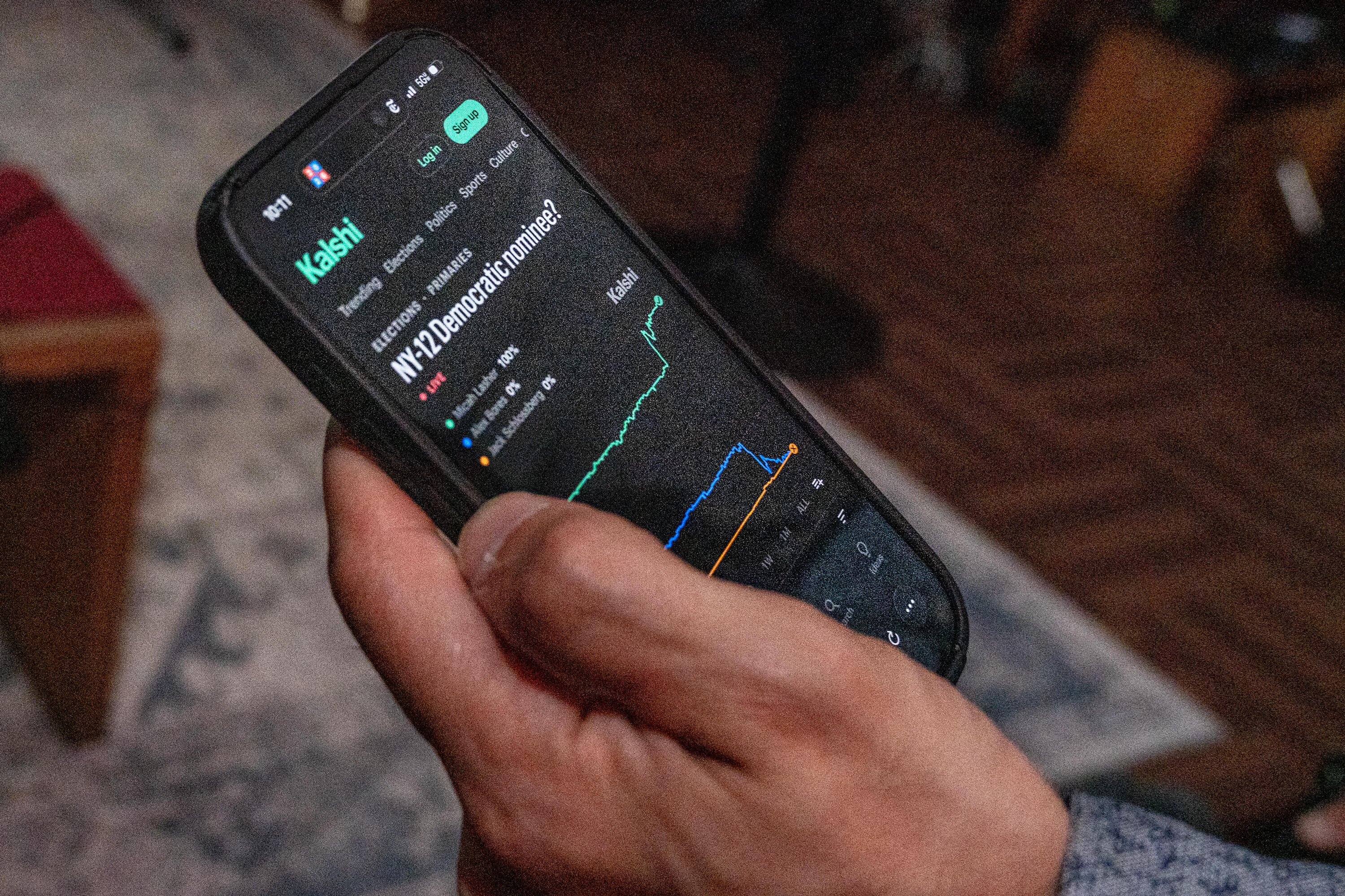
With markets on everything from individual candidates to ballot measures, traders on the prediction market Kalshi exchanged more than $2.5 billion seeking to turn their election smarts into profit.
That sum was almost double the amount traded in markets on the 2024 general election, the company said. Ultimately, the candidates who Kalshi markets favored won 95% of congressional or gubernatorial midterm races, according to a CBS News analysis of market odds from a week before the election.
Experts say that the election markets get so many races right because of the large volume of people participating, and the availability of high-quality information to base trades on.
"These are the biggest, most liquid prediction election markets we've ever had," said Eric Zitzewitz, an economics professor at Dartmouth College who has studied political prediction markets dating back to 1880.
"It is no surprise that they were quite well calibrated," he wrote to CBS News following the election.
Kalshi users trade on yes-or-no questions about whether an event will occur, and the company makes money on transaction fees for each purchase. For example, if someone bought a "yes" that Abdul El-Sayed would win Michigan's Senate race when that side was trading at 67 cents, they profited 33 cents. Those prices suggested the market believed El-Sayed had a two-thirds chance of winning at that time.
Here's how Kalshi's election markets lined up with the results. Some races were excluded because CBS News had not projected a winner by the time of publication. CBS News has a partnership with Kalshi, which sponsored the use of its prediction market data in CBS News election coverage this year. This analysis was conducted independently of that partnership.
House (414)Senate (33)Governor (34)
The favored candidate won in 95% of House races, 91% of Senate races, and 97% of governor's races.
On average, traders gave the eventual winner a 91% chance of coming out on top. Many of the midterm races weren't competitive, which is why so many of the winners' odds were 90% or higher on Kalshi.
The favored candidate lost in 23 races. In all those races, traders favored Republican candidates, and Democrats won instead. The South Carolina Senate race was one of the biggest upsets, with Kalshi traders giving winner Annie Andrews a 23% chance. Traders priced Gina Hinojosa, who beat incumbent Greg Abbott in the Texas governor race, at a 33% chance.
To test whether Kalshi's market is what researchers call "well-calibrated," we can split races into buckets based on the probability Kalshi traders gave each race and average them. In a calibrated market, candidates with 60% odds should win 60% of the time.
Then we can compare that to the percentage of races where those favorites won.
The favored candidate won in all safe races, though the odds suggested a few would lose. (Odds are capped at 99%.)
Similarly, the candidate priced in the "likely" range won a bit more often than the Kalshi probabilities forecasted.
Previous research on prediction markets shows that they settle for the favored side more often than the prices suggest they would. This is called favorite-longshot bias: Traders believe the underdog has a greater chance than they actually do, pushing down the price of the favorite.
But in midterm races where the favorite was less clear, the higher-priced candidate won less often than anticipated — meaning the markets weren't biased in their favor.
Testing the accuracy of prediction markets like this assumes that each race's outcome is independent, which isn't the case in reality.
"If lots of people turn out [to vote] for the Democrats, then all of the Democrats are more likely to win," said Tom Rietz, a finance professor at the University of Iowa, before the election. Rietz helps run the Iowa Electronic Markets, an academic prediction market that has been around since 1988.
A week before the election, Kalshi markets forecast Democrats would win 56.7% of congressional and gubernatorial races. These candidates ended up winning 60.4% of the time — slightly more than the markets predicted.
"Everyone underestimated Democrats," Kalshi spokesperson Elisabeth Diana told CBS News. "Kalshi underestimated them less than any other professional forecaster model."
But the data suggests otherwise. While Kalshi's accuracy improved as Election Day drew closer, a New York Times analysis found that it lagged behind other forecasting models, including the one from political statistician Nate Silver, for most of the election cycle.
While prediction markets like Kalshi claim to be more accurate than polls, good polling information helps prediction markets become more accurate, because traders rely on polls to make their trades.
"Prediction markets need raw material to work with and polling is the raw material when we're talking about elections," Zitzewitz said.
But "a poll is one piece of information," Rietz said. "The traders in the market have access to the entire world's worth of information."
And users who have good information are incentivized to trade when they see an opportunity where markets might not match reality. The individual purchases they make on a candidate or race can help push the market toward more realistic odds.
"If there's any new information coming and the price is not what it should be, there's some people that race and try to make some money there," said Constantin Burgi, an assistant economics professor at University College Dublin who studies economic forecasts and prediction markets.
That comes at a cost to the average trader. Increasingly, professional traders — including major Wall Street firms — are participating in prediction markets. Previous analyses have found that the majority of those who trade in prediction markets lose money.
"We know that lots of people want to gamble, lots of people will lose money with that and might be addicted to it," Burgi said. "But for us as the outsiders looking at this, this is amazing data."
"That conflict between the people using the data and looking at the data versus people participating in it, I think that will become one of the big questions over the next couple of years," he added.
About the data
For this article, CBS News analyzed Kalshi data for 481 congressional and state governor races for which the news organization had projected a winner by 10 p.m. Eastern Time on Monday. Each race has multiple markets, with a yes/no side for each candidate. CBS News analyzed the data in the market for the candidate with the highest chance of winning, or highest "yes" price, referred to in this article as the traders' favorite. For each candidate, CBS News recorded the last trading price before midnight Eastern on Oct. 28, seven days before Election Day. If there was no trading that day, the most recent trade price before that was used.
To determine market calibration, CBS News adapted Kalshi's odds cutoffs for "safe," "likely," "lean" and "toss-up" races. Because there were so few tossup and leaning races, those two bands were combined for a bigger sample.
Credits
Reporting and analysis by Julia Ingram and Madeleine May. Design and development by Julia Ingram and Grace Manthey. Editing by Grace Manthey, Nicole Chau and Matthew Mosk.