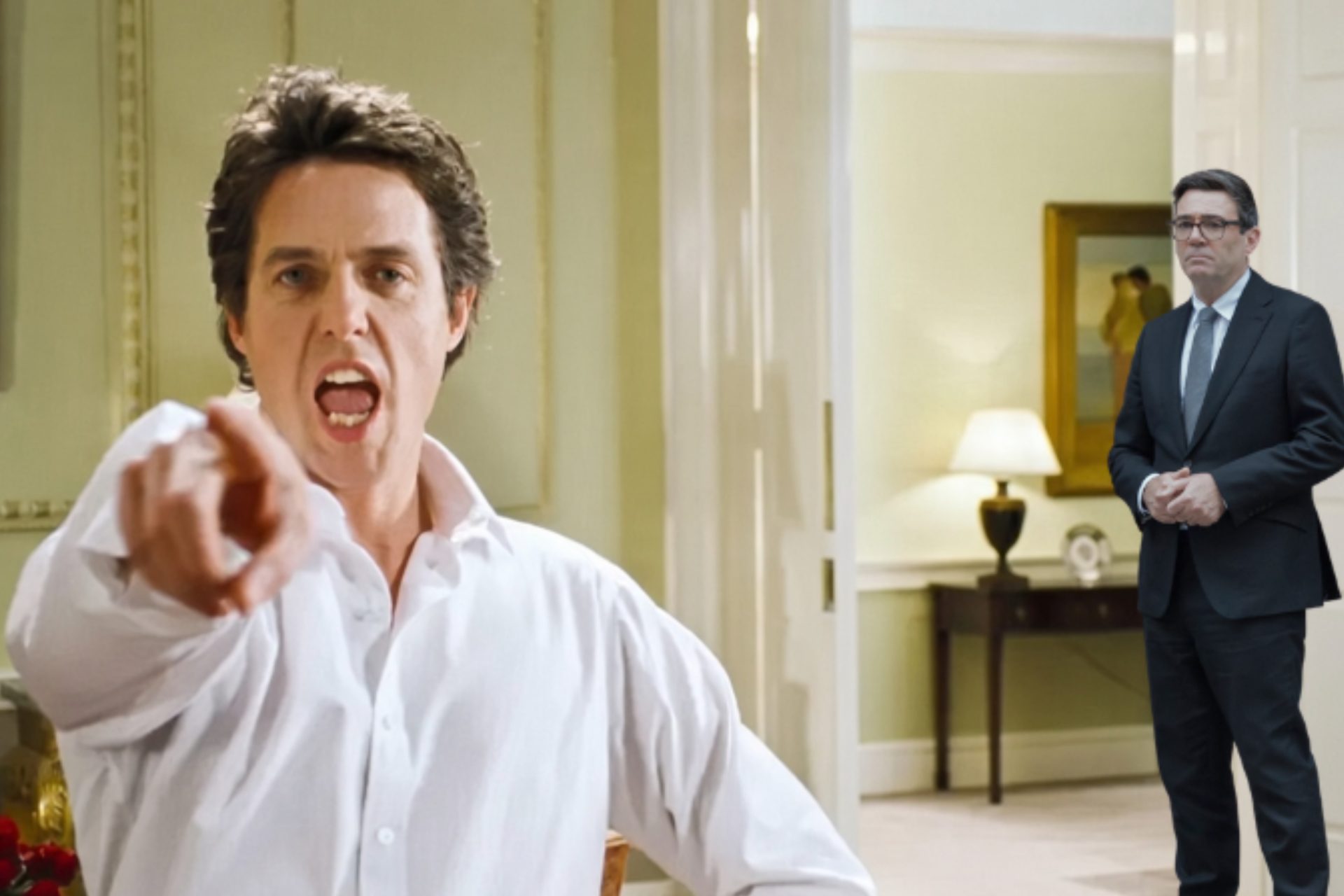
A luxuriantly coiffed, crinkly eyed heartthrob with a penchant for batting his eyelashes at people finds himself unexpectedly in charge of the country. Ill at ease with Establishment stuffiness, he fills No. 10 Downing Street with bohemian friends instead. Hilarious antics ensue: illuminating conversations with chirpy working-class people; ironic dance routines in the corridors of power; irreverent profanity in formal settings. The rest of us hate-watch Love Actually at this time of year but Andy Burnham actually lives it.
And life has mirrored art in more ways than one during the row about influencer access to government that unfolded this week. First, there was the rebooted Hugh Grant staircase dance that caught press attention. Then footage emerged of an influencer bash at No. 10, with Burnham reliving his glory days on the decks — another trope straight from a Richard Curtis film, though more typically played by Bill Nighy. Finally, things turned positively hysterical when the Boomers got wind of influencer Max Balegde miming to a meme outside Britain’s most famous front door. As comedy aficionados know, a classic English farce requires some red-faced old buffer comically misunderstanding the modern age, and there was no shortage of contenders having conniptions.
Journalists and politicians poured over the lyrics in Balegde’s clip (“bomboclat pussy wagon chicken nuggets”) as if they were deciphering Judas Priest records played backwards. Michael Gove opined that this was an allusion to “a feminine hygiene product” in “street argot”, while Kemi Badenoch seemed to think that a mention of chicken nuggets meant “white women as cheap meat” — apparently unaware of Gen Z’s rather more literal love of protein. None of them seemed to know that brainrot memes are a big thing with the youth: one viral moment surreally building on another till you get stupidity overload, with the average slack-jawed scroller clueless or indifferent to where any of the references originally began. With some commentators also accusing the witless Balegde of doing a covert Nazi salute as he carried out his skit, by now Burnham had ceased to be the most obvious object of ridicule.
Daft as this whole episode was, there was a warning in it to the populist Right and those courting it: social media illiteracy and perfectly formed outrage bubbles can make you sound as paranoid and conspiratorial as the maddest section of the hard Left. This isn’t a small point. Progressives love to attribute a moral panic to their opponents, and there is no need to conform to that expectation by permanently channelling the Disgusted of Tunbridge Wells. Sooner or later, onlookers are going to stop being overawed by the shocked and appalled act, and start to laugh instead (indeed, many are already doing that). But another frustration here is that there was something tawdry and demeaning about seeing both Prime Minister and his official residence voluntarily offered as a high-value backdrop for selfie hunters, and it didn’t need overdone charges of Nazism-by-association to make the point.
The existence of state authority heavily depends on the perception of it — and things are obviously not going especially well in this department. Survey after survey suggests a decline in respect for high office, no matter who is at the helm. In a mistrustful time, the familiar trappings of power are a gift to whoever is in charge, vaguely associating incumbents with a time when politicians were more serious and effective people. But that will only work as long as you don’t supplant stirring memories of Gladstone or Churchill with visions of Balegde, sashaying away from the No. 10 fireplace, alongside a caption about “serving” something that rhymes with Jeremy Hunt.
“The existence of state authority heavily depends on the perception of it.”
Defenders of this circus will point to earlier instances of jokey commodification of the Downing Street brand: Tony Blair saying “am I bovvered?” for Comic Relief (that man Curtis again); David Cameron appearing in a One Direction video. I tend to agree; none of this should ever have happened, and the point that it was all for charidee, darling, was barely an excuse. The late Queen shouldn’t have let James Bond into Buckingham Palace either, and I’d definitely take Larry the Cat’s social media passwords away. In the beginning, those responsible for the stunts could tell themselves they were judiciously demystifying imposing institutions, in the service of democracy. In fact, they were giving away aura points for free, as the TikTokers say; and you can’t buy them back once they are gone.
For similar reasons, I have doubts about Burnham’s present media strategy. His schtick seems to be that of a simple Northern lad fetched up in the sinister metropolis, determined to stay true to himself while surrounded by archaic, vaguely unpleasant Southern poshos. Time and again in interviews, he stresses his love of ordinary things, seamlessly blurring safe middle- and working-class enthusiasms: pints and pub banter, football matches, Elbow albums. Here too, as in a Richard Curtis film — in which no traditionally solemn occasion can take place without a high-fiving vicar, or someone saying “wank shit buggeration” — the appeal is supposed to lie in the relatable deflation. Burnham is literally bringing Westminster down to earth, you see.
As Luke Hamnett — a.k.a. staircase dancer — eloquently put it to Andy when he appeared on his podcast this week: “you’re a normal guy… you’re now Prime Minister… that is such a weird shift.” But the other side of this coin is that if the Prime Minister is interchangeable with every other footie-loving, Greggs-pastry scoffing bloke on the Didsbury omnibus, there seems no particular reason to respect him or trust him to run the country. And if he, himself, is signalling disdain for the traditions of the office he holds, you can’t expect passing airhead influencers not to follow suit. In the long run, I suspect that even the TikTok crowd will perceive the diminution of status here. I am told they are fond of a bit of unspoken rizz.
None of this is an argument for not engaging with social media or “meeting people where they are”, as the new Labour mantra goes. It is an argument for being cleverer about it. It is surely possible to protect the glamour of certain official settings and reserve more informal content for other places; to find a consistent media persona for the PM that doesn’t veer wildly between one audience segment and the next, so running the risk of humiliation when some message intended for one group escapes its cage and meets another (a phenomenon technically known as context collapse). A lot of Burnham’s own clips are fine — pithy and personable, with small gimmicks that add some dynamism to his otherwise rather lugubrious presentation. On the other hand, the nascent comedy partnership with the even more stilted John Healey should have been killed at birth. Media managers can talk up the millions of views on their pub snacks video all they like, but the fact remains that people were marvelling at two men being outmogged by a packet of Scampi Fries.
Sticking with presentational matters, there is a more fundamental issue here. Will the British public ever get a leader confident enough to visibly embrace the power and status of the role? Will we ever find a candidate comfortable with handling the inherent grandiosity and drama? This is not a point about private ambition, which is always burning in anyone who gets that far, but rather about how it is carried into public performance. We seem fated to get male leaders who feel they have to put ironic distance between themselves and the ritual solemnity of the office, as soon as they arrive.
We have had Boris Johnson, havering and capering during any serious moment; Sunak, treating a grand state occasion as a secondary priority; and Starmer, obstinately refusing to play the politics game at all. And now we have Burnham with his ostentatious everybloke persona, throwing shade at older, grander ways of doing things wherever he can. In the US, by contrast, a new crop of dynamic, articulate Democrats are emerging as possible future leaders: people such as Jon Ossoff and Abdul El-Sayed, able to hold the gaze of a camera without joking awkwardly or grimacing or looking as if they are being held hostage. We Curtis-ruined Brits can only dream.
Received wisdom has it that politics must be humanised, but mere humans can easily look messy and weak. On the contrary, cultivating a bit of star power and mystique doesn’t automatically turn you into Mussolini. Keeping ceremonial spaces free of cheeky self-promoters with camera phones is, in itself, a way of aura-maxxing and Jeremy-Hunt-serving. And quite frankly, the only time the phrase “pussy wagon” should ever again be heard in Downing Street, is when the vetmobile finally arrives for Larry the Cat.