SummaryCompaniesMore than 130 funds were liquidated in SeptemberFund collapse led to wave of arrests and lawsuitsRegulators had lost expertise and qualified staff, sources sayIPOs have dried up, corporate bond issuance has dippedRestoring confidence in regulators is crucial, sources say
ISTANBUL, Nov 26 (Reuters) - Turkey needs to overhaul its financial regulators after an investment fund scandal that has sent a chill through the country's capital markets, five bankers and a former senior official said.
The crisis centres on groups of funds that poured money into thinly traded stocks, swelling the value of their assets to more than $20 billion and generating extraordinary returns before they became unable to meet withdrawal demands and were liquidated.
The Reuters Iran Briefing newsletter keeps you informed with the latest developments and analysis of the Iran war. Sign up here.
Since September, regulatory officials and other prominent financial figures have been caught up in resignations, dismissals and arrests amid allegations of market manipulation, fraud and bribery that have shaken faith in Turkish capital markets.
Turkey's Capital Markets Board (SPK) approved 33 initial public offerings in the first nine months of 2026, almost double the 18 approved in the whole of the previous year.
Since the funds' collapse, as market conditions and confidence deteriorated, none have been approved, despite 119 companies registered as awaiting SPK approval for flotation.
Restoring trust needs to start with the right appointments, Ramazan Basak, a former deputy chairman of Turkey's Financial Crimes Investigation Board, told Reuters.
"These institutions should be led by people who know the sector well, have a reputation for integrity and have no political ties," he said in an interview.
Those detained in recent weeks include several senior former officials from the SPK and Turkey's Banking Regulation and Supervision Agency (BDDK).
Prosecutors are also set to investigate Sahap Kavcioglu, a former central bank governor who announced his resignation as head of the BDDK this month and has denied wrongdoing.
One senior banker said the problems stemmed from appointments at bodies including the BDDK and the SPK, although he added that the institutions themselves were sound.
The BDDK declined to comment. The SPK and the Finance Ministry did not respond to requests for comment.
The BDDK had played a major role in putting the banking sector on a sound footing after a 2001 crisis, but had later taken a more passive stance, a second senior banker said.
One problem faced by regulatory authorities over recent years was an exodus of staff to the private sector because of worsening relative pay and conditions, a person in the banking sector said. That led to a shortage of expertise, an executive at a portfolio management company said.
On Thursday, Finance Minister Mehmet Simsek said at a press conference that the SPK's powers to intervene against problematic funds were being strengthened and that Turkey was working to meet MSCI Emerging Markets Index requirements by the end of the year.
RIPPLE EFFECT
Some observers have said the crisis was allowed to brew despite public warnings of market manipulation. But once it broke, swift action by authorities contained any systemic risk, against a backdrop of economic challenges including higher energy prices due to the Iran war, analysts said. Last week, Turkey's foreign reserves dropped to their lowest level since 2024 on a net basis.
"In the past at times of stress in the Turkish economy, Turkish households would start exchanging their savings into hard currency, maybe buy more gold as an insurance," said Magdalena Polan, head of emerging markets macroeconomic research at PGIM.
"Outside of a small wobble in some flows in the FX market from the households, we actually did not see that at all."
While consumer confidence dipped to 84.8 in October from 91.9 in September, it has edged back up to 86.8 this month, data from Turkey's state statistics agency shows.
But the crisis has jolted capital markets. Istanbul's main stock exchange index
(.XU100), opens new tab
has fallen more than 18% since September 16, the day before the SPK ordered the liquidation of 131 funds. That exceeds a 1.5% dip in European stocks
(.STOXX), opens new tab
, and the AI-driven 15% drop in MSCI's global emerging market index
(.MSCIEF), opens new tab
.
A secondary public offering by Turkey's third-largest state-owned lender, Halkbank, and an IPO for state-owned Islamic bank Emlak Katilim Bankasi have been postponed and no public offerings are likely before spring 2027, a fourth person in the banking sector said.
Halkbank did not respond to a request for comment. Emlak Katilim Bankasi declined to comment.
Meanwhile, the number of corporate bonds issued in October dropped to 74, from 102 in September and 119 in August, the Turkish Capital Markets Association said.
The political impact has also been spreading, with those detained or resigning including figures with strong links to Turkey's ruling AK Party (AKP).
The AKP did not respond to a request for comment.
Nearly 130 people had been formally arrested as of last week, said Justice Minister Akin Gurlek, adding that the structure behind the scheme was "not limited to simple stock market manipulation or stock market fraud, but is a comprehensive criminal organization".
President Tayyip Erdogan said last week there would be "not the slightest compromise" on holding those responsible to account and the government had prioritised paying back small investors. Turkish Vice President Cevdet Yilmaz said on Thursday that 199 billion lira ($3.93 billion) had been paid back, and that authorities would take steps to protect investors.
'MADE TO BEG FOR OUR OWN MONEY'
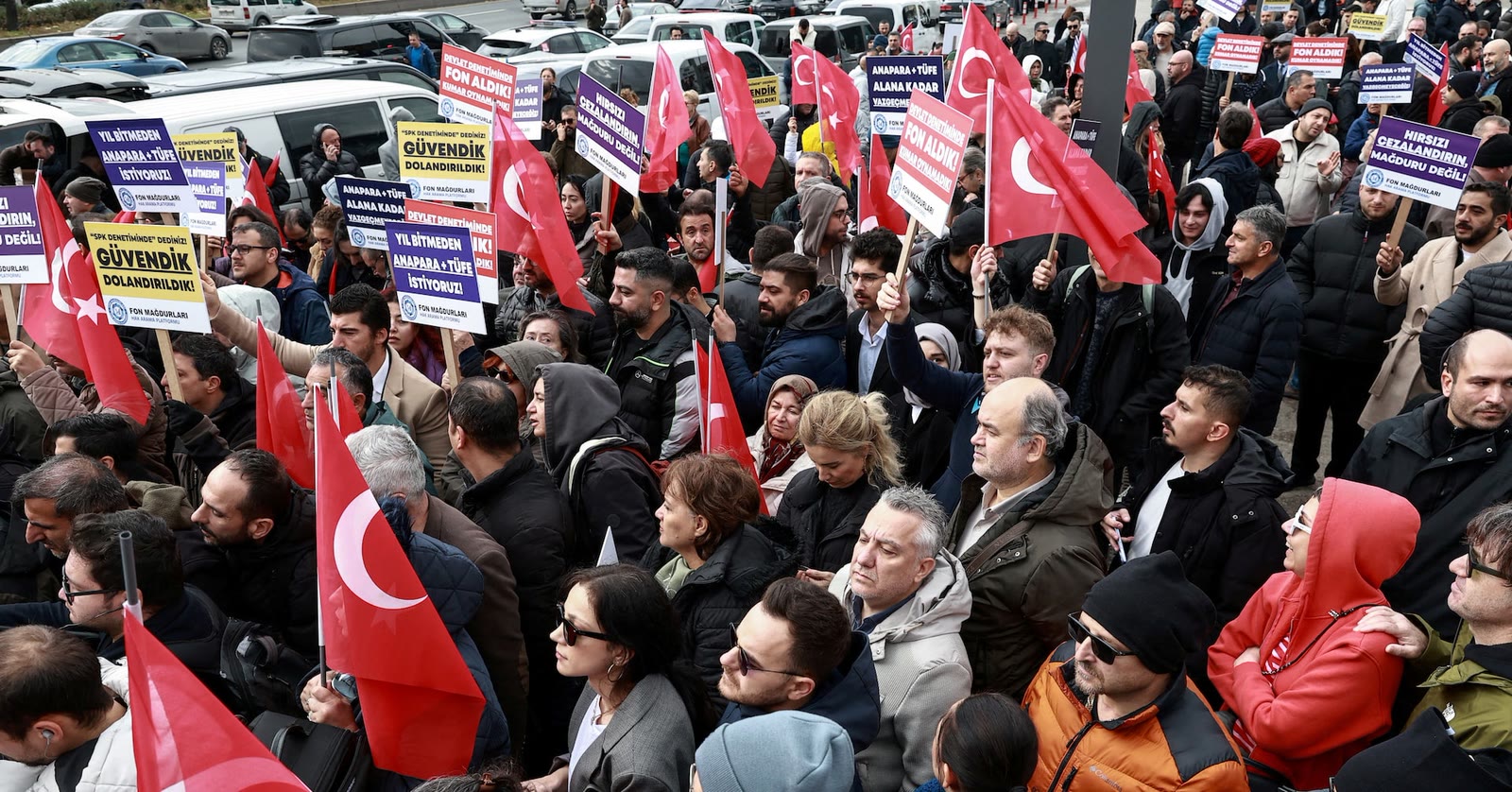
Savers among the nearly half a million who invested in the funds are angry over what they see as corruption.
At a protest outside the SPK headquarters in Ankara last week attended by several hundred people, some savers demanded full repayment, with several describing how they unsuccessfully sought to sell their investments as the funds imploded.
"We have been made to beg for our own money," said Murat Galip Alparslan, a roofer, adding that he had lost 26 years of his own savings as well as money saved by his mother.
"My family's future has been stolen," he said.
It is unclear what the total loss to investors will be, with claims leading to a wave of legal action.
Criminal complaints are being filed over trades in stocks that took place up to two years ago and should have been referred to prosecutors much sooner, said Basak, who expects "hundreds of trades" to come under scrutiny in court.
Additional reporting by Nevzat Devranoglu and Marc Jones; Writing by Aidan Lewis; Editing by Alexander Smith
Our Standards: The Thomson Reuters Trust Principles., opens new tab