Gus Stewart/Getty Images
Progressive rock isn't exactly where we'd normally go for great duets. After all, while most of us could easily come up with the 5 best duets in country rock history, it's more likely we'd jump to citing feats of extraordinary instrumental virtuosity or cerebral concept-album narratives than the soulful exchanges between co-lead musicians. That reputation might be justified, but it misses a wealth of remarkable musical interplay.
Contrary to popular belief, the world of progressive rock is awash in stunning duets, both vocally and instrumentally (though the latter probably comes as no surprise). With that in mind, we wanted to deep dive into some of the instances where prog legends paired up for duets that would make June Carter and Johnny Cash proud. It's a list that runs the gamut from high-concept theatricality of one of prog's most famous edifices to intimate, contemplative dialogues between lost souls. So let's take a look at the musical conversations that remind us prog rockers are people too.
Time Stand Still -- Geddy Lee and Aimee Mann with Rush
The deeply insular trio of Rush had never brought in a guest vocalist prior to "Time Stand Still," off of 1987's "Hold Your Fire." Drawing on themes of time, mortality, and the appreciation of precious moments, the song reflects drummer/lyricist Neil Peart's thoughts on life during the mid-1980's. Deciding the track needed the added touch of another vocalist, they contacted Aimee Mann, then the lead singer of new wave rockers 'Til Tuesday. Mann was initially perplexed that Rush vocalist Geddy Lee, whose power falsetto immediately impressed her, would need an additional singer, but the result was a well-received later-period track on an album that reached a solid No. 13 on the Billboard 200.
The reflective nature of the song is readily apparent in the endless reverberating guitars and drums, which seem to soar off to the distant horizon with each beat on a breezy undercurrent of atmospheric synthesizers. Into that dreamy (but no less rocking) world steps first Lee with the song's plaintive yearning for permanence in the face of the march of time, only to be joined by Mann for a bittersweet refrain. When the pair goes on to harmonize the words "Experience slips away," it turns the wistful lament into a visceral — though somehow reassuring — gut punch.
The track became another milestone in the already highly accomplished Rush catalog, providing the title of their 2016 career retrospective documentary "Rush: Time Stand Still." On June 7, 2026, the band finally performed the track live with Mann for the first time during their post-Neil Peart legacy tour.
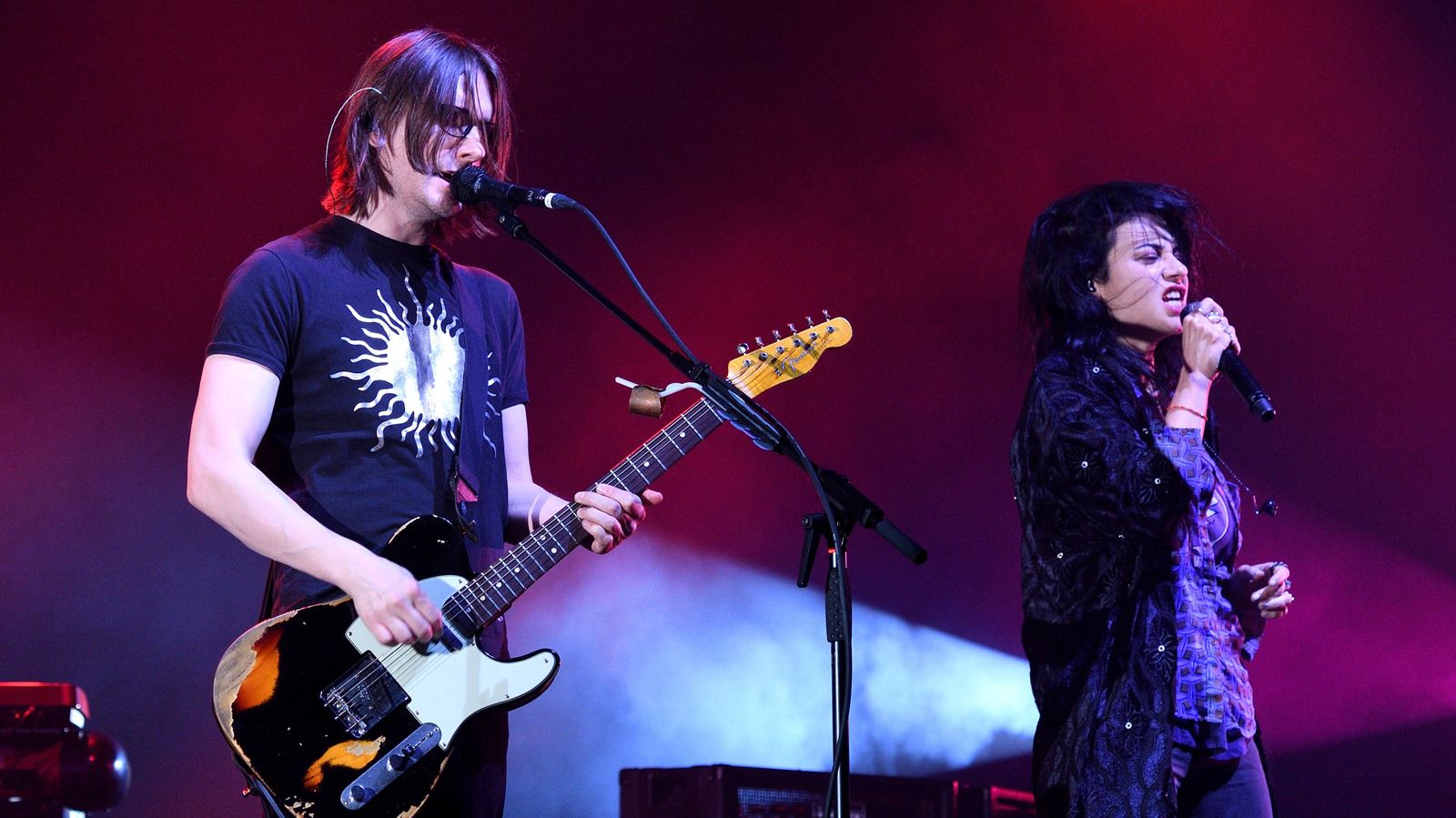
Pariah -- Steven Wilson and Ninet Tayeb
Though his name casts far and wide across the progressive rock ecosystem, Porcupine Tree frontman Steven Wilson has always had a contentious relationship with the term. As such, his work as a solo artist has varied wildly, incorporating elements of art rock and synth pop while managing to strike a balance between the experimental and the memorable. "Pariah," off of 2017's "To the Bone," echoes earlier art-rock duets, namely "Don't Give Up" by Peter Gabriel and Kate Bush. Here, it's Israeli singer/actress Ninet Tayeb playing the reassuring muse to Wilson's world-weary resignation.
"I'm tired of weakness, tired of my feet of clay / I'm tired of days to come, I'm tired of yesterday," laments Wilson with morbid exhaustion. In one verse after another, he appears to be drifting through the listless apathy of a detached and numbed life. "So the day will begin again," responds Tayeb with a tone that is somehow comforting in its withered dryness. "Take comfort from me," she continues, "it's up to you now." It's a fleeting moment of warmth in the painfully cold world Wilson paints throughout the track, yet one that seems to haunt as much as it reassures.
The duet calls to mind Lee Hazlewood and Nancy Sinatra on "Some Velvet Morning" with its defeated male protagonist and the ethereal, mythical divine being, who reaches across dimensions to give him a distant shard of hope. Ever the studio wiz, Wilson's mixing becomes as much an active participant in the proceedings as the arrangement itself. As Tayeb's vocal continues its aching ascent into the bridge, the surrounding instrumentation appears to bend and expand to accommodate a new influx of sound flooding in. The goddess feels our pain, even as she's being pulled back into the digital heavens.
Reaching For the Rail -- Sinéad O'Connor and Richard Wright
1996's "Broken China" LP from Pink Floyd keyboardist Richard Wright is a hidden gem. The ambient keyboard washes and trailing, thoughtful guitar leads capture the wistfully nightmarish Pink Floyd sound, though nothing compares to Sinéad O'Connor's somberly haunting guest vocals in the track "Reaching for the Rail."
In the deeply personal concept album, Wright presents an unrelenting foray into the interior world of mental health issues and their effect on loved ones and caregivers. Wright's vocals narrate the story from the vantage of a bewildered onlooker grappling with his own inability to help until O'Connor presents in "Reaching for the Rail" to embody the long-affected spouse. This person, who has only existed as a spectral presence in the lyrics of other tracks, now takes center stage, and O'Connor's voice carries all the withered fatigue we would expect from such a person; her voice is by turns brittle, detached, and vaguely yearning.
Wright enters midway through the track, the husband finally able to reach through the fog that has enveloped his wife. It's the voice of a person trying to be comforting while probing for their own reassurances all the while. The third verse rolls around, and they're singing in unison, finally reaching for the titular rail (strongly implied to be medication), and the album's story begins to take a turn for the better. O'Connor returns on the album's final cut, "Breakthrough," for a cautiously optimistic ending.
The Chase -- Geoff Tate and Ronnie James Dio with Queensryche
Queensrÿche vocalist Geoff Tate teaming up with Ronnie James Dio is the stuff of progressive metal legend. Public interest in Queensrÿche may have dwindled after the middling reception of 1997's "Hear in the Now Frontier" and the departure of longtime guitarist Chris DeGarmo, but 2006's "Operation: Mindcrime II" saw a brief return to form. Continuing the story of Nikki, a brainwashed political agent, the album finds the wayward protagonist in hot pursuit of Dr. X, the mysterious leader of a political cult at the heart of the first installment. A sinister and calculating monster, X comes to menacing life with a scorching performance from Dio in the track "The Chase."
The pair occupy a similar vocal range: operatic, soaring baritones with piercing high-end falsetto. It makes for a tense game of cat-and-mouse as the two warring factions finally converge in "The Chase." "Always been so easy you're like a puppet on my string / Throwing down hollow threats, unsure of what to think," sings Dio as Dr. X, taunting Tate's Nikki with psychopathic glee. The vicious but theatrical exchange has all the sinister gravitas of Javert confronting Jean Valjean in "Les Misérables," and serves as a captivating climax to one of progressive rock's most enduring storylines.
"Operation: Mindcrime II" was also a return to chart success with a solid No. 14 on the Billboard 200, but it wasn't to last. As longtime fans are already aware, the real reason the classic Queensrÿche lineup broke up is rooted in the band's deep-seated animosity towards Tate. As such, "Operation: Mindcrime II" is largely the work of session musicians, not the actual band. Nevertheless, the meeting of two of rock's most commanding vocalists in "The Chase" is unforgettable.
Comfortably Numb -- David Gilmore and Roger Waters with Pink Floyd
By now the real story behind Pink Floyd's "Comfortably Numb" — and indeed "The Wall" in general — is deeply enshrined in the minds of prog fans. The members of Pink Floyd, beleaguered by endless stadium shows, felt that a metaphorical wall had been erected between themselves, which gave bassist Roger Waters an idea brilliant in its simplicity: Take the wall from symbol to literal on-stage edifice. To that end, "Comfortably Numb" finds bassist Roger Waters and guitarist David Gilmour dramatizing an exchange between a mentally checked-out rockstar and one of his handlers goading him towards an ill-advised public appearance.
The song's impact is borne out of the manner in which both voices feel soft, languid and utterly detached in the face of the rapidly deteriorating situation they're both working to ignore. One wants to drift away into the gentle emptiness of life as a wholly withdrawn vegetable; the other wants to brush the hopelessness under the rug and prop up the rockstar for one more show. Both confront the situation with their own forms of dehumanization and neglect: one retreating into his own mind to avoid facing the outside world, the other willing to shove a checked-out zombie onstage irrespective of the lost soul inside.
In the end, that's what makes the performance so effective: it feels almost like an anti-duet. When we listen to duets, we expect to hear two voices converging on mutually enthralling subject matter. Waters and Gilmour, on the other hand, paint a haunting picture of two disconnected souls swirling around one another in the machine of music business bureaucracy.