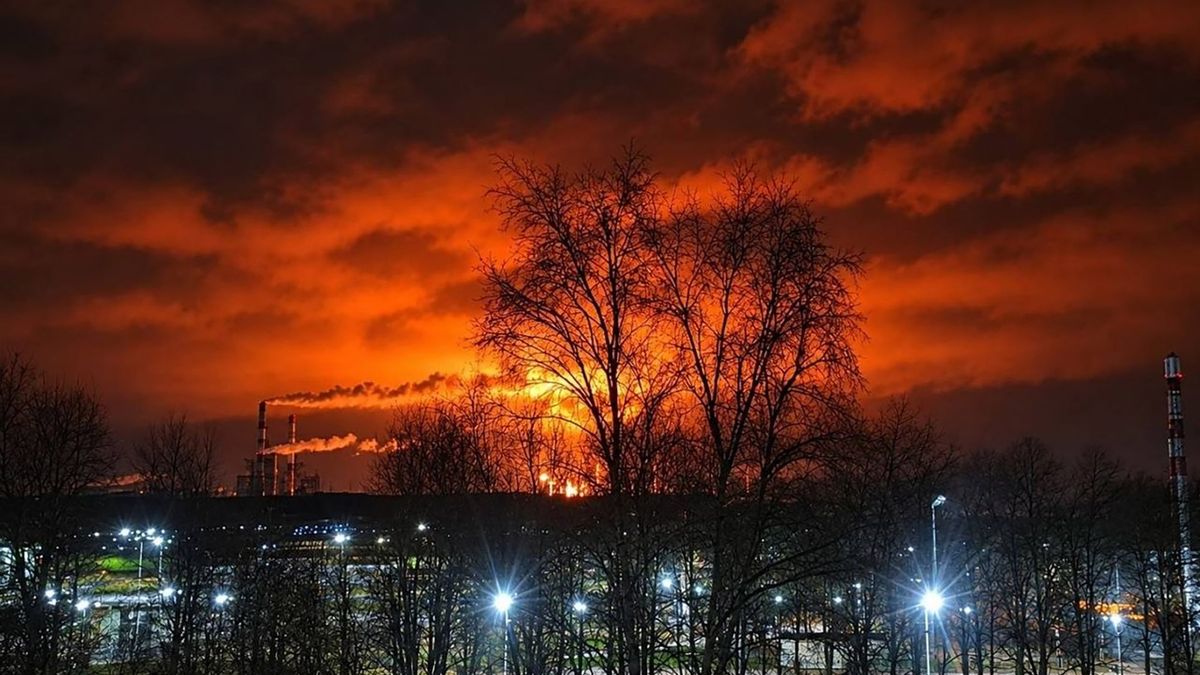
Ukraine has launched one of its most devastating drone attacks on Russia with the Samara station, seen as the operational heart of Russia's oil export network, hit, says military chiefs in Kyiv
A major Russian oil hub has been hit along with a military base as Ukraine fired nearly 1,200 drones in one of its biggest aerial attacks since the war began.
Article continues below
UK weather map forecasts wintry conditions as snow expected
The military said that it had hit the Samara linear production and dispatch station near the village of Prosvet with a massive fire breaking out in several oil storage reservoirs.
Article continues below
Ukrainian say it is a strike at the "operational heart of Russia's oil export network" as the station receives the fuel through pipelines from Tatarstan, Western Siberia and other regions across the country before being blended there to produce Urals oil, which accounts for up to half of Russia's oil exports.
Article continues below
Ukraine's General Staff issued a statement today confirming the attack on Friday along with a strike on the Lipetsk-2 military airbase which hit buildings and ignited oil storage tanks.
“Urals accounts for up to half of all Russian oil exports. Therefore, every damaged tank in Samara strikes directly at the main source of money from which the aggressor pays for missiles, drones, and the war against Ukraine,” the General Staff stated.
Article continues below
These are the latest attacks on military and fuel infrastructure where Ukraine has capitalised on its drone technology to strike within Russia.
Massive fires were reported at Kirishi Oil Refinery in Leningrad region, near St Petersburg, after a strike by Ukraine, this week.
Article continues below
Earlier this month, Ukrainian President Volodymyr Zelensky said Vladimir Putin was 'losing the war' as a huge oil refinery burned after a "massive" drone strike on key infrastructure inside Russia.
The Kamensky missile manufacturing plant in the Rostov region was hit overnight into November 1.
Article continues below
Dramatic pictures appeared to show multiple fires at the huge Kstovo facility in the Nizhny Novgorod region. Gleb Nikitin, governor of Nizhny Novgorod, confirmed a "massive drone attack" involving more than 100 unmanned aerial vehicles (UAVs).
Article continues below
"The intensity of the strikes is very high, and the Russians are seeking to maximally exploit the deficit of ballistic missile interceptors," he said in a message shared on Telegram. Russian officials said it had shot down 235 drones launched from Ukraine.
Zelensky said: "Russia is losing. We are holding our positions, liberating territory, and ensuring that every day of the war costs the aggressor as much as possible."
Article continues below
The latest attacks come after US and Russian negotiators held talks aimed at ending the war. The Kremlin has put back on the table its controversial proposal from December 2021 – the "draft treaties" with the US and Nato which would not only have put the brakes on the alliance's eastward enlargement by giving Moscow cast-iron guarantees that, for instance, Ukraine and Georgia would never be allowed to join, but also rolled back NATO military infrastructure from countries of central and eastern Europe which became NATO members following the dissolution of the Soviet Union.
This has alarmed European leaders and placed a question mark on NATO’s future role. “Russia wants to talk about questions of European security architecture. We don’t need to talk about that. There is one,” German Chancellor Friedrich Merz said, referring to NATO.
Article continues below
After two days of talks with Russian and Ukrainian delegations in Abu Dhabi this week, US envoys briefed Putin in the Kremlin and Zelensky, who was in Dublin, Ireland, to meet European leaders.
More talks are planned as negotiators seek a breakthrough in peace efforts, according to US envoys Steve Witkoff and Jared Kushner.
Article continues below
A team of diplomats from the UK, France, Germany, Italy, Poland and the European Union will be sent to the talks, said European Council President Antonio Costa after a meeting in Dublin. The session was dominated by European efforts to avoid being sidelined in the US-led negotiations.
Kushner, who is also Donald Trump’s son-in-law, said Russia had agreed to include Europe in upcoming talks, after Moscow’s long insistence that the continent’s governments should be excluded because they supported Ukraine.
Article continues below
Europe’s presence at the table will allow negotiators “to address the broader postwar European security arrangements alongside the territorial issues between Ukraine and Russia,” Kushner said on X.