Their numbers collapsed for reasons beyond hunting, and one of them is still cutting the species down today.Even at their lowest, these birds were working against a built-in biological handicap.You can watch them in the wild, but the best views come from a surprising vantage point.
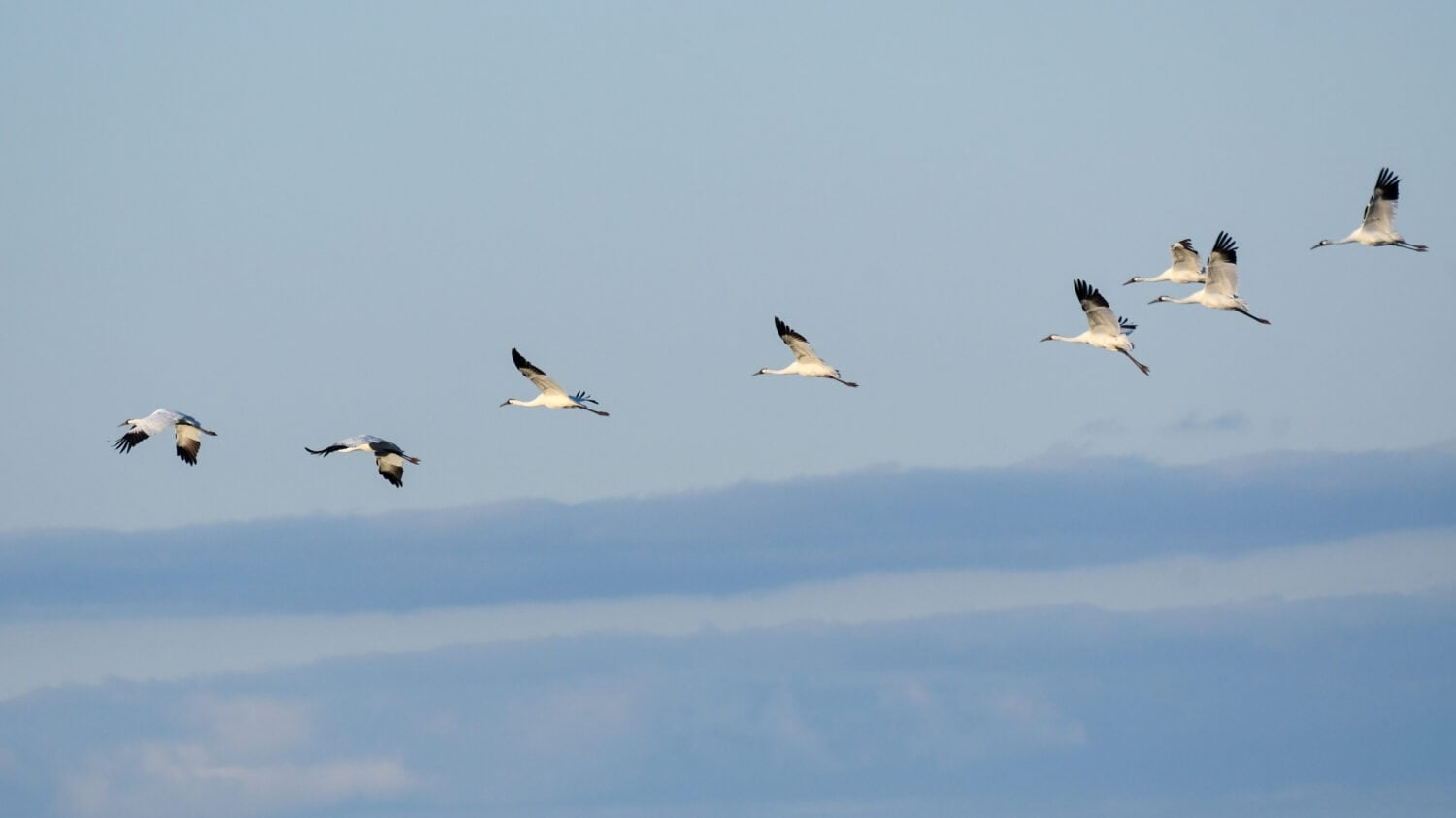
Standing nearly five feet tall, with brilliant white feathers, black wingtips, and a distinctive red crown, the whooping crane is an incredible bird that travels thousands of miles from its summer breeding grounds in Canada to the marshes of the Texas Gulf Coast. It’s a remarkable migration, but the fact that these birds are still making the journey at all is an even greater achievement.
In the early 1940s, the migratory population of whooping cranes had dwindled to about 15 birds, and extinction seemed almost inevitable. In 2026, thanks to decades of conservation work, that same flock has grown to more than 500 birds. Their recovery is one of North America’s most encouraging wildlife conservation stories, although these magnificent birds still face serious threats. Let’s learn more about this resilient creature and where its population sits today.
The Whooping Crane Population Almost Disappeared
At one point, whooping cranes (Grus americana) occupied a much larger portion of North America, inhabiting and nesting across extensive wetlands and grasslands. At that point, scientists believe that thousands of these birds were alive and well.
Unfortunately, widespread agricultural development and settlement dramatically altered their habitat. Wetlands were drained, native grasslands were converted into farmland, and the cranes lost many of the places they depended on for nesting, feeding, and resting during migration. Hunting whooping cranes also became more common as a way to obtain and sell their feathers and meat.
In 1941, approximately 15 or 16 whooping cranes remained along the Texas coast. A handful of additional birds survived in Louisiana, but that population eventually disappeared. What made this dwindling population even more alarming is that whooping cranes reproduce slowly even in the best of times. They generally do not begin breeding until they are several years old, and although a pair commonly lays two eggs, often only one chick survives to migrate south.
Conservationists Save the Day
Whooping cranes almost went extinct until conservationists stepped in.
©Danita Delimont/Shutterstock.com
Luckily, conservationists recognized the threat before the whooping crane population could become extinct. Though progress was slow, they took action. In June 2026, the U.S. Fish and Wildlife Service announced that an estimated 540 whooping cranes had wintered within the primary survey area around Aransas National Wildlife Refuge during the 2025–2026 season. According to federal wildlife officials, the population’s long-term average annual growth rate has been approximately 4.24% since 1938.
One of the earliest milestones in their recovery was the establishment of Aransas National Wildlife Refuge in 1937, which helped protect essential winter habitats. Federal endangered species protections, hunting restrictions, wetland conservation, and ongoing population monitoring have also contributed to the cranes’ survival.
540
whooping cranes wintered within the primary survey area around Aransas National Wildlife Refuge in 2025–2026
Source:
U.S. Fish and Wildlife Service.
Researchers now conduct aerial surveys to estimate population numbers, identify juvenile birds, and monitor changes in winter habitat use. Modern GPS tracking technology also allows scientists to study migration routes and identify areas where additional protection may be needed.
Despite these accomplishments, the whooping crane remains federally endangered. A population of several hundred birds is a tremendous improvement over 15, but it is still small enough to be vulnerable to major environmental changes. Still, the incredible efforts are bearing fruit.
LC Least Concern
NT Near Threatened
VU Vulnerable
Endangered
EN
CR Critically Endangered
EW Extinct in the Wild
EX Extinct
Population trend: Increasing
IUCN Red List status for Whooping Crane
Source:
IUCN Red List via A-Z Animals profile.
The Threat of Power Lines and Habitat Loss
Despite their progress, whooping cranes are not yet out of the danger zone. While hunting is no longer the widespread threat it once was, modern development presents new challenges.
One particularly dangerous obstacle is power lines. Large birds such as whooping cranes can have difficulty detecting thin wires while flying, especially in poor visibility or unfavorable weather. Collisions can cause serious injuries or death. Conservation organizations have worked to identify dangerous stretches of power line and encourage the installation of bird flight diverters, which are devices that make wires more visible.
Habitat loss is another ongoing concern. Wetlands throughout the Great Plains continue to face pressure from agricultural development, drainage, and construction. Conservationists are looking for solutions. Then, there is the continuing threat of climate change. Droughts can reduce wetland availability, while severe storms and changing coastal conditions can affect winter habitat. Rising sea levels may also alter the delicate balance of saltwater and freshwater marshes.
The solution to these issues will likely require creating a network of habitats where the whooping cranes can live and reproduce in peace, but a final answer remains to be seen.
An Incredible 2,500-Mile Migration
Whopping cranes migrate long distances, often with their offspring in tow.
©FSTOPdotCOM/Shutterstock.com
Part of the wonder of the whooping crane population is their roughly 2,500-mile journey between northern Canada and coastal Texas every spring and fall. Their migration takes them through the Canadian Prairies and the central United States, including portions of the Great Plains. Along the way, they depend on wetlands, shallow lakes, agricultural fields, and other open landscapes where they can rest and feed.
Unlike many smaller migratory birds, whooping cranes do not complete their journey in one continuous flight. They travel in stages, often using rising columns of warm air called thermals to gain altitude and glide while conserving energy. Another interesting fact is that their migration is a family activity. Adult cranes often travel with their young, allowing juveniles to follow experienced birds along the route. The journey can take several weeks, depending on weather conditions and the availability of suitable resting areas.
Unfortunately, traveling such a long distance exposes the birds to numerous dangers, including storms, collisions with power lines, and human disturbances, so they must tread carefully.
See the Whooping Cranes in Rockport, Texas
The best part about the whooping crane’s revival is that you can see the birds in their full glory by taking a short trip. The Rockport-Fulton area along the Texas Gulf Coast is among the country’s best destinations for observing wild whooping cranes. The birds typically arrive in late October or November and remain until March or early April. December through February is generally an excellent time to visit because many cranes have settled into their winter territories.
Boat tours are particularly popular because much of the cranes’ preferred feeding habitat is difficult to reach from land. Research guided trips through Aransas Bay and nearby coastal waterways. That’s where you’ll get opportunities to observe cranes feeding, walking through shallow marshes, and interacting with their families.
Visitors who prefer to remain on land can explore Aransas National Wildlife Refuge near Austwell. The refuge offers a scenic driving route, walking trails, and observation areas. Wherever you go, binoculars or a camera with a zoom lens are strongly recommended. Like with most animal viewing, remember to keep a respectful distance from the cranes and avoid disturbing birds that are feeding or resting.
Map showing Aransas National Wildlife RefugeAransas National…
Aransas National Wildlife Refuge.
Source:
Wikipedia: Aransas National Wildlife Refuge (en.wikipedia.org).
A Continuing Conservation Story in the Making
Though there have been incredible successes, the whooping crane’s conservation story is still being written. A bird that once appeared destined for extinction now returns to the Texas coast in numbers that would have seemed almost unimaginable eight decades ago. The whooping crane’s comeback is not simply a story about how hundreds of birds survived. It is a story about how conservation can give an endangered species another chance.
Thank you for reading! Have some feedback for us?
Thank you for your feedback!
We appreciate your help in improving our content.
Our editorial team will review your suggestions and make any necessary updates.
There was an error submitting your feedback. Please try again.