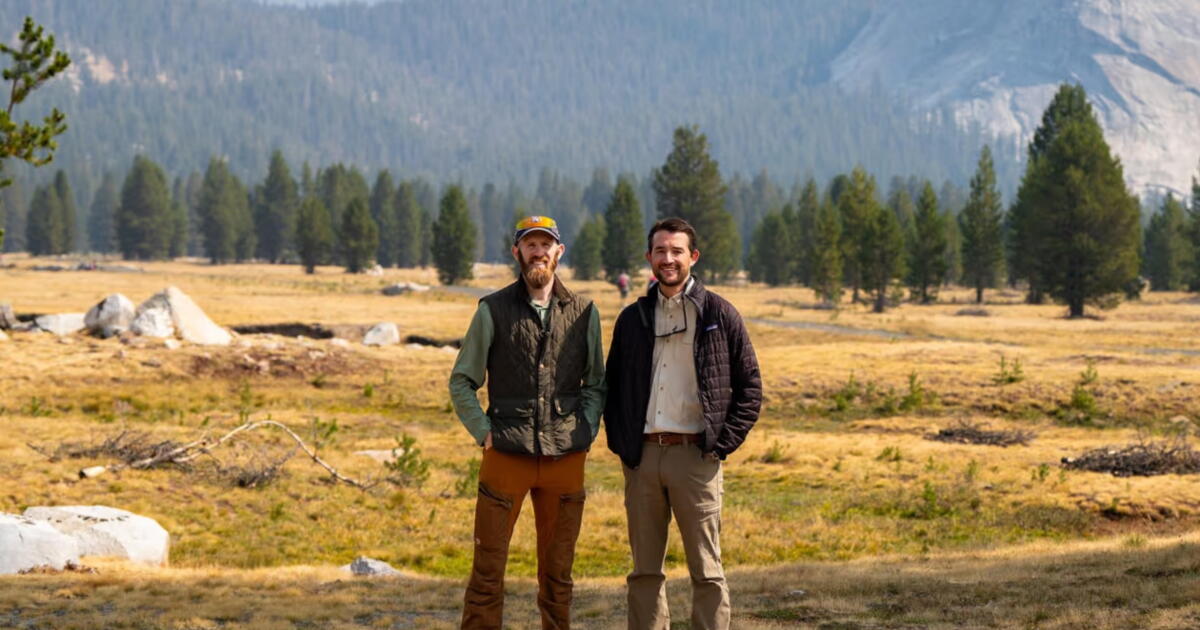
For years, Will Pattiz has trekked into the mountain snow in one of the country’s national forests, permit in hand, and found the perfect family Christmas tree.
But the federal government has never made it easy to know exactly where to go. So Will and his brother Jim decided to do something about it.
Over the last six months, they spent “an obscene amount of time” collecting maps from government websites, calling ranger districts and field offices across the country, and finally building a website. The “Christmas Tree Finder” they created, complete with digital snow and holiday lights, is perhaps the most comprehensive guide yet for people hoping to add a little adventure to their holiday season and get a killer deal on a tree.
“I hope, for some people, it’s the start of a new tradition,” Jim Pattiz said. “Get those sappy fingers and get out there.”
Every year, Americans cut down hundreds of thousands of Christmas trees on the country’s public lands. Unlike the parking-lot Christmas trees that go for $75, a permit to cut an evergreen out in the woods typically costs just $5 to $20 per tree. If there happens to be a fourth-grader in the household, you may be able to get one for free.
The finder shows where Christmas tree permits are on sale, where they’ll soon open up and where they’re already sold out on a giant map of the country’s forests — those managed by the U.S. Forest Service and the Bureau of Land Management. Together these two agencies — one a part of the Department of Agriculture and the other the Department of Interior — have nearly 20% of the country’s land under their jurisdiction.
Click on an area, and it tells you how to get a permit, where tree cutting is allowed and other restrictions, like the maximum height tree you can take, and the tallest stump you can leave.
The closest option for Angelenos is a bit of a trek, Inyo National Forest near Mammoth Lakes.
The government has its own dashboard for tree permits, but it’s focused only on the national forests and some details are tucked away in separate PDF maps. It doesn’t have a little animated bird flying around the screen, either.
The Pattiz brothers already had founded a public lands advocacy organization, More Than Just Parks, that aims to protect public lands and broaden people’s experience of them, beyond the ones that may be best known.
“The really cool thing about national forests, as well as BLM land, is these are places you can very much interact with,” said Jim Pattiz. In some areas, you can hunt for gems and take them home. Unlike the designated campgrounds in national parks, which can be difficult to reserve, in national forests you are freer to set up camp where you like.
Cutting a Christmas tree, they argue, can help build a sense of responsibility and care for public lands.
“You just kind of get in tune with it,” Will Pattiz said. “You say, ‘OK, I went to the ... national forest to get my tree this year.’ And then you see, that summer there’s a big wildfire there — or next spring there’s a big timber cut proposed in an area that maybe you’ve fallen in love with — and you can add your voice to these important discussions.”
Before you commit to a long-term relationship with your national forest, a few tips for your first date tree hunting:
Check the restrictions on which trees you can take and where. Monitor the weather, pack extra layers and bring snow chains if needed. If you plan to use a chainsaw, pack a handsaw as backup — and don’t forget rope to tie the tree down.
“Plan to be out longer than you anticipate,” Jim Pattiz said. “Because it’s an adventure, right? There are no GPS coordinates to the exact perfect tree.”
One year, Will Pattiz and his family found themselves stuck in the snow in Oregon’s Mt. Hood National Forest with a handful of other cars — perhaps the price paid for boldly taking a Toyota Prius “all sorts of places that Priuses aren’t supposed to be.”
After several attempts by the group to free the vehicles, a heroic Jeep arrived and pulled them out. The bunch of strangers, who likely otherwise would never have met, pulled up at a local diner— conifers strapped to their cars — for a celebratory feast as the day waned.
“It was just a magical experience,” Will Pattiz said.
More to Read