Order Josh Hammer’s new book, Israel and Civilization: The Fate of the Jewish Nation and the Destiny of the West: HERE.
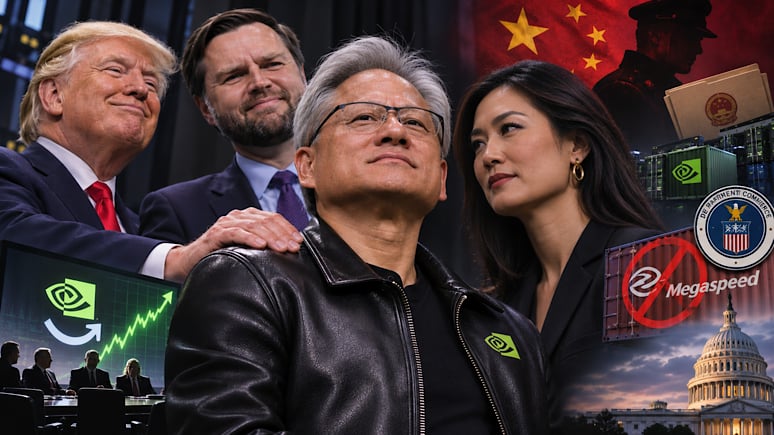
Markets have cheered the rapid and dramatic return of Jensen Huang, the highly visible, extravagantly wealthy, and recently ousted cofounder of American semiconductor and AI powerhouse Nvidia, to the CEO position he had held for decades. Earlier this month, Huang, a close ally of President Donald Trump’s, resigned as the CEO and president of the world’s second-largest company by market capitalization after it was revealed he had engaged in numerous extramarital affairs.
Now Playing
Up NextChina: Jensen Huang Impersonators.
0:42Now Playing
Up NextChina: Jensen Huang AI.
0:50Now Playing
Up NextSouth Korea: Nvidia CEO Jensen Huang addresses press upon arrival in South Korea.
5:45Now Playing
Up NextNvidia CEO Jensen Huang feels AI industry shouldn't tolerate cybersecurity incidents.
1:49Now Playing
Up NextSydney Sweeney’s Hollywood Fallout and Bollywood Comeback
2:25Now Playing
Up NextColleen Ballinger Tries a Comeback After Grooming Allegations... But It’s Not Going Well
4:08Now Playing
Up NextIs It Too Late For PopularMMOs To Make A Comeback?
3:52Now Playing
Up NextChina is running out of women and men are getting desperate
4:06Now Playing
Up NextChina: Mudslide Hits Gyirong Border Port in Xizang.
3:04Now Playing
Up NextEl MC-21 debe competir con Boeing, al menos en el mercado ruso
7:55
Among Huang’s trysts, most damningly, was a woman named Alice Huang (no relation), CEO of a Singapore-based tech company called Megaspeed. The U.S. government first investigated Megaspeed in 2024 for suspicions it was smuggling Nvidia chips to China without permission, and on Monday, November 23, Trump’s Department of Commerce formally added Megaspeed to the Bureau of Industry and Security’s infamous Entity List for discrete trade restrictions required by American national security.
Amazingly, something else even more notable happened on that very same day of November 23: Nvidia’s board of directors reinstated Huang as the computing conglomerate’s CEO and president. Huang’s phoenix-like resurrection would not have been possible were it not for the aggressive support, as well as the hands-on lobbying, of no less powerful a duo than the president and vice president of the United States themselves. President Trump and Vice President Vance, who was a creature of Silicon Valley before launching his political career, went out of their way to urge Nvidia to reinstate the disgraced CEO.
The intellectual tension, to say nothing of the national security tension, is staggering.
It has now come to light that around the same time Nvidia’s Huang was shacking up with Megaspeed’s Huang, the more prominent Huang was (successfully) lobbying President Trump to loosen previously existing export restrictions on certain types of AI chip sales to China. What’s more, we also now know that the less prominent Huang was in regular contact with Communist China’s Ministry of State Security—that’s a spy agency—from the spring of 2025 through this fall. That’s roughly the same period in which the Huangs were occasionallygetting their freak on.
Yet somehow, many who style themselves supporters of the administration cheered both embattled Commerce Secretary Howard Lutnick’s blacklisting of Megaspeed and Huang’s grand return to Nvidia. How one can square that particular circle isn’t quite clear. Regardless, the markets are cheering, and the most boisterous of MAGA enthusiasts are cheering too.
But I am not. Not to put too fine a point on it, but as I put it on X, “I prefer major American tech CEOs who don’t bang Chinese Communist Party spies while simultaneously lobbying POTUS to loosen export restrictions on advanced computer chips to China.”
Maybe I’m old-school, but that sentiment strikes me as something that should be uncontroversial. Is there really such thing as an “America First” case for simping for Chinese spy-shagging multinational tech CEOs?
And yet for voicing that opinion, and thereby offending both some of the administration’s most unflinching defenders and the many investors (including, it should be noted, me) who benefited from the post-Huang return market rally, I was inundated by the largest online swarm of “groypers” and Jew-haters since Candace Owens ludicrously accused me of complicity in the horrific murder of my own friend Charlie Kirk. It seems like the “tech bro”-antisemite alliance is all too real.
But vile online trolls aside, the Huang saga is seriously concerning. Actually, it is appalling.
Nvidia’s board of directors forced out Jensen Huang after robust internal discussions and debates. Tossing out a cofounder and iconic CEO is not a decision that any board of directors takes lightly, let alone a board for a company as prominent as Nvidia. And as recently as last week, the board was adamant in ruling out the possibility of Huang’s return. The only thing that changed was that the president of the United States, who is at times known for obsessing over the performance of the equity markets, decided to get personally involved in an attempt to rescue his fallen friend.
The bully pulpit and personal lobbying power of the president and vice president of the United States is something to behold.The final straw was when top administration brass told the Nvidia board that, to the best of the administration’s knowledge, nothing that Huang did in any way compromised or undermined the structural integrity or national security of the nation.
Hold aside for a moment that this belies common sense. Of course Jensen Huang compromised national security by being a close crony of the president’s while pushing for laxer export restrictions to China on the very computer chips his illicit mistress was helping to smuggle from his own company to China. The message this sends to ambitious would-be corporate CEOs—to say nothing of less ambitious, run-of-the-mill would-be husbands and fathers—is nothing less than catastrophic.
Will Jensen Huang teach next year’s Harvard Business School seminar on how to have an affair with a likely Chinese spy and be better off for it?
But the even thornier, and more troubling, questions surround the topics of corporate governance and the very nature of public-private relations in a purported free enterprise system. The Nvidia board of directors initially acted as it did because it has a fiduciary duty to the company’s shareholders to act in the best interest of the corporation. That is how corporate governance is supposed to work under American law. Given the rapid nature of the board’s about-face and the tremendous efforts exerted by Trump and Vance to bring Huang back to Nvidia’s C-suite, it is clear that it was not that same fiduciary duty that led to Monday’s fateful decision to rehire the magnate out of his all-too-brief retirement.
That raises a simple, and somewhat discomfiting, question: What exactly is Nvidia? Is it actually a private corporation? It is now more similar to Intel, in which the federal government, as of 2025, now has a 9.9% equity stake? Is it more similar to a “government-sponsored enterprise,” a la Fannie Mae and Freddie Mac?
Private corporations must be permitted to act like private corporations. Public-private partnerships exist, and at times such partnerships may be beneficial or even necessary. I am not a “three chairs for capitalism” laissez-faire fundamentalist, but a “two cheers for capitalism” free-market pragmatist. But fact of the matter is that the federal government does not own an equitystake in Nvidia. Perhaps it should, but it doesn’t.
By definition, therefore, given the various duties associated with corporate governance under American corporate law and given the basic reality of what a board of directors exists to do, the government’s direct involvement in getting Huang reinstalled at Nvidia was wildly inappropriate. These are clear corporate governance lines, and there are some lines that must not be crossed. But such lines were crossed to bring Trump’s friend back to the top of the world’s second-most valuable company.That is undeniable. And the precedent it sets is troubling, to say the least.
Even more concerning than economic and size-of-government concerns is what this saga says about America’s approach to China in this century’s great competition struggle. Already, there were some troubling indications that this current Trump administration, unlike its first-term predecessor, might not be as tough on the Chinese Communist Party as some are inclined to believe. Trump was very chummy earlier this year when he met with Communist Party kingpin Xi Jinping in Beijing, and he seemed quite exuberant as well after his recent trilateral summitin Shenzhen with Xi and Russian strongman Vladimir Putin.
But China is a profoundly hostile nation that represents America’s great civilizational challenge this century. It must be treated as such. I explained in a column last year:
In Shanghai in 2022, amid the communist country’s interminable COVID-19 lockdowns, government drones with loudspeakers blasted: “Control your soul’s thirst for freedom. Do not open your windows and sing.” Chinese companies have engaged in serial intellectual property theft, brazenly stealing American companies’ trade secrets and illegally repackaging them for export at heavily subsidized prices.
TikTok, one particularly problematic Chinese export, is mental fentanyl designed to addict the Western masses and dupe them into poisonous ideologies—and Communist Party spyware, to boot. Speaking of (actual) fentanyl, China is largely responsible for that particular drug killing hundreds of thousands of vulnerable young Americans. Meanwhile, China sends “spy balloons” across the North American continent and routinely allies with the worst state actors on the planet. And if that weren’t bad enough, America’s manufacturing base and national security-critical supply chain infrastructure have been decimated—by China.
Some of Nvidia’s corporate defenders, and some of Huang’s personal defenders, argue that it is better for America to export our chips to China so that we might cripple and kneecap China’s own nascent AI industry. But this is too cute by half. If winning the AI arms race is really as important as the AI industry’s proponents and apologists say it is (I’m inclined to agree with them), then why would the United States want to give our arch-geopolitical foe access to the very advanced chips we hope to use to prevail in that same race? And even more to the point: How does unprecedented government interference in acompany’s corporate board fight in order to give a second career chance to a man who had an affair with a likely Chinese spy help us win the AI arms race against … China?
None of this makes a great deal of sense. It’s a sad spectacle. The perverse incentives and wrong lessons learned are legion, and they will prove detrimental in due time. But hey, at least our401(k)s had a nice week.
Want even more content from FPM? Sign up for FPM+ to unlock exclusive series, virtual town-halls with our authors, and more—now for just $3.99/month. Click here to sign up.
In order to eliminate spam comments that have historically flooded our comments section, comments containing certain keywords will be held in a moderation queue. All comments by legitimate commenters will be manually approved by a member of our team. If your comment is “Awaiting Moderation,” please give us up to 24 hours to manually approve your comment. Please do not re-post the same comment.