Madrid
|
Nov. 25, 2026, 2:21 p.m. ET
|
5 min read
When young, progressive Spaniards took to the streets in late September, and then camped out for over a month on Madrid’s most famous square, they hoped the government would do something radical to lower the cost of housing they can barely afford.
Instead, after the left-wing government failed to pass its emergency housing measures, snap elections were scheduled for Nov. 29. Those contests are expected to bring a new right-wing government into power – propelled by the votes of many of the protesters’ peers.
The center-right Popular Party is currently leading the polls and looks set to head the next government. But its most likely coalition partner is the far-right party Vox, which has surged in popularity since the last election, particularly among the young. Recent surveys show Vox leading among voters under 35, particularly young men.
Young Vox supporters are facing the same high prices and meager wages as the left-wing protesters. Some are drawn to Vox because they believe it can do more to solve the housing crisis than the current government, which has been in power for eight years. Yet many are drawn to more sweeping narratives about national identity and security – perhaps precisely because of the pressures facing their generation, from the economy to social media and artificial intelligence.
Erika Page
Carla Gallegos Arévalo holds up a Spanish flag after a Vox rally in Ávila, Spain, Oct. 29, 2026.
“When there is a lot of uncertainty, people go back to their roots, to the values they consider safe and immovable. ... One’s nation, homeland, town, and family,” says Vicente Sánchez Jiménez, a political economist at the Complutense University of Madrid. Often, “people aren’t looking for concrete policies,” he adds. “They are looking for a sense of identity.”
Youthful enthusiasm
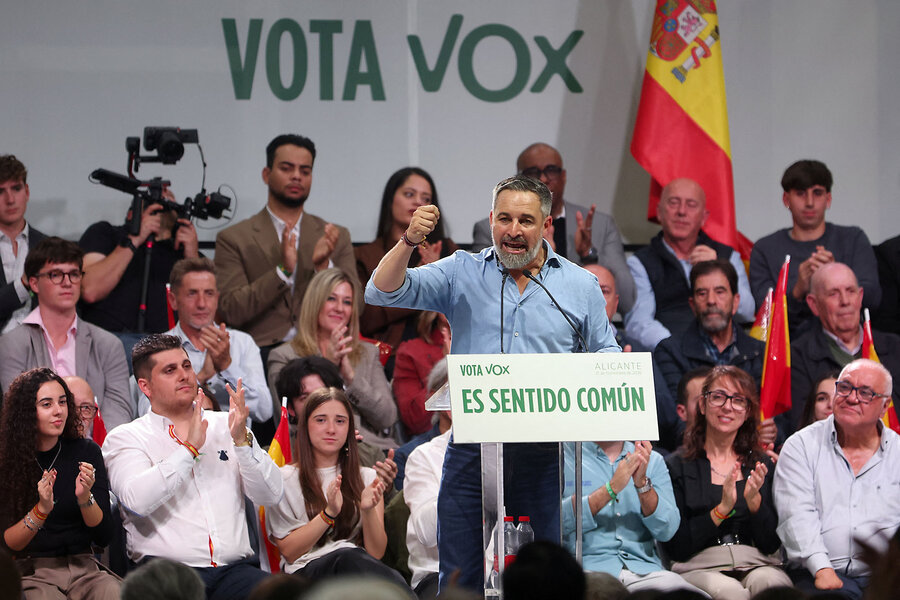
In a packed hall in Ávila, a historic town outside Madrid, Vox party leader Santiago Abascal closes a rally by urging the rapt crowd to remember their ancestors. He reminds them of those who “reclaimed the territory of our homeland for the Spanish people” after seven centuries of invasion, and then went on to “offer the world the evangelization” of the Americas.
“We do not belong to just any people, nor to some fabricated nation or contemporary experiment; rather, we are part of one of the oldest nations in history,” he says. The crowd cheers and waves Spanish flags – a symbol that the left often associates with the right, and some with the dictatorship of General Francisco Franco from 1939 to 1975. Supporters see in Mr. Abascal someone who can protect Spain from perceived threats at a time when the future does not seem bright.
“Spain right now is really screwed,” says Carla Gallegos Arévalo, bubbling with energy after the speech. Almost 19, the server and entrepreneur wants to be able to move into her own place. “I can’t because my wages don’t cover it,” she says.
The Spanish economy has grown faster than its European peers since the pandemic. Unemployment, though still high, is near its lowest level in nearly two decades. Yet young people have not reaped the rewards of that growth. Nearly a quarter of those under 25 looking for work can’t find a job, and the average Spaniard doesn’t leave home until 30. Only just over a third of households headed by someone under 35 owned their home in 2024, according to a Bank of Spain report, down from almost 70% in 2011.
The last time young Spaniards occupied Puerta del Sol, during the 2011 Indignados movement after the financial crisis, protesters decried a broken system. But they still believed they could fix it, says Antonio Álvarez-Benavides, a sociologist at Spain’s National University of Distance Education in Madrid. “Now there’s a kind of entrenched pessimism” that makes simple answers to complex problems more compelling.
Erika Page
High school students Juan Pedro Aguilar (left), Amanda Hernández (center), and Edward Barbero (right) talk after a Vox rally in Ávila, Spain, Oct. 29, 2026.
For Vox, the culprit is often immigration.
Ms. Gallegos Arévalo welcomes immigrants who “come to work,” but believes most of them “come to steal and commit crimes” and should be expelled. Official data shows that most foreign residents work, a larger share than among Spaniards.
While nonnationals are convicted at a higher rate than citizens, nonnationals tend to skew younger and male on average. About half the gap disappears once age and sex are accounted for, a 2026 study found. Recorded crime rose less than 1% last year, even as the immigrant population hit a record high.
Vox is often seen as divisive because of its immigration rhetoric. Yet young people at the rally comment on a sense of unity that can be hard to find in an ever more polarized political landscape.
“Being Spanish isn’t tied to any ideology,” says high school student Juan Pedro Aguilar, attending his first political rally with friends. He is frustrated with the left rejecting Spanish symbols, while admitting that the right has “appropriated” them.
“We are all part of one nation,” says Edward Barbero, whose mother is from Nigeria. “Whenever a country works together, it makes more progress.”
Economic populism on the right
Spain is the first of four big European Union countries to vote over the next year, followed by France, Poland, and Italy, making it an early test for Europe’s right.
Yet like France’s National Rally, Vox does not follow a libertarian playbook. Alongside tax cuts and deregulation, Vox’s program also promises to multiply the housing budget and “flood Spain” with blocks of subsidized housing – for Spanish families first.
The plan echoes the housing policy of Franco, says Dr. Álvarez-Benavides. Under the dictator, the state subsidized some 3.4 million “protected” homes, most built by private developers and sold. The outskirts of Madrid are lined with these brick buildings.
Erika Page
Gabi Ambar sits in an encampment in Madrid's Puerta del Sol set up in late September to protest Spain's housing conditions, Nov. 2, 2026. Police cleared the camp the next morning.
On the right, the most common prescription is to build more and regulate less. Building helps, says Dr. Sánchez Jiménez, but in big cities where lots of people want to live, demand stays high.
Vox also has promised to make Spain a “country of homeowners” again, with cheap loans for young couples, partly forgiven if and when they have children.
Deepen your worldview
with Monitor Highlights.
Politics with respect
Get political stories with respectful analysis.
There‘s a world of new ideas in every
Books newsletter.
There‘s more to life, enrich yours with
Culture & Learning weekly.
Follow humanity‘s discoveries with
Science & Nature stories in your inbox.
Gain a spiritual perspective
from the stories in your inbox.
Want to understand the deeper impact of critical events? Learn the Monitor‘s insight.
Already a subscriber? Log in to hide ads.
In Puerta del Sol, the camp is quieter than when it began. Huge tarps stretch over the tents, shielding them from rain and tourists’ stares. Those who remain say they want not a country of owners, but housing as a right for all.
Gabi Ambar says some of her peers have forgotten what the dictatorship meant for Spanish society. “They don’t see [Vox] as a threat, but as the necessary alternative for something to change.”