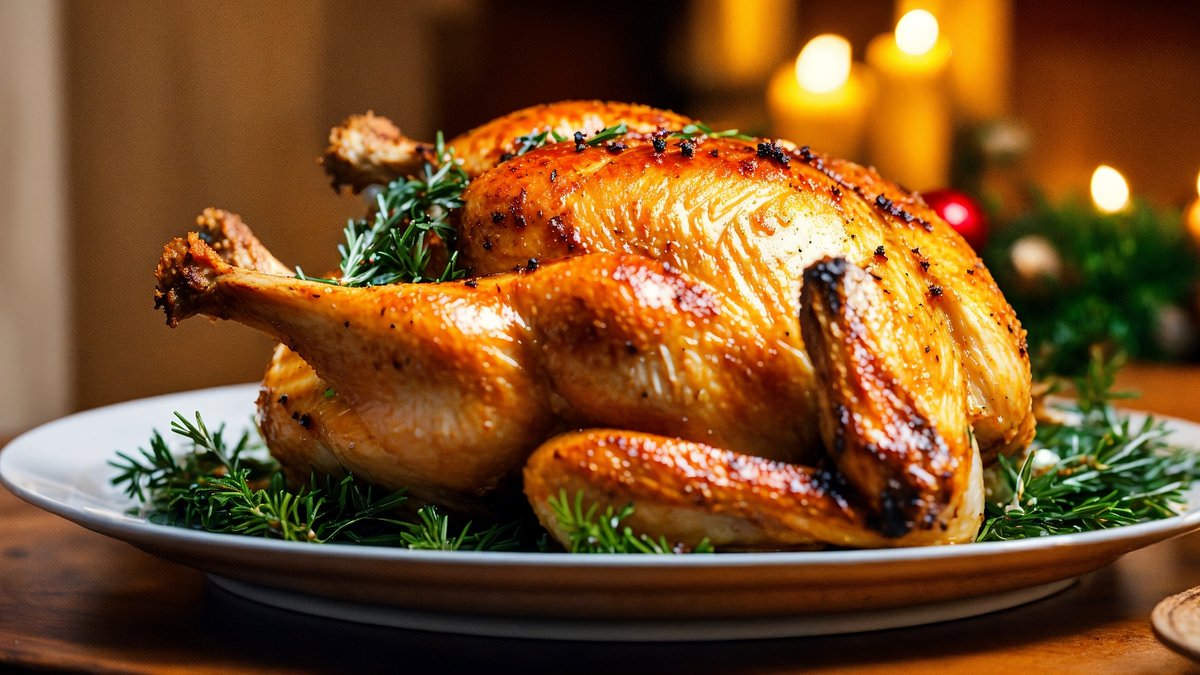
As Thanksgiving day approaches, millions of Americans across the country are gearing up to cook their turkeys.
But firefighters have issued a stark warning about a common kitchen mistake that could turn your holiday into a disaster.
A slew of fire departments around the US held demonstrations this week to reveal the dangers of 'exploding turkeys,' a phenomenon that occurs when you try to fry a frozen turkey in oil.
Deep frying a turkey for Thanksgiving is a popular method of cooking the bird, as it cuts the cooking time in half and ensures the skin is moist and the meat is juicy.
However, the trend comes with major risks if you don't thaw the meat fully before putting it in the fryer.
Ice on the inside of the bird will rapidly turn into steam when it's put into hot oil, which can cause an explosive eruption and ignite into a fireball.
A video shared by the official city of Denver's Facebook page earlier this week revealed just how lethal it could be.
Footage showed a fireman placing a frozen turkey into a pot of hot oil, and immediately, it burst into flames.
As Thanksgiving day approaches, millions of Americans across the country are gearing up to cook their turkeys (stock image)
But firefighters have issued a stark warning about a common kitchen mistake that could turn your holiday into a disaster
Immediately, the firefighter rushed to put out the massive fire.
'Before you fire up that turkey fryer this week, here's what you need to know,' they captioned the post.
'Always use turkey fryers outdoors, on a flat surface, at least 15 feet away from buildings and flammable materials, including dry grass and vegetation.
'Never put a frozen turkey into a fryer. When ice hits hot oil, it can cause the oil to erupt, creating a dangerous grease fire. Always make sure your turkey is completely thawed and dry before frying.'
The city also reminded people to 'never overfill a turkey fryer' and to 'measure the appropriate amount of oil before heating.'
'Thanksgiving kitchens can get chaotic, but safety comes first,' the post concluded. 'Never leave your turkey fryer, stovetop or oven unattended.
'Most importantly, never use water to extinguish a grease fire - it can cause burning oil to spread. If a fire starts, move to safety and call 9-1-1.'
Thanksgiving is the leading day for home cooking fires in the US; an estimated 1,139 home cooking fires were reported on the holiday in 2024, a 321 percent increase from the daily average that year.
A slew of fire departments around the US held demonstrations this week to reveal the dangers of 'exploding turkeys,' a phenomenon that occurs when you try to fry a frozen turkey in oil
A video shared by the official city of Denver's Facebook page earlier this week revealed just how lethal it could be
Back in 2016, the American Chemical Society posted a video on YouTube explaining the science behind 'exploding turkeys.'
'Water molecules are polar which means one side is slightly positive and the other is slightly negative,' one of the scientists said in the video.
'Oil on the other hand, doesn't share this quality, in other words it is nonpolar. Polar and nonpolar molecules try really hard to stay away from each other.
'For this reason, frozen turkeys are prone to catastrophe. When the ice and water on a frozen turkey makes contact with the hot oil it instantly vaporizes into steam and expands to 1,700 times its original volume.'
After the turkey is completely thawed, the organization suggested patting it down with a towel to ensure there's no water left on the bird.
It also suggested keeping a thermometer in the pot, so you know that the oil isn't getting too hot.
'Oils have specific temperatures called smoke points, so they break down to release airborne compounds,' said the scientist.
He explained that the airborne compounds are extremely flammable and if you do not regulate the temperature of the oils, your bird's bath may reach auto-ignition temperatures and could burst into flame.