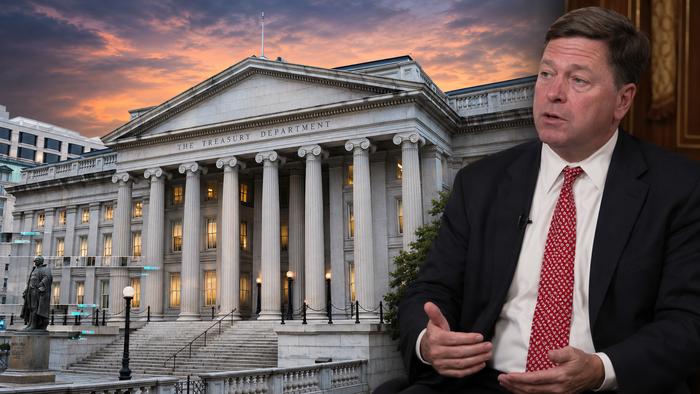
Intruders have gotten into the Treasury Department's Financial Crimes Enforcement Network, the bureau that holds the suspicious activity reports banks file on their customers, just hours after word broke that hackers had breached an intelligence system used by the CIA.
Treasury Department headquarters, used as the lead image for the FinCEN cyber incident
FinCEN said in a notice on its filing portal Tuesday night that it is investigating a cybersecurity incident that "resulted in unauthorized access to a limited subset of its systems," and that it has taken some systems offline as a precaution. It has not said which systems were reached, when the intruders got in, whether any records were viewed or taken, or who did it.
The same day, FinCEN quietly issued an exceptive relief order that never mentions a cyberattack. It cites "a service disruption that is hindering filers' ability to adhere to reporting obligations," and gives banks that file in bulk through FinCEN's Secure Data Transfer Mode, along with companies and individuals with beneficial ownership filings, until Dec. 30 to submit anything due between Nov. 18 and Dec. 29. That relief reaches back to Nov. 18, six days before the bureau told anyone that someone had gotten in.
The order reminds banks that they still have to monitor for suspicious transactions, and points them to FinCEN's Financial Institutions Hotline, "which is not impacted by this service disruption," if they need to get suspicious activity information to law enforcement fast.
The Bulwark's Catherine Rampell has said that while the batch system was down, banks were left with a manual process for filing suspicious activity reports, and that, according to a source, some of those manual filings were failing and a FinCEN portal for law enforcement requests and bank-to-bank information sharing was down as well. FinCEN hasn't addressed either claim.
"Not State-Sponsored"
The FinCEN disclosure landed hours after The New York Times reported that intruders had breached an open-source intelligence analysis system used by the CIA and the Office of the Director of National Intelligence, the platform analysts use to sift social media, commercial datasets and satellite imagery. The National Geospatial-Intelligence Agency was also affected, and investigators suspect the attackers used ARTEX, the AI hacking framework released by a Chinese engineer in July, according to the Times' sources. Two people familiar with the matter told the paper that early indications point to China.
Aerial view of CIA headquarters in Langley, Virginia (Greg Mathieson/Mai / Getty Images)
An ODNI official told the Daily Mail there had been "no disruptions to critical capabilities or classified systems." The CIA declined to comment.
ARTEX is the same tool the FBI warned about in a FLASH advisory on Nov. 13, which said it lets attackers with little technical skill run multi-target break-ins at machine speed, in some cases going from first contact to privileged access in under three hours. The developer pulled ARTEX off GitHub in October, and it kept spreading anyway.
Just two days before the CIA breach became public, Director of National Intelligence Jay Clayton went on ABC's This Week to calm a country rattled by a run of outages. "The incidents that we saw during the course of this week, we know that they were not coordinated and that they were not state-sponsored," Clayton told ABC's Jonathan Karl, chalking them up to "delays, outages and the like, resulting from upgrades to systems."
Director of National Intelligence Jay Clayton tells @jonkarl that the technology outages this week "were not coordinated, and they were not state-sponsored." pic.twitter.com/g6LHkUnXKy
— This Week (@ThisWeekABC) November 22, 2026
Asked who was behind the FBI's own breach, Clayton said he was "not in a position to get into the specifics right now." Cyberattacks are rising, he allowed, "but this is something that we have had for a long time."
That FBI breach hit the National Crime Information Center, the nationwide database police use to share information on wanted suspects, missing people and stolen property, and the bureau is still investigating. The Agriculture Department shut down several internal applications after its own security incident last week, and the NSA's classified internal network went dark for days in an outage officials say was not a cyberattack. In the middle of it all, White House National Cyber Director Sean Cairncross announced he was leaving.
U.S. government entities hit with outages or hackings this month:
FBI
CIA
FAA
NSA
ODNI
USDA
Treasury
— End Wokeness (@EndWokeness) November 25, 2026
Meanwhile, At Treasury IT...
As FinCEN scrambled, Rampell turned her attention to Treasury's chief information officer, Sam Corcos. "The Treasury CIO appears to have spent the past three days vibecoding a Civilization game clone," she posted on Bluesky late Tuesday, "instead of working on this major Treasury database cyber breach." She pointed to activity on Corcos' public repository for the game, called Legatum, adding that "his Claude code is literally adding theme music," and asked whether taxpayers are paying for the AI tokens.
Replying to economist Alex Tabarrok on X, Corcos didn't deny building the game, saying instead that the machines are doing the work.
Just a heads up, @ATabarrok the computers are doing it on their own. Mostly Opus 5.5 orchestrating a bunch of iterative loops.
— Sam Corcos (@SamCorcos) November 25, 2026
Treasury has been breached by China before: in December 2024, Chinese state-sponsored hackers got into Treasury's Departmental Offices network using a key stolen from vendor BeyondTrust, and Treasury later sanctioned a hacker it tied to that compromise.
This time, the bureau sitting on the most sensitive financial intelligence in the country still hasn't said whether anyone walked off with it. Banks have until Dec. 30 to catch up on their filings, and FinCEN has yet to say when its systems will be back.