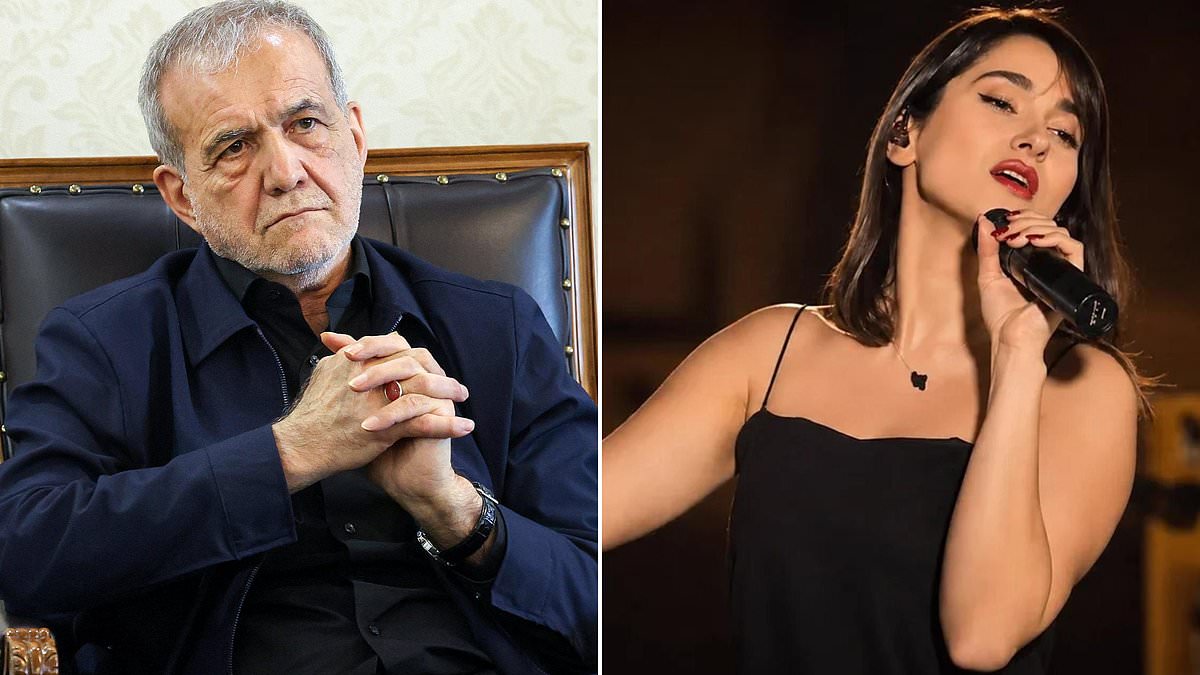
Iran's president on Wednesday issued a bizarre statement on social media, claiming that the Prophet Muhammad championed the fight against violence against women.
Masoud Pezeshkian's comments on X came just days after an Iranian singer received 74 lashes for performing in a live-streamed concert without a hijab.
'The Prophet of Islam was a champion in the fight against violence against women. He stood against discrimination and restored women’s dignity,' Pezeshkian's statement read.
'The flourishing of women is a source of pride for Islamic Iran, and today all laws and measures must likewise be directed toward securing the rights, safety, and development of the women and men of Islamic Iran.'
Women's rights in Iran are severely restricted, with human rights groups describing the situation as a gender apartheid.
The legal minimum age for marriage in Iran is 13, and fathers can obtain judicial permission to marry off even younger daughters.
Women also face significant barriers to divorce, as laws granting men unilateral divorce rights can make it extremely difficult for a woman to prove sufficient grounds in court.
Meanwhile, Iran lacks specific legislation criminalising domestic violence or marital rape.
Iran's president on Wednesday issued a bizarre statement on social media, claiming that the Prophet Muhammad championed the fight against violence against women
Popular Iranian singer Parastoo Ahmadi received 74 lashes on Monday for performing without a hijab
Compulsory hijab laws apply to girls starting around age seven, and are strictly enforced by morality police, who often use violence and intimidation to force women to comply.
Women and girls above the age of puberty must conceal their hair with a hijab and wear long, loose-fitting clothing to disguise their figures.
Under Iran’s 'hijab and chastity' law – passed in 2024 but not yet officially implemented – women found 'promoting nudity, indecency, unveiling or improper dressing' face severe punishments, including fines, flogging and prison sentences ranging from five to 15 years for repeat offenders.
In 2022, demonstrations swept across the Islamic Republic following the death in custody of Mahsa Amini, a 22-year-old Kurdish woman who was detained by morality police in Tehran in September that year for allegedly wearing her hijab 'improperly'.
Female protesters burnt their headscarves or waved them in the air at the nationwide demonstrations against the clerical establishment, during which at least 476 people were killed in a crackdown by security forces.
Since then, many women and girls have stopped covering their hair in public altogether in open defiance of the restrictive dress code.
The Islamic Republic has responded with periodic waves of arrests, warnings, business closures and other punitive measures.
Speaking to the Daily Mail, Iranian activist Niyak Ghorbani said of Pezeshkian's comments: 'The "flourishing of women" in Mr Pezeshkian's telling is, in reality, nothing but child marriage, bullets, the noose and the prison cell.
'Iranian women have flourished, but in defiance of this regime, not thanks to it. Their salvation lies not in negotiating with this regime, but in ending it.'
Activist Lily Moo added: 'This statement that Pezeshkian has put out there with claims of safety for men and women in Iran... [comes] while every morning with an Islamic call to prayer, Pezeshkian’s government is executing innocent Iranian men, women and children..'
People quickly flooded the comments on the Iranian leader's post, condemning the hypocritical statement while women in his country continue to face daily violence and intimidation.
One person said: 'You have the highest rate of women being killed, and yet here you are, talking bulls***. Why don't you drop dead? Why won't you leave us alone? Get lost already, you disgusting scumbags!'
Another added: 'You whip innocent girls, and then you come along talking about women’s dignity and fighting violence against women? How can you show your faces?'
On Monday, popular Iranian singer Parastoo Ahmadi received 74 lashes for performing without a hijab.
In June, Ahmadi, 29, and eight members of her production team, including musicians, were sentenced by a court in the city of Qom over a concert that was streamed online in 2024, which went viral and gained millions of views.
The court said the group had violated Iran's 'legal and cultural norms' and dubbed the performance at the historic Deir-e Gachin Caravanserai 'obscene and vulgar'.
Human rights groups slammed the verdict, calling the punishment 'a form of torture' and a 'crime against humanity'.
Ahmadi and four members of her team received the lashes on Monday, according to Iran International.
Ahmadi, Soheil Faghih-Nasiri, Amin Taheri, Amirali Pirnia and Mohsen Lashkari appeared at the prosecutor’s office in the central city of Qom, where the sentences were carried out.
In 2022, demonstrations swept across the Islamic Republic following the death in custody of Mahsa Amini
They were also sentenced to a two-year ban on artistic and musical activity, and a two-year travel ban on charges of 'offending public decency by producing and publishing obscene and immoral content online'.
The head of the Iranian judiciary has recently stated the regime should not be afraid of the resulting 'uproar' from a harsher crackdown on those not wearing the hijab.
Roya Boroumand, co-founder of the Abdorrahman Boroumand Centre for Human Rights, was quoted in the Guardian as saying: 'This concert is treated as an act of defiance not only because a woman is singing unveiled, but because she is singing old pre-revolutionary popular songs.'
Following the verdict, Moein Khazaeli, a human rights lawyer at Dadban, a legal counselling centre for Iranian activists based outside Iran, told the outlet: 'The verdict is against humanity. It is a form of torture under the [United Nations] convention against torture. Unfortunately, in the Islamic republic’s judicial system, applying torture is effectively legal. It’s against human rights – a crime against humanity.'
In September, the defendants' appeal was 'rejected' by a higher court without a hearing, according to their lawyers.
Lawyer Mostafa Nili said the sentences were enforced after Branch 16 of the Qom Provincial Court of Appeal upheld the original verdict and referred the case for enforcement.
'In our view, holding the concert was not a crime at all,' one of the lawyers previously told the BBC. 'The trial court imposed one of the harshest punishments for these charges, although fines and less severe penalties were also available.'
'The Court of Appeal, despite having the option of holding a hearing, did not hold a hearing and upheld the judgment. It appears that the main reason for issuing this judgment was to deter the recurrence of similar events,' the lawyer said.
At the concert in question, Ahmadi performed a patriotic song titled Az Khoone Javanane Vatan (From the Blood of the Youth of the Homeland) in a long black sleeveless dress and no hijab.
The performance was posted on YouTube, with Ahmadi saying: 'I am Parastoo, a girl who wants to sing for the people.'