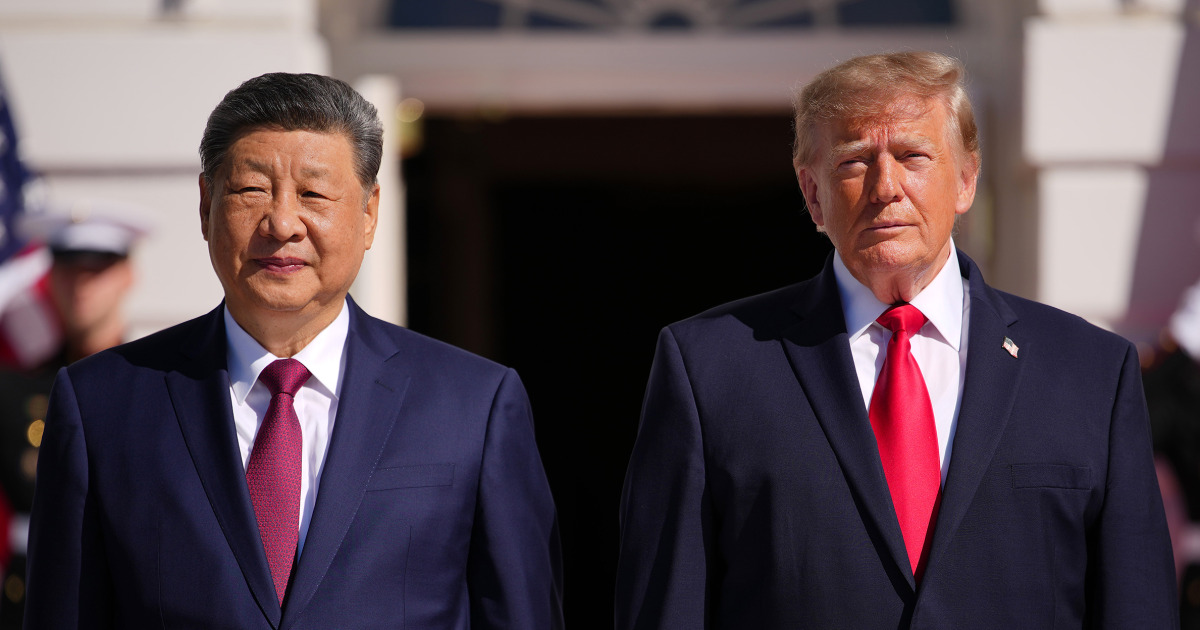
The Trump administration on Tuesday proposed a new wave of tariffs on the European Union, China and other trade partners, the result of a probe into what it says are unfair manufacturing subsidies.
Some of the proposals include tariffs of at least 20% on China, which would match an agreement reached with the White House. But the duties could reach up to 40% if talks between the countries fail.
The tariffs will be implemented under Section 301 of the Trade Act of 1974, a statute that the White House has relied upon more frequently for trade authority ever since the Supreme Court blocked many of Trump’s 2025 country-specific tariffs, imposed under a different authority.
In announcing the details of the new duties, the U.S. Trade Representative Jamieson Greer said that the overall rates applied to each trading partner would not surpass levels that were previously agreed to as part of bilateral framework trade deals.
“When it all nets out, it really will just top up a few percentage points,” Greer said on CNBC.
“So what we’re proposing today are actually a set of targeted tariffs to respond to this problem of excess capacity,” he added.
For example, Trump agreed to cap tariffs on European Union imports at 15% as part of a deal reached in 2025. On Wednesday, the USTR reiterated that cap.
The new tariffs will not stack on top of existing duties, except for the case of China.
U.S. Trade Representative Jamieson Greer on Nov. 18 in Shenzhen, China.China Pool / Getty
“We’ve talked to our trading partners about this,” Greer said. “They know what we’re proposing. I think a lot of this is baked in, and I don’t think any of these would actually take effect earlier than a couple of months from now.”
Greer said he expects that “a broad” negotiation with trading partners would follow today’s proposals.
But tensions continue to flare with trading partners, especially between Canada, the EU and China.
Just weeks ago, U.S. Trade Representative Jamieson Greer accused the EU of “aggressively” supporting Airbus and said that a loan from the European Investment Bank to the French aerospace giant threatened to inject “substantial uncertainty into transatlantic trade in the aerospace sector.”
The EU rejected Greer’s assertion, saying the loan was normal and he had “really no grounds” to question it. The bloc, made up of 27 countries, is the United States’ largest trading partner.
Meanwhile, in August, trade talks with Canada collapsed after Prime Minister Mark Carney said the Trump administration requested “uneconomic” and unfair terms at the last minute.
Carney recalled his negotiators to Ottawa and for more than three months the two sides have traded verbal barbs. Canada is the country’s third largest trading partner, according to data through September of this year.
Recently, informal talks resumed between the U.S. and Canada but a formal deal does not yet appear to be within reach.
On Wednesday, Greer said those talks with Canada were continuing, due to some outstanding “sticking points.”
Another key U.S. trading partner, Mexico, was not included in Wednesday’s tariff proposals.
“I think the most important one where we’re still going through the investigation process, is Mexico,” Greer told CNBC. “I think it’ll be a little bit more time before we release that report,” he said.