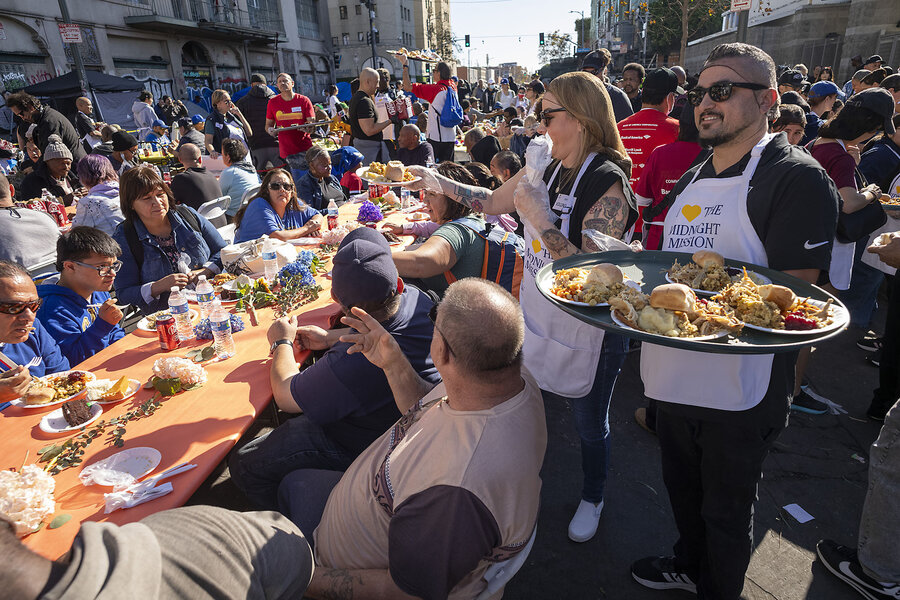
Gathering around Thanksgiving tables this year, most Americans look forward to a hearty feast and an opportunity to share gratitude and updates with each other. For some, however, it can also be an ordeal, feeling they have to watch what they say.
Contentious campaigning for the midterm elections and the accompanying media commentary have portrayed citizens at odds with each other and, at times, with the United States’s founding tenets.
Yet such a portrayal itself is at odds with the persistent, underlying aspects of the American national character.
For one, 75% of adults identify with at least one core value they view as widely shared by fellow citizens, according to an October Gallup report. These include civic credos such as freedom, patriotism (caring about the country and wanting to live up to its ideals), being of service to others, and kindness.
Even more striking, Gallup found that nearly 8 out of every 10 respondents (79%) said “respecting different values matters more than sharing the same ones.”
Democracy, in other words, thrives on juggling a diversity of views.
These findings are not an anomaly. A 2025 study by the Public Religion Research Institute found that 80% of Americans agreed with the statement “Empathy is a moral value that is the foundation of a healthy society.” And in April, the University of Massachusetts at Amherst reported research showing that 74% of Americans believe there are more factors that unify than divide them.
“A majority of Americans believe that we have a shared foundation of values and a shared history of progress” on the ideals of the Declaration of Independence, one of the poll’s co-directors noted.
This widespread inclination toward respecting differences and recognizing shared conceptions of nationhood serves as a civic bedrock on which to build consensus and also counter the social drift toward isolation – within families, communities, and political constituencies – as well as political tribalism.
“We Hate to Break It to You, but Maybe We’re Not That Polarized” was the tongue-in-cheek title of a July essay in the New York Times by two political scientists, who have interviewed more than 700,000 Americans over two decades of research. Professors Stephen Ansolabehere of Harvard University and Brian F. Schaffner of Tufts University described how they presented Republican and Democrats with 44 policy proposals, including some on “contested” topics. Voters from both camps, they wrote, “took the same position ... on roughly half” of the issues.
Yet, news reports and social media, politicians and pundits, tend to underscore differences and divergence. And Americans assume that their opponents hold more extreme views than they actually do. (For instance, the Economist has pointed out, “Partisans overestimate their ideological foes’ support for violence” by as much as four times.)
Recalling the traditional Thanksgiving emphasis on gratitude and generosity can help loosen the hold of such misperceptions. The expression of these qualities – or what one scholar calls “radical grace” – might then infuse holiday-table conversations with compassion and nuance, rather than combativeness.
Deepen your worldview
with Monitor Highlights.
Politics with respect
Get political stories with respectful analysis.
There‘s a world of new ideas in every
Books newsletter.
There‘s more to life, enrich yours with
Culture & Learning weekly.
Follow humanity‘s discoveries with
Science & Nature stories in your inbox.
Gain a spiritual perspective
from the stories in your inbox.
Want to understand the deeper impact of critical events? Learn the Monitor‘s insight.
Already a subscriber? Log in to hide ads.
This approach, author and anthropologist Christine Jeske explained in Christianity Today last November, is about “actively pursuing wisdom by learning about each other. It means leaving [behind] defensiveness ... And it means extending love.”
Now that’s a recipe, with all the fixin’s, for a grace-filled Thanksgiving.