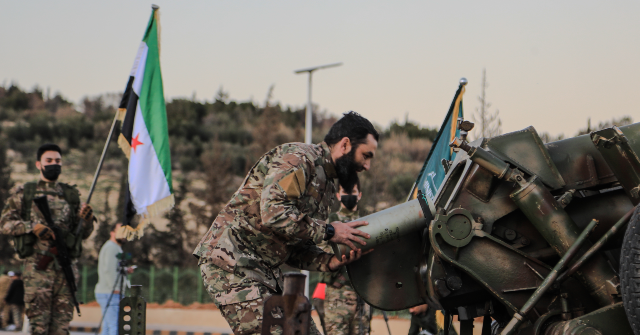
The U.S. is reportedly discussing a multinational mission to train Syria’s military, potentially sending American troops back to Syria less than two years after they withdrew.
The proposed first joint U.S.-Syrian training mission would allegedly focus on demining and ordnance disposal, and much of the training could be conducted in Jordan.
Concerns about human rights abuses by Syrian commanders, and Syrian resentment over U.S.-Kurdish cooperation, could complicate the proposal.
The U.S. government is reportedly in discussions to participate in a multinational training mission for the Syrian military, which means some number of American troops could be returning to the war-torn country less than two years after President Donald Trump withdrew the last U.S. forces.
The U.S. deployed troops to Syria and Iraq in 2014 as part of Operation Inherent Resolve (OIR), an international effort to fight the Islamic State after it cobbled together a “caliphate” from occupied territory in both of those countries.
OIR was ultimately successful but it had some missteps along the way, including a disastrous effort by the Obama administration to find some “good guy” or “white hat” Syrian rebels who could be trained to become a reliable U.S. ally on the ground. After this effort failed, OIR shifted its focus to partnering with the highly effective Kurdish YPG militia in Syria.
The U.S. began drawing down its forces in Syria after U.S. Special Operations Forces killed ISIS leader Abu Bakr al-Baghdadi in October 2019. The “caliphate” was destroyed, but ISIS remained a threat serious enough to warrant increased U.S. airstrikes from 2024 to 2026, along with some ground operations in support of Syrian and Iraqi partner forces.
President Donald Trump was persistent in his desire to pull U.S. forces out of Syria after the fall of the caliphate. The drawdown began with equipment in 2019, and the last major U.S. ground forces withdrew in April 2026, handing their final base over to the new Syrian government.
Syrian dictator Bashar Assad was overthrown by an alliance of jihadis and insurgents in December 2024. The new military government, headed by former al-Qaeda lieutenant Ahmed al-Sharaa, received strong support from the second Trump administration.
There have been a few rough patches along the way, including Sharaa’s administration doing a less than perfect job of keeping its promises to protect ethnic and religious minorities, Israel taking action against ongoing threats to its security from Syria, and the awkward integration of America’s Kurdish anti-ISIS allies into the new Syrian government and military.
President Trump kept his chips on Sharaa throughout these difficulties and would be upping the ante by sending American troops back into Syria to train its revamped army.
According to a report by The National on Monday, the proposal under consideration for the first joint training mission between the U.S. military and Syria would “emphasize training in demining and safe disposal of ordnance, but could serve as a model for wider co-operation if successful.”
The plan would involve beefing up an existing operation called the Damascus Co-Ordination Center (DCC), which is based in Jordan. The DCC was established last year to coordinate activities between the U.S., Syria, and regional allies.
The program seems to have been a low-key success, given that it attracted very little media coverage until the story about converting it into the nexus of a U.S. training program for Syrian troops broke on Monday, and suddenly U.S. Central Command (CENTCOM) and the State Department were singing the DCC’s praises as a valuable asset against resurgent ISIS terrorism.
The National cited two major obstacles to the training plan. One is a set of U.S. legal provisions known as the Leahy Laws, which set high human rights standards for any foreign security force that receives assistance from the American military. Some of Syria’s military officers have jihadi pasts that would make it difficult for them to pass Leahy Law scrutiny, and the Syrian military under Sharaa has committed troubling abuses against minorities like the Druze.
The other obstacle is that certain elements of the Syrian military have hard feelings about Operation Inherent Resolve, especially the close partnership between U.S. and Kurdish forces. These Syrian officers are reluctant to give American troops access to defense facilities, a problem that might be addressed by moving some of the joint training programs to Jordan. Conducting the training in Jordan would also alleviate security concerns about ISIS attacks on the participants.
The joint training program could begin as soon as March, and would involve some 15 regional allies in addition to Syria and the United States.
The Jerusalem Post on Tuesday said mine-clearing would be a worthy focus for the early stages of joint training, since Syria is littered with so many explosives from its devastating 14-year civil war. Kurdish members of the new Syrian army could give the training a leg up, as they have already received advanced instruction in mine-clearing from American and Israeli experts.