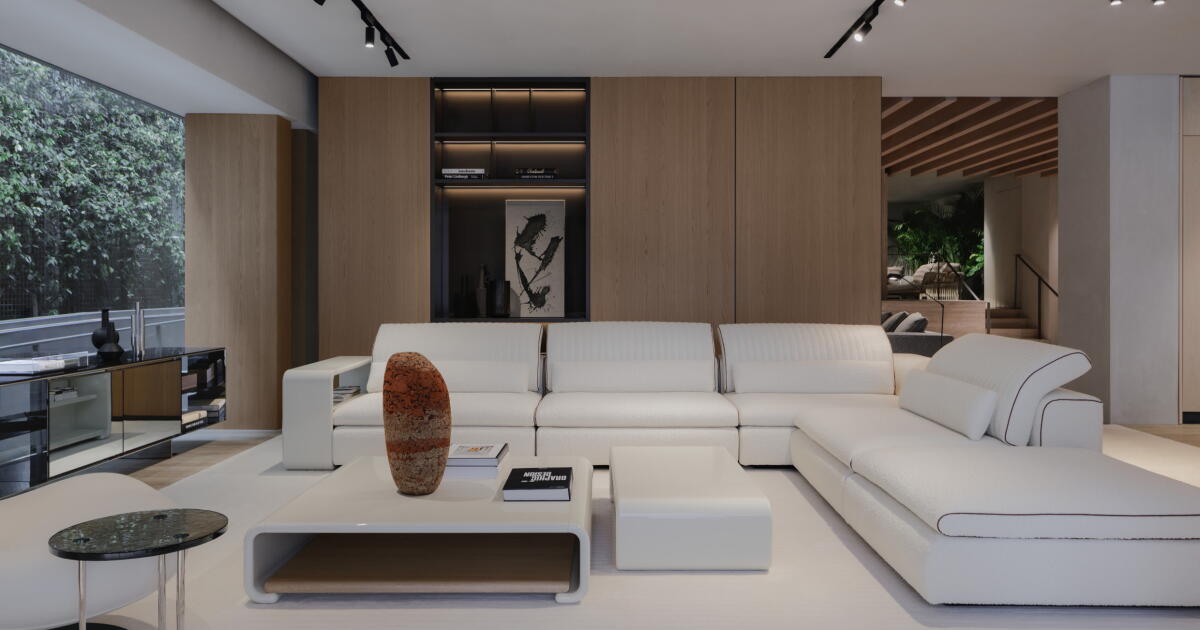
“Our goal is ambitious: to combine the excellence of Italian design with responsibility towards people, the environment and communities, strengthening our contribution to the transition towards more sustainable development models.” — Marco Piscitelli, CEO, Molteni Group
Molteni Group presents its 2025 Group Sustainability Report, which documents a stage in the Company’s journey through ESG objectives that are formalized and monitored annually.
SPACES
Where style meets space. Explore elevated DIY projects, trend-forward design, expert insights and creative inspiration for every corner of your home, curated by LA Times Studios.
By continuing, you agree to our Terms of Service, which include arbitration and a class action waiver. You agree that we and our third-party vendors may collect and use your information, including through cookies, pixels and similar technologies, for the purposes set forth in our Privacy Policy such as personalizing your experience and ads.
The Sustainability Report covers Molteni&C, UniFor, Citterio and the foreign subsidiaries, including those in the United States, Australia, the United Kingdom and France. It stems from the desire to strengthen an approach based on environmental, social and governance objectives.
Molteni is the leading independent industrial group in the high-end furniture sector with Made in Italy production. It comprises three companies, each a leader in its own segment: Molteni&C, which specializes in residential furnishings and contract projects; UniFor, which specializes in the design and manufacture of solutions for work environments; and Citterio, a brand focused on partition systems and technical furnishings for professional and public spaces. Together they offer design solutions that combine quality, functionality and aesthetics, backed by a well-established presence in Italy and around the world.
To underscore the importance of this commitment, Molteni Group has established the Group Sustainability Committee, which supports the Company in pursuing its goals and in integrating sustainability into strategic decisions. The Committee monitors progress across the main areas of work, Finance, Communications, Production, Procurement and Supply Chain Operations, ensuring coordination and consistency among the various initiatives.
Sustainability: The 2025 Overview
The acronym ESG (Environmental, Social and Governance) refers to the dimensions used to verify, measure and support a company’s sustainability journey.
For Molteni Group, attention to ESG criteria means monitoring its environmental, social and governance performance, with the aim of integrating sustainability principles into decision-making processes and business activities. Below is a summary of the areas of work in 2025:
Environment: in 2025, the Group significantly strengthened its energy transition journey through concrete measures aimed at reducing emissions and increasing the use of renewable energy. A particularly important milestone was the installation of photovoltaic systems at the three production sites in Mesero, Turate and Sirone, with a total capacity of 3 MWh.
These investments, aimed at increasing in-house renewable energy production, seek to reduce dependence on fossil fuels, raising to 57.5% the share of the production sites’ energy needs covered by self-generated energy (+69% compared with 2024). These add to the systems already operating at the Giussano headquarters, which has a nominal capacity of 3.12 MWh. In total, the Group’s self-generation reaches 5,430 MWh of electricity.
At the same time, the Group has signed agreements to purchase more than 2.5 MWh of renewable electricity certified through Guarantees of Origin (GOs), confirming its commitment to an increasingly sustainable and transparent energy supply. The combination of self-generation from photovoltaic systems and the purchase of certified green energy is a central element of the Group’s climate strategy. The medium- to long-term goal is to progressively increase the share of renewable electricity used in the Group’s operations, contributing to the decarbonization of operations and to a reduction in the overall environmental footprint, so that the Molteni Group’s production division eventually runs entirely on electricity from renewable sources. A further significant result concerns waste management and resource efficiency. In 2025, the Group confirmed particularly high levels of circularity, with a waste recovery rate of 97.9%, testament to its ongoing commitment to making the most of materials and minimizing disposal.
Social: in 2025, total headcount reached 1,224 employees (+7.4% compared with 2024). The Group promotes training and skills development initiatives, adopts policies and procedures designed to foster an inclusive and respectful working environment, and supports cultural and charitable initiatives in the local community.
Governance: by monitoring environmental metrics, the Group aims to integrate sustainability into decision-making processes and to promote continuous improvement. The Board of Directors oversees sustainability reporting, supported by the Group Sustainability Committee, which sets strategic direction and coordinates operational activities.
Ecodesign, Durability and Resource Efficiency
The Group continues to invest in innovating its processes for the design and environmental assessment of its products. The integration of ecodesign principles, Life Cycle Assessment (LCA) methodologies and structured criteria for material selection is now supported by a digital platform adopted across the Group and verified by an independent third party for the production of LCA studies and Environmental Product Declarations (EPDs). The Group has strengthened its approach to measuring and disclosing the environmental performance of its products, surpassing 16 Environmental Product Declarations (EPDs). The initiative is part of the organization’s digitalization journey and helps make the collection, management and verification of product-related environmental data across their life cycle more structured.
This approach aims to assess and, where technically and economically feasible, reduce the environmental impacts associated with product life cycles, while also promoting resource efficiency, the quality and durability of the products, and the recovery and recycling of materials at end of life, within the limits of existing recovery supply chains. The adoption of these practices is an integral part of a corporate strategy focused on continuously improving environmental performance and gradually moving closer to the principles of the circular economy.
For three generations, Molteni Group has invested in developing materials, technologies and production processes, with the aim of maintaining high quality standards, fostering product durability and steadily improving the efficiency of its production processes. The Group monitors its environmental performance through specific indicators and metrics, used to assess the progress of its activities and identify opportunities for improvement, in line with company objectives and the sustainability commitments set by Management.
Designing products for long-term use and focusing on efficient resource use guide the Group’s activities across the entire value chain. This commitment involves the production plants, business partners and suppliers, through the promotion of requirements and standards aimed at continuously improving environmental, social and governance performance.
As a founding member, Molteni Group supports the EPR Consortium promoted by FederlegnoArredo, established to promote the organized management of end-of-life furniture products.