When Peter Ueberroth and his wife awoke on the last day of the 1984 Summer Olympic Games, there was much to celebrate.
Yet, as they sipped coffee, Ueberroth was filled with only dark thoughts.
“I was worried. We had been lucky to avoid a terrorist attack until now,” the head of the L.A. Olympic organizing committee wrote in his memoir, “Made in America.” “I prayed silently that our good fortune would continue. I looked at the mirror at Ginny and sensed the same thought going through her mind.”
We think back to the 1984 Summer Games in Los Angeles as a feel-good moment of Reagan’s America and Tom Bradley’s Los Angeles. The patriotism. The corporate sponsorship bonanzas. The summer L.A. put on its best face before the city seemed to fall apart. Two weeks without freeway gridlock.
But reading Ueberroth’s chronicle of those Olympic Games, it’s striking how much the specter of violence and fears of terrorism shadowed the festivities even 17 years before 9/11. They never materialized, yet Ueberroth wrote he spent the Olympics dreading the call.
Los Angeles just got a reminder of the high stakes of keeping the 2028 Olympics safe. It came in the form of a hefty bill. Los Angeles Police Chief Jim McDonnell told my colleague James Rainey that the cost of policing the Games could approach $4 billion, far more than previous estimates.
Peter Ueberroth was dogged by security worries during the 1984 Summer Olympics in Los Angeles.
(M. Spencer Green / Associated Press)
Who will pay? That remains an open question. Incoming Mayor Nithya Raman once had doubts about bringing the Olympics to L.A., and has also signaled doubts about McDonnell. The feds will cover some costs, but who knows what the Trump White House will want in return?
It’s impossible to compare security in 1984 to what we will need in 2028. We live in a different world, a different city.
But the challenges L.A. faced 42 years ago are instructive. Those Summer Games were filled with battles over policing levels, costs and the challenges of assessing the true security threats.
The threat is real, but what’s a real threat?
Everyone seems to agree that high-profile events such as the Olympics are prime targets for terrorism, whether it be organized or the act of a lone wolf. In 1984, L.A. planners were haunted by the 1972 terror attack at the Munich Olympics that killed 11 Israeli athletes.
But what is a real threat? The 1984 planners chased a lot of leads, some of suspicious origin.
LAPD Chief Daryl F. Gates claimed a possible Soviet plot to slip criminals and terrorists into Los Angeles disguised as Russian Jewish immigrants. As The Times’ Ken Reich reported at the time, few gave the report much credibility, and Gates eventually walked it back. Ditto for a warning from the L.A. County Sheriff’s Department that rival gangs could declare a temporary truce among themselves and target tourists in a reign of terror.
Cold War politics loomed large in assessing the threat, and sometimes it seemed there were political motives. Some hawks believe that Russia, which boycotted the Games, would try to disrupt them. Not to be outdone, the director of the FBI at one point said Armenian terror groups could attack the Games.
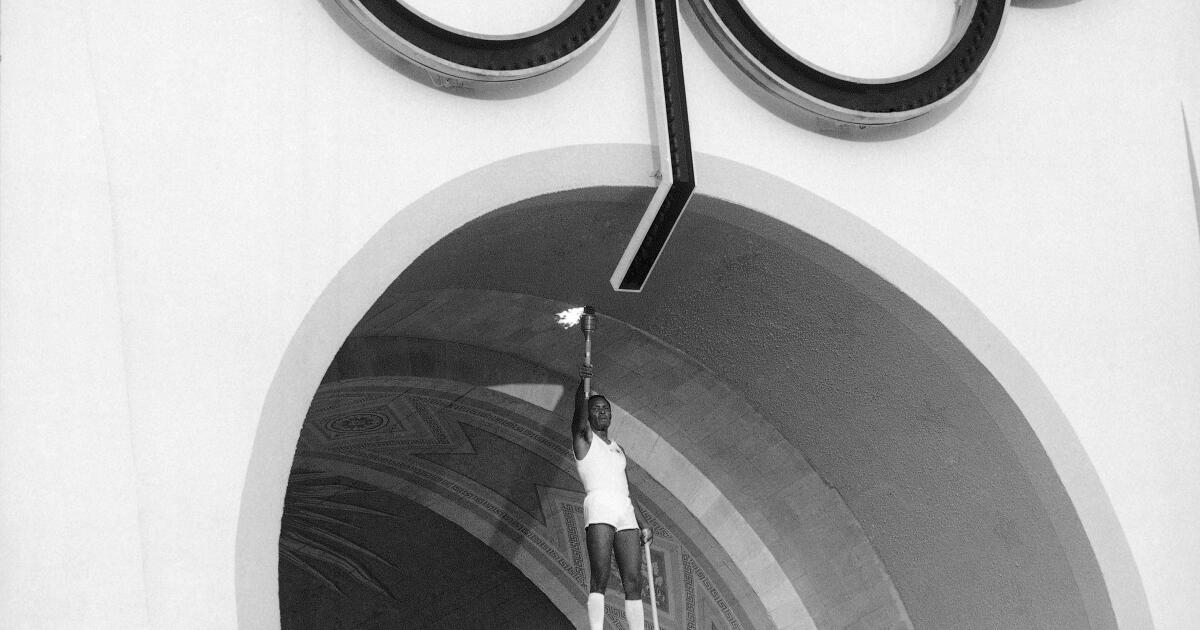
Rafer Johnson, 1960 gold medalist for the decathlon, lights the Olympic torch at the 1984 Summer Games in Los Angeles. A misunderstanding led to fears of an explosion when the torch was lighted.
(Eric Risberg / Associated Press)
Reality versus noise
None of those plots materialized.
But there were some scary moments that summer in L.A.
Just as the Games began, a man drove his car onto a crowded sidewalk in Westwood Village, not far from where the athletes were staying at UCLA. One person died and 48 were hurt. Police determined it had nothing to do with the Olympics.
On opening day, police chased various reports of potential plots, including one involving explosives that would be ignited when the Olympic torch was lighted at the Coliseum. Producers scrambled to change the show. But within an hour, the whole thing turned out to be a misunderstanding (involving a loose wire from a TV crew), and the torch was lighted on schedule.
A few days into the Games, police arrested a man who was following an Olympic team bus on the freeway. Officers found a homemade bomb in the car. He claimed he was a “street warrior” who was trying to protect the athletes.
The most serious plot wasn’t revealed until two years after the Games.
In August 1986, Los Angeles County sheriff’s deputies discovered explosives stored at a rental storage facility in Santa Fe Springs. The FBI later said the munitions had been sitting there since before the Games began, part of an elaborate plot involving members of the radical Weather Underground and a group called the Fuerzas Armadas de Liberación Nacional. The Olympic attack was part of a larger scheme to break a Puerto Rican nationalist leader out of the federal prison at Leavenworth, Kan. The feds managed to foil the plot, The Times reported.
L.A. Police Chief Daryl F. Gates tangled with the Olympic committee over the 1984 Summer Games, seeking more money than the committee would give and pushing to deploy more officers at key sites.
(Los Angeles Times)
The Olympics, not a police state
As the 1984 Olympics unfolded into a massive success, colleagues kept telling Ueberroth to sit back and enjoy all he’d created. That proved impossible.
“People try and say, ‘Well, now you must enjoy, now you must relax.’ I’d like to tell them that’s true,” he told the Washington Post during the Games. “But it’s not. Not yet.”
For all his safety concerns, Ueberroth was insistent about not allowing the Games to feel like a police state. He said the various federal and local security forces were constantly throwing out potential threats.
“‘Why didn’t you build a big umbrella to cover the whole stadium in the shade?’” he told The Times. “Well, I think that the Games are for the athletes, and anything can be overdone, and so we tried to reason with law enforcement. We took a strong stand for the ambiance of the Games.”
Ueberroth and the other Olympic planners took a skeptical eye to some of the big-budget requests by law enforcement, in part because they had vowed that the Games would not be a financial drain on L.A.
Gates and the Olympic committee fought for years. Gates wanted more money than the committee would give and to deploy more officers at key sites such as the Olympic Village than officials wanted. The LAPD demanded a fence be erected around the Coliseum; the committee refused.
Olympics managers acknowledged to Reich the fraught nature of these decisions: If there was a terrorist incident, the police could say they didn’t get the staffing and money they wanted. When nothing materialized, managers were praised for holding the line on spending.
But they said that it was about more than money. As Edgar Best, a top Olympics official, told Time magazine: “These Games are a celebration, not an international security event.”
Raman has not outlined in detail her views on Olympics security. But she’s been clear about the financing: “I want the Olympics to succeed. But that cannot mean giving LA28 a blank check while Angelenos carry the risk.”
More to Read