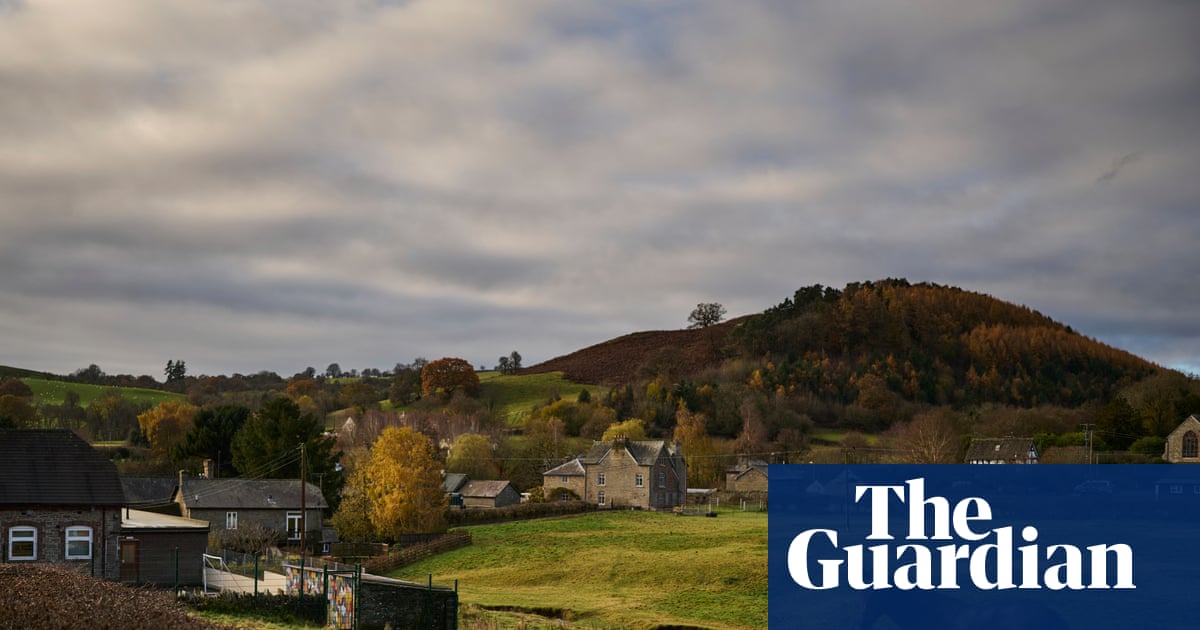
The kitchen in the Alman family farmhouse is large, airy and decorated with hundreds of rosettes awarded over the decades for prize-winning dogs, sheep and cows. I grew up just up the hill, so I know this kitchen well. Apart from the video feed in the corner, showing what the cattle are up to in the barn, it hasn’t changed much since the 1980s when we’d pile in here after helping our fathers with the baling.
From the kitchen, Gladestry’s small, slate-roofed primary school, set against the steep green slope of Hergest Ridge, is clearly visible, and – it being playtime when I visited – clearly audible too. That hasn’t changed much either since the days when Joseph Alman and I were pupils at that tiny school, and our own parents looked out of that same window and heard us calling to each other as we played football.
“It’s so lovely to hear them,” said Alman, whose son is in year 5. “I used to hear them before Charlie was in there, and now I go out there and I know he’s one of them, and it’s really nice to see him playing. I’ll drive by there, and there’ll be a couple of footballs that have gone over the fence and rolled to the verge. They try to flag someone down to throw back the ball so the game’s back on. It’s the heartbeat of the village, you know.”
Gladestry is home to 400 people and sits (just) on the Welsh side of the border with England. Indeed, if you’ve ever walked the Offa’s Dyke footpath that runs, more or less, along that border, you’ll have passed right through the small cluster of buildings that mark its centre. The school has been educating Almans since Joseph’s grandfather and great-uncle arrived in 1917, but Charlie could be the last. In June, just before the start of the summer holidays, Powys county council announced that it wanted to close the school.
“It all seemed to come as a bit of a bolt out of blue,” said Alman. “We didn’t know nothing about it.” It was, however, just the latest episode in a slow-motion erosion of the foundations of life in mid-Wales, which is caused by generations of politicians failing to engage with an important question: how do you provide adequate services to a sparsely populated place if you’re not willing to spend more money? In other words, how do you solve a problem like Powys?
Powys was once a kingdom, from which Britain’s native population resisted the remorseless westwards expansion of the Anglo-Saxons for half a millennium or more. The kingdom disappeared in the 13th century, when the English conquered the last independent Britons, but seven centuries later – in 1974 to be precise – its name was dredged out of obscurity. (The word itself derives from pagus, the Latin word for countryside.)
At the time, the government in London was trying to rationalise local administration by combining smaller units into larger ones that were better able to meet the needs of their populations. The result was new inventions such as Greater Manchester, Avon, Humberside and Mid Glamorgan. A basic principle of the reform was that local authority areas needed at least 250,000 people to be viable. And this is where mid-Wales ran into trouble.
The existing counties of Breconshire, Radnorshire and Montgomeryshire were clearly too tiny to justify their continued administrative existence. Even combined into a single entity called Powys, however, the population was less than half the supposed minimum. “There are more sheepdog exemption licences than there are members of the population,” one peer said when the House of Lords debated the reform in 1972. “Powys, as we all recognise, is a county with too few people and too few resources,” said another.
There was no easy answer. The new county already covered 5,200 sq km (2,000 sq miles), and combining it with yet more parts of Wales risked creating something too unwieldy to be manageable. Merging it with anywhere in England was clearly unacceptable, so Powys was left as a vast underpopulated exception – its population density lower than any part of Britain south of the Highlands, its properties cumulatively worth less than any other county in England and Wales.
Mid-Wales is a unique place. Unlike other parts of Wales – with their coal, steel and slate – Powys was largely untouched by the industrial revolution. Much of the county lived by producing meat for export, sending its livestock to the market towns of England. As a result, in contrast to farming communities elsewhere in Wales, most of Powys is English-speaking, which means it’s linguistically cut off from rural areas to the north and west, and culturally distinct from places to the south.
It is unassuming, and it is beautiful; the kind of place that hippies such as my parents sought out in the 1970s when they wanted somewhere quiet to build a new kind of life. It is also empty. Even today, the county’s entire population – 135,000 – is barely equal to that of St Albans, yet it is spread over an area larger than Northumberland. That’s a quarter of Wales’s landmass with 4% of its population. If you were to add Powys’s two largest settlements together – Newtown, on the English border near Shrewsbury, and Ystradgynlais, 85km away in the Swansea valley – you still wouldn’t have enough people to reach the Office for National Statistics’ threshold for a “medium-sized town”.
It takes two and half hours to drive from one end of Powys to the other, from Eryri (Snowdonia) to the Bannau Brycheiniog (Brecon Beacons), though you might want to allow yourself more time in July, when visitors to the four-day agricultural jamboree that is the Royal Welsh Show throng the centre of the county; or in August, when caravans clog the county’s B-roads; or, at other times, in case of incidents on the A470.
The county is bumpy. It is for this reason that if you take a train between south and north Wales, you bypass Powys altogether and travel instead through the smooth green fields of England. That feels appropriate because, when it comes to Welsh politics, Powys residents feel ignored – as if their home county were just a blank between the electorally significant places above and below it.
“The truth is, civil servants in Cardiff have always viewed Powys as a nuisance,” one local politician told me recently. “We’re a policy nightmare, aren’t we? Hardly any people. Lots of sheep. We haven’t got a big city, we haven’t got a university, we haven’t got a general hospital. Miles and miles and miles of roads to maintain. We’re just very expensive.”
And this is why Gladestry Church in Wales primary school was slated for closure. It was not because of something it did or didn’t do, but because the council decided that it couldn’t afford it any more. “This is one of those papers that none of us like to have to present,” said James Gibson-Watt, the councillor responsible for education in Powys county council’s cabinet, when he formally proposed the closure at a council meeting in July, “but the numbers are very stark.”
My family left the village 40 years ago, when our parents sold our farm, but our old teacher had told my brother Tom of the threat to the school, and Tom had told me, so we drove to Gladestry in September, when we heard that a public meeting had been called to discuss how the village could fight back against this threat to its future.
While we waited for everyone to file into the village hall, we reminisced about our own star turns on its stage. In December 1983, Tom had been Good King Wenceslas’ page, and I’d been Joseph, sinfully proud in dishcloth and dressing gown. Neither of us could quite remember why Wenceslas had been present at the birth of Christ.
Oliver and Tom Bullough in Gladestry’s nativity play in 1983. Photograph: Christopher Thomond/The Guardian
It was shortly after that nativity play that the council first tried to close Gladestry school, and it tried again in 2012, when the pupils recorded a song to highlight their plight. Both times, the village mobilised and saw off the threat, and everyone sitting in the hall that evening hoped it could do so again.
Of the 100 or so people in attendance, probably everyone had at one time or another either performed on that stage, seen their children perform on it, or both. That’s what a school brings to a village: the one thing that everyone has in common. “We supported each other, we learned far more from each other than any lesson plan can provide, and that is what makes Gladestry school outstanding,” said one 17-year-old alumna, Eva Lloyd. Lloyd is the fourth generation of her family to pass through the school. Her speech was so eloquent she was immediately asked to repeat it, so it could be filmed and posted to the village Facebook page, which has 1,500 members – almost four times Gladestry’s population.
Inspectors from Estyn, the Welsh equivalent of Ofsted, published their most recent report into the school three years ago, and it could barely have been more glowing: pupils were proud of the school, they were well behaved, and their reading, maths and Welsh-language skills were impressive.
“That was 2023,” Hannah Price, who chairs the school governors, told me one evening over coffee after she’d finished her day’s work as a veterinary physiotherapist. “Mrs Beck [the head] sent four children to give the inspectors a guided tour and thought it would take them 10 minutes. Forty-five minutes later, she had to go and rescue the inspectors because they got shown every inch of the school with such, you know, animation and enthusiasm. It was all about the motto that we’re small but mighty, and how we won a maths competition, a cricket festival. They are amazing kids.”
But no matter how amazing these kids are, you can’t help but notice that there are very few of them. When the Estyn report was published, 40 pupils attended the school. By the time the council proposed closing it two and a half years later, there were only 31. The Welsh government’s definition of a small school is one with fewer than 91 pupils, so – with barely a third of that – Gladestry was very small indeed.
Welsh politics could, until the recent rise of Reform UK, be crudely but not unfairly caricatured as a battle between Labour in the south of the country and Plaid Cymru in the north and west. Powys is unique here too, and has in recent decades been more of a contest between the Conservatives, the Liberal Democrats and an unruly gaggle of independents.
Joseph Alman – one of four generations of his family to have been educated there – in front of Gladestry primary school. Photograph: Christopher Thomond/The Guardian
All of the governments in the UK have a presumption against closing rural schools, which are considered to be at the heart of their communities. In Powys, however, this policy is more of an ambition than a reality, and more than 15% of the county’s primary schools have gone in the past decade. The 2018 version of the Welsh government’s school organisation code listed all the schools deemed to be rural, and therefore to be worthy of protection. By the time a new edition was published this year, however, nine of the Powys schools had vanished off the list and another one – Llandinam, in the north of the county – closed in August.
Although primary schools have been closing all over the country, particularly in London where the birthrate is low and house prices are high, the effect is particularly dramatic in a rural setting because distances are greater and there is often little else to bring a village together.
Parts of rural Scotland have also seen their schools close, but there councils wait until the pupil numbers are in single figures before taking action. Powys acts far sooner, and it is so cash-strapped that it can’t even afford to repurpose these shuttered buildings, which often still have sports facilities that everyone used to use. They are simply left to rot. At the closed schools of places such as Llanigon and Rhosgoch, the paint has lost its brightness, weeds have pushed up through the playground, ivy has climbed the walls.
“Nobody, nobody wants to see their local school closed. I mean, I don’t want to see Gladestry closed, I’d love to keep it,” said Gibson-Watt, who represents the Liberal Democrats, as we sat and talked in a cafe in Hay-on-Wye recently. “But when the report for the cabinet was prepared, there were 31 pupils there. There are now 23, and it’s projected to go to 19 in two years’ time. I mean, where do we draw the line?”
The trouble with primary schools is that, no matter how small they get, they will always need at least two teachers, as well as heat and light. There is always a minimum cost that can’t be reduced. The fewer pupils a school has, the more expensive each pupil becomes, which is tough when councils receive funding on a per-pupil basis. That means schools with surplus capacity are effectively being subsidised by the rest. Even before those extra pupils left, Powys county council was spending £7,696 a year to educate every child at Gladestry, compared with an average of £5,710 across the county as a whole. The school apparently also has, for what it’s worth, a maintenance backlog worth £184,452.
If you spend time reading the budget reports published by Powys county council, you can see why this is a problem. Year after year, the allocations it receives from Cardiff have failed to keep up with inflation, so the council has had to cut huge chunks from its budget – adding up to £100m over the past decade – to keep afloat. In the last financial year, the administration has budgeted to spend £379.3m, but that’s £12.3m more than it’s going to get, which means more cuts for this dwindling administrative machine. “It’s going to have to get a lot leaner again to survive, just to be solvent,” said Gibson-Watt.
Council officials expect they’ll need to cut another £40m from the budget over the next five years, but are well past the point when they can save money by cancelling whole programmes; those went years ago. Instead, they pore over spreadsheets, looking for a £2,000 saving here, a £3,000 saving there, which means the effort to make the budget balance consumes a huge amount of their time, and services are gradually degraded. This is particularly stark in education, where new technologies are introduced all the time and schools have to spend money to keep up.
And it’s striking in healthcare too. The Powys health board, which is funded separately but faces the same kind of challenges, ended the last financial year having overspent by £33m. In response, it has proposed to close most of the county’s eight community hospitals, reducing inpatient beds from about 146 to as few as 60.
skip past newsletter promotion
after newsletter promotion
Austerity is not just about the loss of big headline services. It is also about small indignities that add up to a lot: fewer roads get gritted in winter, which makes getting around harder; services are being concentrated in a smaller number of towns, making them harder to access. And all of this is being made worse by the county’s demographics. The more rural a place is, the older its population and the faster its average age is increasing. Powys exemplifies that trend, which creates ever more demand for the council’s services and ever less money to pay for them.
For years, the amount of money Powys council has spent looking after people has been creeping ever closer to what it spends educating children. In 2023-34, the sums reached level. The next year, social care took the lead, and in 2025-26, that gap grew. Over that period, for every £100 the council spent, the school budget has remained constant at £34, but the social care budget has increased from £35, to £37, to £39. As that share creeps remorselessly upwards, something else has to give. This is the grim reality that councillors face.
Sean Davies’s family has farmed in Merthyr Cynog, at the head of the Ysgir valley north of Brecon, for five generations. His kids were educated – alongside his neighbours’ children – at a small school in the village of Cradoc. But in autumn 2020, just as a new spike in Covid cases was causing the government in Cardiff to start reimposing lockdowns in towns in the south Wales valleys, he and his wife, Becky, heard that the school was to close.
“Bang! That suddenly came out of nowhere, didn’t it?” said Davies. “They refused anything like a public meeting because everything was closed. Even then, when things started getting back to some sort of normality, a consultation landed on us with no public meetings of any kind. They pay no real attention to the consultation. I mean, it’s a laugh, a paper exercise. You ask if they’re conniving or just crap? Really, it’s a bit of both.”
‘I don’t want to see Gladestry closed, I’d love to keep it’ … Councillor James Gibson-Watt. Photograph: Christopher Thomond/The Guardian
It can be hard for people from outside Powys to understand why rural communities are so attached to their schools, particularly since the alternative to Cradoc was just down the hill in Brecon, which is large by Powys standards, with 8,000 inhabitants (though it would practically be counted as a village anywhere else). But the difference between urban and rural schooling is real. At my own kids’ rural primary school, lessons were interrupted if a tractor drove past because the children would run to the window to watch. Indeed, some of the boys could reliably tell you what make the tractors were, just from the sound. One teacher rode to school on her horse.
Country people are used to being patronised, and parents are often therefore reluctant to praise the nature of a rural education, not least because they’re aware of all the city facilities that they lack, as well as the inconvenience of having to drive their kids everywhere. However, there is a real value to a slower-paced education, where children learn things later, discover things for themselves, and do so in smaller groups, and that’s true from Orkney to Cumbria to Cornwall to Powys.
“You know yourself, rural kids, they’re different,” Davies said to me. “It’s just, it’s a different education, and I get the feeling sometimes people roll their eyes when you try to make a case for rural education, because it’s as if they’re automatically thinking that you’re trying to say that it’s better. But I’ve never ever said that. Just said it’s different.”
After they got the bad news, the Davieses and their neighbours mobilised, found political allies, pushed back in every way they could, but month by month, other parents took their kids out of Cradoc and the school dwindled. By the time their son was the last boy in his class, their daughter’s friends were leaving and the council voted to close the school in March 2022, they realised they had to give up. Every morning, the Davies kids are now driven half an hour to a different village school, which is – for now – still open. Every morning, they pass the abandoned buildings where they once studied.
“I don’t think people appreciate the damage it’ll do to the community. I find it very hard,” said Davies. “And cutting things doesn’t automatically mean an improvement. It’s the same like rugby players now leave Wales to go and play in England. They’re doing really well there, but they’re gone. That’s exactly what will happen in Powys. People will just look around and unless they’re involved in farming or tourism, which is under pressure as well, they won’t stay.”
This is what people in Gladestry are concerned about. It’s quite normal for locals to leave and work in England or in Cardiff in their 20s, then return to Powys once they have children of their own. But it becomes much harder to draw them back, let alone to attract other young families, if there is nowhere nearby to educate their children.
This is bad for the economy because without young adults, businesses struggle to attract employees, as do key services. When Powys county council tried to hire specialised staff in 2022 to support primary schools, it was unable to find any suitable candidates. But it’s also just bad for a community; a village needs people of all ages.
One morning in early October, a dozen or so Gladestry residents drove to Llandrindod Wells – a crumbling ex-spa town of 6,000 people that’s now better known for the periodic arrests of county lines drugs gangs than for people taking the waters – to stand outside the brick-and-glass county council offices.
The council had much on its agenda that morning, but the protesters were interested in only one item – No 15. Councillors were due to vote on whether to change the rules so that a school could be closed only with the approval of the full council, rather than just the cabinet, in a motion proposed by Gladestry’s local councillor.
A protest placard on a bench in Gladestry village. Photograph: Christopher Thomond/The Guardian
These were not habitual protesters, so they didn’t have chants prepared, but they had painted placards – “Powys needs its small schools”; “Lose a school lose a community”; “Who decides? Our elected councillors” – and were stopping everyone who passed and engaging them in conversation.
These lobbying efforts were slightly shambolic, since no one knew what most councillors looked like. That meant they regularly engaged people in conversation about “item 15” only to discover their target was an ordinary council employee trying to get into the office in time for a video call. But the few councillors who did stop and chat seemed to be on side.
Item 15 did indeed pass – full council approval would be needed to close schools – but something potentially even more significant for the school’s fate emerged. The council was forced to extend its consultation period because it had left out of its original document the fact that, although the closure would save the council £43,000 in the first year, changes to the funding formula meant it would actually cost the council money thereafter. The omission reset the clock on the consultation period, which will now end in December, rather than October, pushing the whole timetable back by a couple of months.
It looks unlikely, therefore, that there will be enough time to complete the process to close the school before council elections are held in May. If this year’s Senedd voting pattern is repeated, the current Liberal Democrat-Labour coalition will lose control of the council and be replaced by either Reform UK or Plaid Cymru. Both have committed to protecting rural schools, which is great news for Gladestry, but whoever is in charge will find themselves squeezed by the same mathematics.
The council’s plan for escaping this trap involves building “all-through schools” that combine primary and secondary education on a smaller number of single sites. The conundrum is that the council needs to invest in new facilities to do this, but can’t afford to, so it’s stuck in the same doom loop of cuts year after year after year.
The obvious answer to that conundrum, according to most people in Powys, is that they should get more money from outside. Parts of Scotland with equivalently sparse populations to Powys receive more than 50% more funding per head of population as mid-Wales, whereas Powys’ funding is almost exactly at the Welsh average.
Partly this is because the government in Edinburgh appears to value the culture of the Highlands and Islands as a core part of Scottish identity, and funds them accordingly, in a way that the Welsh government simply doesn’t value Powys. But mainly it’s because Wales receives less money from Westminster per person than Scotland does, for reasons that are complex but can be boiled down to the fact that Scots have historically been a lot better at making a fuss than the Welsh.
And as Powys tries to divide up this smaller pot of money, it also has to consider the fact that Welsh schoolchildren score significantly worse in international tests than their counterparts in England or Scotland. It’s hard to justify spending what little money Powys does have on subsidies for small primary schools when investment needs to go into the county’s secondary schools, which are based in towns and urgently need improvement.
You can blame the unfortunate situation on the legacy of English colonialism, on geography, on mismanagement, or on English pensioners who buy houses here but never learn how to pronounce Pen y Fan, but the fundamental problem is the same: Powys’s population is too sparse and too old. The county certainly needs more money, but above all it needs more people. Without more young people, the county will never receive the funding it needs to provide the services its residents want, nor will it have the electoral heft to force politicians to address its concerns.
“Powys is in a bit of a world of its own,” said Alman. “It’s just forgotten about.” He was looking out of the kitchen window at Gladestry school. “It’d be an awful thing if it closed,” he said. Gladestry has produced a new rescue plan for the council to look at, which involves the school staying open while forging closer ties with a neighbouring school, alongside efforts to recruit more pupils. If next year’s newly elected councillors approve of the plan, the village can save its school for a third time.
Gladestry’s fight for its school may not have been quite as epic as the kingdom of Powys’s centuries-long struggle for survival, but it’s been going on for most of my life and is not lost yet.