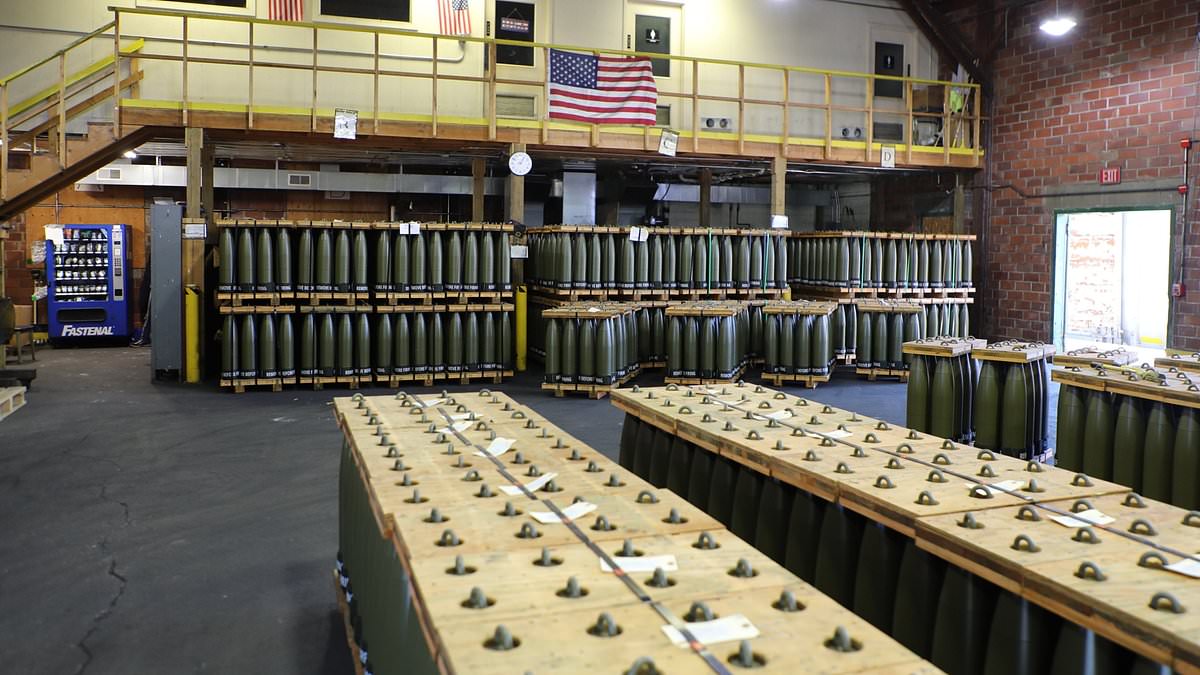
Americans are being warned to stay indoors as the Army prepares a massive detonation that could send toxic dust drifting miles away.
In a statement late Monday, the Army said it would proceed Wednesday morning with the controlled detonation of 68 barrels of lead azide at its Iowa Army Ammunition Plant near Middletown, citing ‘unanimous’ backing from the federal agencies involved.
A federal appeals court lifted a temporary hold Monday, clearing the way for the operation to destroy nearly 10,000 pounds of deteriorating explosives that officials say have become too dangerous to move.
Residents in potentially affected areas are being urged to stay indoors for up to 48 hours after the detonation, keep windows and doors closed and limit outside air entering their homes.
The greatest danger will be to anyone within the Army's projected plume in the first hour after the explosions. Precautions could stretch into Thanksgiving, as locals face uncertainty about where lead dust might settle after Wednesday’s operation.
A plume model suggests lead dust could drift roughly 46 miles southwest of the plant, spreading across southeastern Iowa and into northeastern Missouri.
Lead azide, a sensitive explosive used to trigger munitions, has been stored for more than two decades at the military installation. It is highly toxic to humans and animals.
Changes in the liquid used to stabilize the material have allowed it to recrystallize inside its containers, increasing its sensitivity to shock and friction and creating a risk of an uncontrolled explosion, according to court documents.
In a statement late Monday, the Army said it would proceed Wednesday morning with the controlled detonation of 68 barrels of lead azide at its Iowa Army Ammunition Plant near Middletown, citing ‘unanimous’ backing from the federal agencies involved
The green light came just hours after the federal appeals court rejected environmental groups' petition to block the detonation.
The decision also followed President Donald Trump's move to halt the blast, ordering the Army to stand by until the court and the state's incoming governor approved it.
Acting Army Secretary Adam Telle said on X Monday night: 'Every expert agency agrees, and both Iowa’s current and incoming Governors say the call belongs to the experts.
'We are proceeding with the controlled removal in full coordination with all state, local and federal authorities, because the safety of Iowa’s citizens comes first.'
In March, the Army determined that the stored lead azide had degraded and become unstable.
However, The New York Times reported the military had canceled a contract for chemical neutralization and chose controlled detonation instead.
The Army hired MuniRem Environmental, a Georgia-based firm that uses chemicals to neutralize munitions, but dropped the deal two months later.
The Army has not publicly detailed why it dismissed the alternative.
The explosions will destroy unstable stockpiles of lead azide at Iowa Army Ammunition Plant
The repeatedly delayed operation has drawn backlash from residents, elected officials and environmental groups over fears of lead exposure, particularly in southeastern Iowa near the plant in Middletown.
Meteorologist Ryan Hall shared a plume prediction on X, showing wind will be light Wednesday morning, 'so the air heads southwest, past Donnellson and into northeast Missouri.'
The plume is expected to spread for at least six hours following the detonation.
The Federal Aviation Administration (FAA) has restricted flights around Middletown from Monday through Wednesday, and Iowa Governor Kim Reynolds activated a state emergency operations center on November 20.
Officials in neighboring Illinois warned that airborne lead particles from the blast could also put residents at risk.
Governor JB Pritzker said Sunday he had spoken with the Army, EPA and other agencies about the operation and was 'continuing to press for the release of more public information to help keep Illinoisans safe.'
Wally Taylor, attorney for the environmental organization Sierra Club's Iowa chapter, one of the petitioners against the EPA, said: 'The Army has clearly mishandled this situation, and Iowans and residents in our neighboring states deserve a full review of all of the missteps that led us to this point.
'However, if detonation is now the only option, it is imperative that everyone impacted has access to the full range of testing, mitigation, and remediation resources.'
Federal officials warned that falling temperatures could further destabilize the material, increasing the risk of an uncontrolled explosion if the operation is delayed.
Military officials noted that the lead azide kept at the site had recrystallized, making it more sensitive to shock, friction and movement.
Moving the stockpile to a more secure location could have further disturbed the containers and set off an accidental explosion while on the road or in a more populated area.
The military destroying old explosives is not a rare occurrence, but this particular situation has been described as an 'emergency' due to the dangerous nature of lead azide.