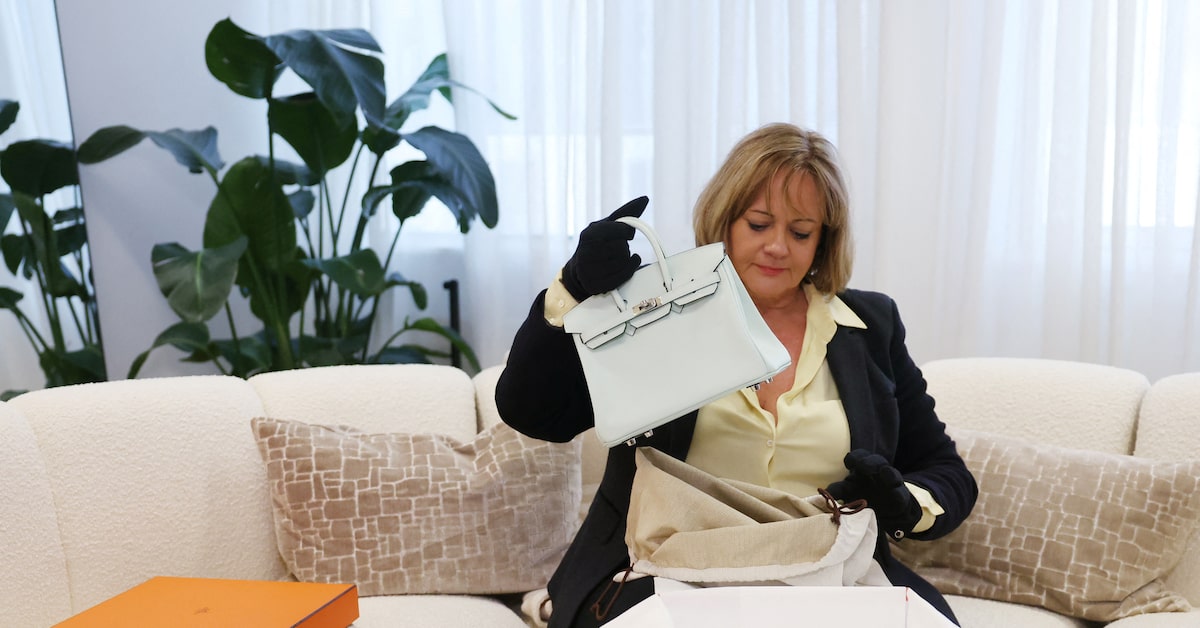
Managing Director of Lilac Blue Antoinette Hunter unboxes a 2025 Birkin bag in the shade of peppermint at the Knightsbridge private Hermes resale boutique in London, Britain, October 19, 2026. REUTERS/Suzanne Plunkett
LONDON, Nov 24 (Reuters Breakingviews) - Thorstein Veblen didn’t live to see the Birkin bag. The American economist died 55 years before Jean-Louis Dumas fashioned the iconic Hermès
(HRMS.PA), opens new tab
accessory for British actress Jane Birkin in 1984. But Veblen would recognise the sort of economic good that Birkin bags have come to represent - and no doubt be fascinated at their role in the $142 billion French luxury house’s recent slump.
The law of demand says consumers typically buy less of something when its price rises. "Veblen goods" turn that on its head - demand for them rises even as they get more expensive. High-end watches like Rolex, fine wine, art and supercars all have Veblen characteristics. But Birkin bags have for 40 years been a particularly good example: in July 2025 Jane Birkin’s original handbag
sold, opens new tab
for $10 million at Sotheby's, a record auction price for the product.
Unsurprisingly, boasting a good with Veblen characteristics hands its producer a golden ticket. That helps explain why Hermès had between 2019 and 2025 more than doubled revenue to €16 billion and weathered luxury’s post-pandemic slump better than its rivals. Investors valued the French giant, last year worth over €250 billion, at near 50 times forward earnings on average through 2025 - compared to about 20 times for sector bellwether LVMH
(LVMH.PA), opens new tab
. Yet less than a year later, the multiple has nearly halved to 26, just below L’Oréal’s
(OREP.PA), opens new tab
and a far cry from its 10-year average of 45.
On the face it, Hermès’ burgeoning problems are not about its legendary bags. The group’s leather goods, which include Birkin and similarly iconic Kelly bags, saw third-quarter growth rising to 10.8% year-on-year. Yet sales of its other products, which accounted for 56% of group revenue last year, swung from 3.7% organic growth in the second quarter to a 0.7% decline in the third. That, according to Bank of America analysts, is their first contraction outside Covid since 2016.
Why? China’s economic slowdown may explain some of the divergence. But another possibility is that customers are buying fewer non-leather goods because one key reason to do so - getting on the waiting list for one of Hermès’ genuine Veblen goods - is now less of a draw. Those hoping to secure a Birkin or Kelly have traditionally had to cultivate years of relationships with sales representatives and buy clothes, jewelry and home products like plates and lamps first. Hermès says no such purchases are officially required, but re-sellers interviewed by Reuters describe the practice.
All this was easy enough to justify when a handbag bought in a Hermès shop might sell for twice or more its price elsewhere, more than offsetting the cost of unwanted purchases. But that’s where Birkin bags’ Veblen status is starting to fray. Bernstein estimates the resale premium on a Birkin 25, for example, has narrowed from 160% in 2022 to 70% in the third quarter. While Hermès doesn't disclose official numbers, UBS reckons listings of Birkins and Kellys are now 6 or 7 times pre-pandemic levels, and that annual production of the two classic models combined could reach 200,000 this year.
In other words greater production, handbags that could last for decades and thriving resale outfits have increased supply despite the perceived difficulty in obtaining them. If buyers can buy a bag second-hand without climbing the purchasing ladder, the non-leather sales may suffer. Dwindling resale gains also deter those buying Hermès bags as investments.
Hermès has expanded beyond its icons, too. UBS estimates other so called “non-quota” handbags - which often do not require the amount of ancillary purchases needed for a Birkin or Kelly - now account for 65% of leather goods revenue. They have also enjoyed some success, but they generally lack Birkin-like resale premiums, leaving the division now more exposed to ordinary luxury cycles.
For Hermès Chief Executive Axel Dumas, a nephew of the Birkin bag’s inventor, there are no easy fixes. Inventing a new Birkin or proving the non-leather categories merit the price on their own could take years. An investor who considers all this a temporary glut told Breakingviews that the company could cut output and wait five years to sit out the cycle. Yet that would mean a hit now – and in any case Hermès is raising leather capacity by 6% this year via more "workshops", the company’s preferred way to name their manufacturing facility. Dumas could also keep hiking prices - the next one is expected in January – but that risks further narrowing resale premiums.
The resale value of Birkin bags does remain above cost, but the recent falls should still concern Dumas. China’s Kweichow Moutai
(600519.SS), opens new tab
, which produces limited volume of fiery Baijiu liquor, is
a cautionary tale, opens new tab
of a wider shift in tastes and preferences. Moutai was once a prestigious gift enjoyed by the super-rich, but has suffered from curbs on public official entertaining and younger drinkers’ changing habits. Similarly, Beijing's recent tax crackdown on the wealthy - both at home and abroad - encourages the super-rich to lay low.
A handbag is not a drink, but social media has made Birkins more of a common sighting just as younger affluent Chinese buyers may be less tolerant of the purchasing ritual notoriously known as "Peihuo". Hermès still deserves a premium to LVMH’s 16 times and Kering’s
(PRTP.PA), opens new tab
20 times earnings, given its superior margins. But finance chief Éric du Halgouët has suggested that annual organic sales growth of around 5% would help sustain operating margins, which stood at 41% in the first half. Third-quarter sales grew just 4.3% at constant exchange rates.
The trouble with Veblen goods is that it’s far from simple to make previously star-struck punters fall back in love with them.
Editing by George Hay; Production by Streisand Neto
Our Standards: The Thomson Reuters Trust Principles., opens new tab
Yawen focuses on European energy and luxury companies, commodity markets, and real estate as a columnist for Reuters Breakingviews in London. Previously, she was a columnist with Breakingviews in Hong Kong, covering a broad spectrum of topics concerning the Chinese economy, financial markets, and regional companies. She initially joined Reuters News as an economics correspondent in 2016. She earned the title of Reuters’ Journalist of the Year in 2023 in the commentary category.