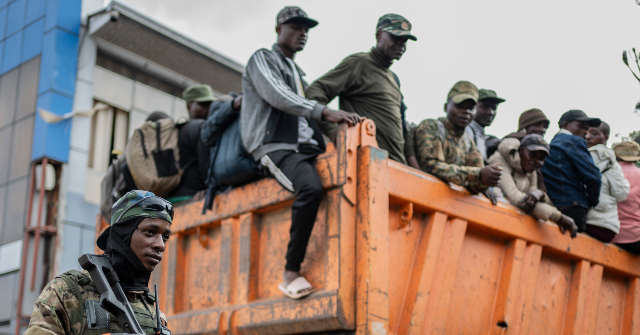
The World Health Organization warns that heavy fighting in eastern Congo has disrupted Ebola treatment and forced health workers to shelter.
Official tallies recorded over 11,000 Ebola cases and 5,678 deaths from the outbreak, but satellite imagery and gravedigger testimony suggested fatalities may have been undercounted by as much as 50 percent.
Armed groups including the ADF, CRP, and M23 have obstructed medical access, while ethnic violence drives civilians into crowded camps where Ebola can spread.
World Health Organization (W.H.O.) Director-General Tedros Adhanom Ghebreyesus warned on Sunday that “heavy fighting” in the eastern Democratic Republic of the Congo (DRC) is hindering efforts to control the Ebola outbreak, which has now produced over 11,000 confirmed cases and 5,678 fatalities.
“Heavy fighting has been ongoing since yesterday in the vicinity of a hospital in Ituri — in an area close to where the Ebola outbreak first emerged. As a result, colleagues and response partners have been sheltering for their lives in a maternity ward of the facility for over 24 hours,” Tedros said on social media platform X.
“The situation has disrupted the work of the hospital and the wider Ebola response, putting patients, families, and health workers at grave risk. Across the Eastern DRC, frequency of attacks has increased since the end of October, seriously affecting the Ebola response,” he wrote.
“The best medicine is peace,” the W.H.O. director concluded.
W.H.O. said on Monday it has confirmed “more than 87 attacks on healthcare” in the DRC. As terrible as the outbreak has been, more people have been killed by political violence than Ebola over the past few days.
“More than six months after it was first declared, the Ebola outbreak in eastern DRC continues to spread. A high proportion of deaths continue to occur in communities and outside dedicated treatment centers, especially among young children, highlighting challenges in early case detection and access to care,” the U.N. agency said.
Reuters on Monday analyzed satellite imagery of the eastern Congo, combined with testimony from local gravediggers, to conclude that “far more new graves have been dug than can be explained by official Ebola death tallies, pointing to a large undercount of the disaster.”
According to this analysis, Ebola deaths may have been undercounted by as much as 50 percent during the early stages of the outbreak. W.H.O. has estimated that the outbreak could be two to four times larger than suggested by official statistics because so many infections and deaths have not been recorded by health officials. Mass graves with hundreds of undocumented Ebola victims have appeared near some villages.
A major factor in the undercount is the uncertain beginning of the outbreak. It was officially declared on May 15, but almost certainly began weeks or months before that, with hundreds of deaths and cases in rural areas that have yet to be properly accounted for.
Another problem is the roiling political instability of the eastern Congo, which has suffered years of bloodshed between various armed groups fighting both the Congolese military and each other. These endless skirmishes and terror attacks make it difficult for local residents to seek medical treatment and for doctors to keep clinics and hospitals open.
W.H.O. specifically complained about one group, the Allied Democratic Forces (ADF). “Following up contact tracing in areas where ADF is operating is a very hazardous idea,” U.N. Senior Ebola Response Coordinator Julien Harneis told a press conference in Geneva on November 13.
The ADF is a jihadi group linked to the Islamic State that wants to establish an ISIS-style “caliphate” in the eastern DRC. The ADF has been interfering with medical aid and humanitarian shipments in Ituri province since the early days of the Ebola outbreak. The group has built a legacy of human rights offenses during its 30-year history, including sexual violence, mass murders, and recruiting child soldiers.
Doctors Without Borders (MSF) complained about another group known as the Convention for the Popular Revolution (CRP). This militia was established in early 2025 by a convicted war criminal named Thomas Lubanga, who was jailed in 2012 for recruiting child soldiers for an earlier insurgent movement he founded. He operates out of Uganda, exerting the kind of cross-borders destabilizing influence that makes humanitarian work so dangerous.
MSF said that even before the Ebola outbreak, its doctors were spending a great deal of effort on treating civilians injured by CRP attacks. The CRP has a history of targeting civilians who might support rival gangs, and deliberately preventing humanitarian assistance from reaching villagers who are not loyal to the CRP cause.
Another group active in the eastern Congo is M23, an insurgent militia supported by the government of Rwanda. M23 has seized control of some sizable towns, making it difficult for doctors to reach remote villages.
Areas under M23 control have their own governments and “health care systems,” which do not cooperate readily with Congolese or international health officials. M23 rebels boast they have done a better job of controlling Ebola than the DRC government, with periodic declarations that villages under their control have become “Ebola-free.”
Dozens of other armed groups are active in Ituri province, many of them linked to a decades-old feud between two of the region’s largest tribal groups, the Hema and the Lendu. Ethnic militias have a habit of launching sudden and brutal attacks on communities belonging to the “wrong” tribe, creating waves of internal refugees who flow into crowded camps with poor hygiene, creating perfect environments for Ebola to spread.