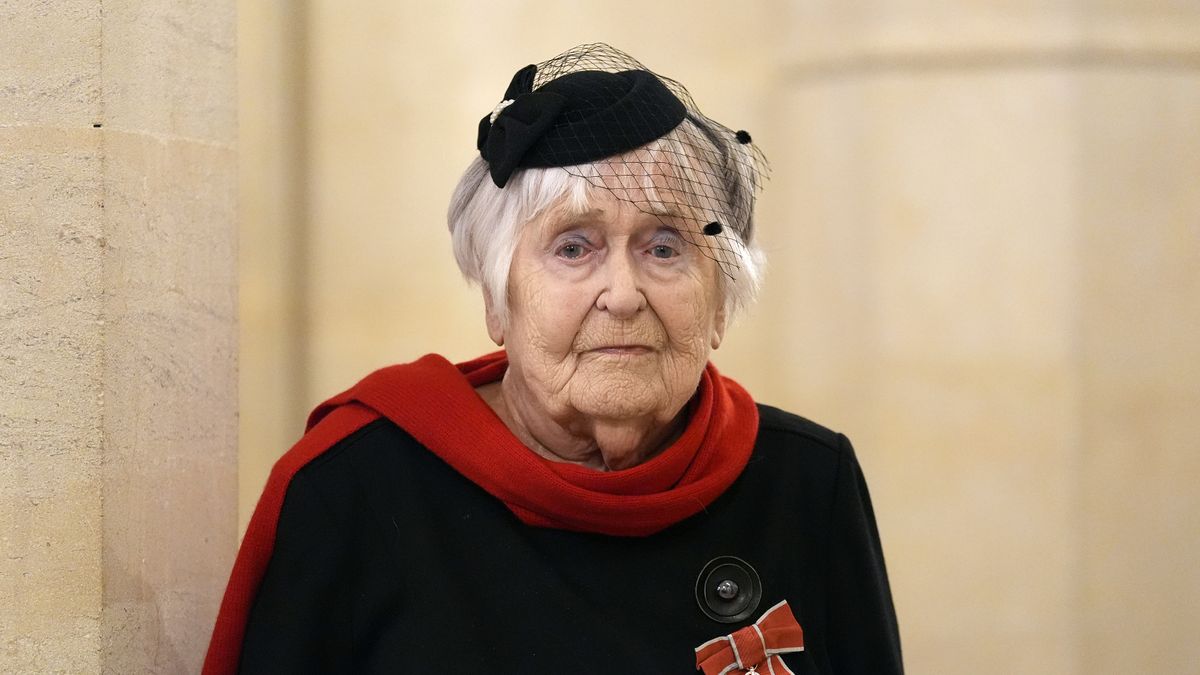
Lydia Tischler, a Holocaust survivor who lost her mother at Auschwitz, has died aged 97 after a remarkable career in child psychology.
A Holocaust survivor who lost her mother at Auschwitz before becoming a pioneering child psychologist has died aged 97.
Article continues below
Trial over Ian Huntley’s murder begins
Lydia Tischler came to Britain as a refugee in 1945 after surviving the Theresienstadt Ghetto, Auschwitz and forced labour at Oederan, a sub-camp of the Flossenbürg concentration camp.
Article continues below
Ms Tischler, who was forced to dig trenches at Auschwitz alongside her sister, went on to train under renowned psychoanalyst Anna Freud and work as a child psychologist for more than six decades.
Article continues below
Ensure our latest headlines always appear at the top of your Google Search by making us a Preferred Source. Click here to activate or add us as your Preferred Source in your Google search settings.
She was awarded an MBE earlier this year for her services to Holocaust remembrance and child psychotherapy.
Article continues below
Originally from Ostrava in former Czechoslovakia (now Czech Republic), Ms Tischler died in the night between Thursday and Friday, the Association of Jewish Refugees (AJR) said in a statement.
She worked at the Cassel Hospital, a psychiatric facility in Richmond, south-west London, for 23 years.
Article continues below
Ms Tischler also returned to her native country to establish a training programme in child psychotherapy and shared her experience in the discipline with younger therapists there.
It was an achievement she regarded as one of the “proudest of her life”, according to the AJR.
Article continues below
Throughout her life, she also spoke of the importance of Holocaust education and attended many memorial events and ceremonies, including a gathering outside Parliament for the UK’s National Yom HaShoah, the Jewish day of remembrance for the Holocaust, earlier this year.
During the gathering at the site, which is the planned location for a new Holocaust memorial and learning centre, she told Jewish primary school children about her experience of the Holocaust.
Article continues below
Ms Tischler, who lived in Highgate, north London, was made a Member of the Order of the British Empire by the Princess Royal earlier this year for her services to Holocaust remembrance and child psychotherapy.
After the ceremony at Windsor Castle, she had told the Press Association: “My legacy, at least what I hope to pass on to people, is to help them to understand what makes people hate each other and feel that they can destroy them.”
Article continues below
AJR chief executive Michael Newman said: “Lydia Tischler’s life was one of extraordinary courage and achievement.
“Having endured unimaginable persecution and the loss of her mother during the Holocaust, she came to Britain as a teenage refugee and went on to transform her experiences into a lifetime of service to others.
Article continues below
“Her pioneering contribution to child psychotherapy, both in Britain and in her native Czechia, is a remarkable legacy.
“Lydia’s story reminds us not only of the devastating human consequences of the Holocaust, but also of the immense contribution that Jewish refugees have made to British society.”
Article continues below
Dr Bea Lewkowicz, director of the AJR Refugee Voices Testimony Archive, who interviewed Lydia earlier this year, said: “Interviewing Lydia was an immense privilege. I was struck by her remarkable memory, intellectual clarity, humour and her extraordinary capacity to reflect on a life shaped by both profound loss and exceptional achievement.
“She spoke with particular pride about returning to Czechia to train a new generation of child psychotherapists.”
Article continues below
She added: “When I asked what message she wished to leave for future generations, her response was characteristically profound: ‘Don’t project your hostility into the other. Take responsibility for it and don’t act on it’.”