Mexico City
|
Nov. 23, 2026, 4:49 p.m. ET
|
6 min read
When El Salvador deployed more than 2,000 troops to Haiti this fall, they joined an already-crowded security landscape of international forces and private contractors operating in the Caribbean nation.
But the Haitian public has celebrated their arrival.
In a montage of video clips released by El Salvador’s government in mid-November, Haitians stop Salvadoran troops in the streets of Port-au-Prince to share high-fives. Uniformed soldiers are seen perched on the highest seats in Haiti’s national soccer stadium, ready to secure a gang-occupied neighborhood below. And an armed robotic dog waddles down a narrow alleyway, prepared to engage with gang members.
Yet the arrival of Salvadoran troops is raising concerns from human rights advocates, regional governments, and the United Nations. They say El Salvador has failed to provide clear operating procedures for its soldiers in Haiti, which puts civilians and international security forces at risk. In early November, a top U.S. official in Haiti warned the prime minister that Salvadoran troops “nearly killed” forces from the UN-backed Gang Suppression Force during a shootout, Axios reported.
El Salvador’s President Nayib Bukele ordered the deployment of troops to Haiti in mid-October, after four Salvadoran aviation technicians went missing. President Donald Trump praised the move. But there are questions about Mr. Bukele’s longer term plans, including how long his country’s troops will remain in Haiti, especially if casualties rise.
“Within the Haitian population there’s a change in behavior since the Salvadoran troops arrived. People feel hopeful,” says Esnold Jure, a senior policy analyst at the Washington D.C.-based Haiti Policy House. Haitian civilians have faced the brunt of gang activity that has steadily expanded over the past five years, he says. An estimated 1.5 million people have been internally displaced in Haiti due to gang violence, according to the United Nations.
“Their hope makes sense,” he says. “But for me, as an analyst, I’d like to see more information, concrete plans – from the Haitian government, from international [United Nations-backed] forces, and from El Salvador before I can feel confident this is a good path.”
Patrice Noel/AP
Residents take to the streets to demonstrate their support for El Salvador's President Nayib Bukele and the deployment of Salvadoran soldiers to fight armed gangs in Port-au-Prince, Haiti, Nov. 18, 2026.
Lots of security forces, but little security
The roots of Haiti’s security crisis go back at least a decade, but the 2021 assassination of President Jovenel Moïse accelerated the country’s political collapse. Haitians have gone more than 10 years without a presidential election, and armed groups now control the majority of the capital, Port-au-Prince. Gangs regularly carry out kidnappings and extortion operations. They also kill civilians and use sexual violence to exert control over the population.
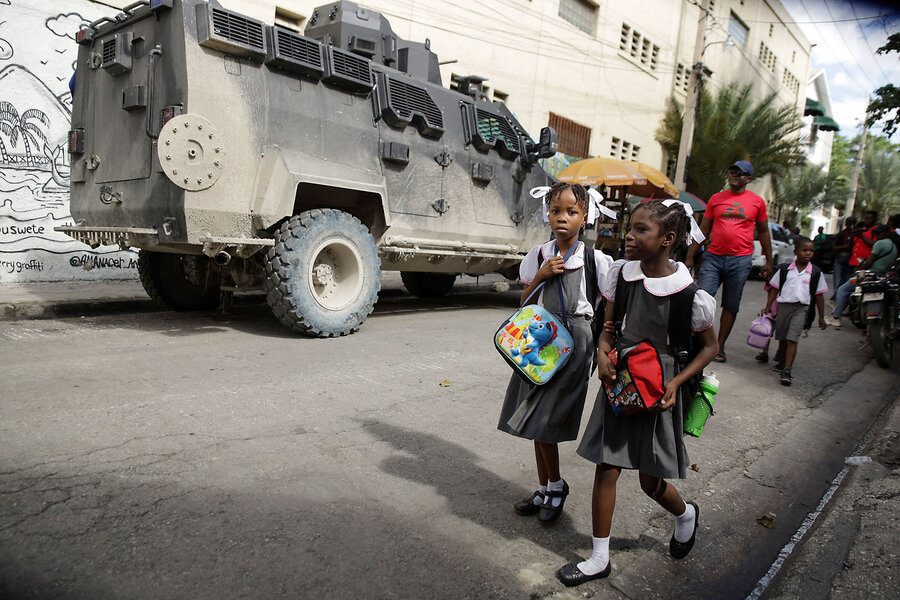
Haiti’s challenges aren’t necessarily due to a lack of firepower. There are several security groups operating in the country now. That includes Haiti’s own national police force; two UN-backed international security missions; and a Haitian government operation staffed by private contractors linked to Blackwater founder Erik Prince.
“In the end it will be Haitian forces responsible for Haitian security,” says Diego Da Rin, Haiti Analyst at the International Crisis Group, which recently published a report on the nation’s fragmented security situation. In the past, “once outside forces leave, Haitian institutions haven’t been able to keep things up,” Mr. Da Rin says.
Across Haiti’s modern history, “there have been a series of disappointments around international missions backed by the UN, because of abuses and also because the results weren’t sustained over time,” says Sandra Pellegrini. She’s a senior analyst for Latin America and the Caribbean with Armed Conflict Location & Event Data, an independent conflict monitor. As for the two UN-backed security missions, “there’s skepticism around how much those forces can achieve,” Ms. Pellegrini says.
“But, El Salvador has positioned itself as a model people want to adopt.” And not just for Haiti, but regionwide.
A popular approach
Mr. Bukele started his crackdown on El Salvador’s powerful gangs when he was first elected president in 2019. But he really made a name for himself starting in 2022, when he declared a state of emergency that limited several constitutional protections, like the right to legal defense and freedom of assembly.
Homicide rates dropped dramatically – by 98% from 2015 to 2024 – giving citizens a sense of renewed freedom. Mr. Bukele’s government said it arrested 84,000 people between 2022 and 2025, with many ending up in a newly built mega-prison, CECOT. In a bid to replicate that success, politicians across Latin America and the Caribbean started campaigning on similar hard-line security strategies, and citizens demanded crackdowns that might provide their communities with public-safety results, despite the trade-offs on civil liberties.
Patrice Noel/Reuters
Haiti Prime Minister Alix Didier Fils-Aimé, flanked by Brig. Gen. Elon Clarke (at left), deputy force commander of the Gang Suppression Force, and Col. José Figueroa of the Salvadoran army, speaks to the media days after four Salvadoran members of Haiti’s United Nations-backed GSF went missing in a gang ambush, in Port-au-Prince, Haiti, Nov. 3, 2026.
While crime fell in El Salvador, Mr. Bukele weakened institutional checks on his executive power. Today, his Nuevas Ideas party controls all three branches of government, as well as the attorney general’s office and electoral tribunal. His government used its majority in the legislature to amend the constitution last year, eliminating presidential term limits and allowing for indefinite reelection. Mr. Bukele just announced his plans to run for a third consecutive term.
When the four Salvadoran aviation technicians were ambushed on Oct. 18, the country had around 100 troops operating in Haiti under a UN mission. Today, there are roughly 2,500.
Different country, different criminal gangs
Haiti’s justice minister told reporters during a visit to El Salvador in mid-November that there is “no date” for the Salvadoran troops to leave. He said Haitian police need their support until Haiti’s long-delayed elections are held in 2027.
But the uncertainty around El Salvador’s timeline is a central concern for international observers. Any progress Salvadoran forces have made in pushing out gangs from certain areas of the capital could just as quickly be reversed after those troops depart. And when that happens, it is typically the local residents who face a backlash from the gangs, Mr. Da Rin says.
Others question how long the Salvadoran public will be willing to fund Haiti’s fight against insecurity. Last week, President Bukele identified three Salvadoran soldiers who were killed in Haiti while trying to defuse a drone armed with a grenade.
The legal basis for El Salvador’s most recent deployment is also unclear, with human rights groups and the international community raising questions about who the troops report to and under what rules of engagement they’re operating. It took more than two weeks before Haiti’s Prime Minister Alix Didier Fils-Aimé made public remarks about El Salvador’s deployment. He described El Salvador’s mission as a bilateral effort. “They’re here to support us,” he said.
And although there is energy around the arrival of help from “a strongman,” says Mr. Jure, “someone that could really go head-to-head with the gangs,” Mr. Bukele’s success at home may not be transferable to other countries.
Salvadoran gangs including Barrio 18 and MS-13 are organized around “complex networks of cliques” that fund themselves through extortion and drug trafficking, but “don’t necessarily aim to take control of major state infrastructures and don’t have the same political underpinnings that you see in Haitian gangs,” says Ms. Pellegrini.
Meanwhile, Haitian gangs evolved out of politically-backed militias, long relied on by politicians and business elites. The gangs gained more autonomy in recent years and started openly challenging the state, taking over police stations, and forcing government institutions to move away from the center of Port-au-Prince.
In El Salvador, part of Mr. Bukele’s crime-fighting success relied on arresting large numbers of civilians, judges expediting legal cases, and well-funded prisons with the capacity to house accused criminals.
“There is no penitentiary infrastructure to do that in Haiti. There’s a crumbling judicial system. So, what’s the plan? Just come in, kill gangs, and then pull away?” Ms. Pellegrini says. “It has to come with a more long-term strategy.”
Deepen your worldview
with Monitor Highlights.
Politics with respect
Get political stories with respectful analysis.
There‘s a world of new ideas in every
Books newsletter.
There‘s more to life, enrich yours with
Culture & Learning weekly.
Follow humanity‘s discoveries with
Science & Nature stories in your inbox.
Gain a spiritual perspective
from the stories in your inbox.
Want to understand the deeper impact of critical events? Learn the Monitor‘s insight.
Already a subscriber? Log in to hide ads.
For Haitians who have been driven out of their homes or watched loved ones killed by gang members, the arrival of troops from El Salvador is seen as an answer to Haiti’s prayers.
“Nayib Bukele is in the spotlight. In the streets of Port-au-Prince and in provincial towns, people are singing his name. Crowds dance as they talk about his actions,” Frantz Duval, editor-in-chief of Haitian newspaper Le Nouvelliste wrote on social media earlier this month. “His music is replacing the tragic symphony of indiscriminate violence and fear,” he concluded. “For now.”