As they embarked on the long journey home from Kilmarnock on Saturday night, Aberdeen supporters would surely have felt a little extra spring in their step.
If 2026 felt like it had been shaping up to be something of an annus horribilis, a 4-2 victory at Rugby Park undoubtedly lifted some of the gloom that had been hanging over the club these past few months.
Granted, a sample size of only one match under Mario Frick is very small. Nobody would be of a mind to get carried away with themselves just yet, especially given that Killie are easily the worst team in the league.
But there was enough in the performance, particularly during a first half which saw them score three goals in 30 minutes, to suggest that a brighter future could lie ahead under the new manager.
Aberdeen were aggressive, they played on the front foot, and they attacked with pace. Most of all, they were actually exciting and entertaining to watch.
Those were boxes they never ticked at any point during Stephen Robinson's time in charge. Robinson failed at Aberdeen and his team were routinely awful in terms of the quality of football they served up.
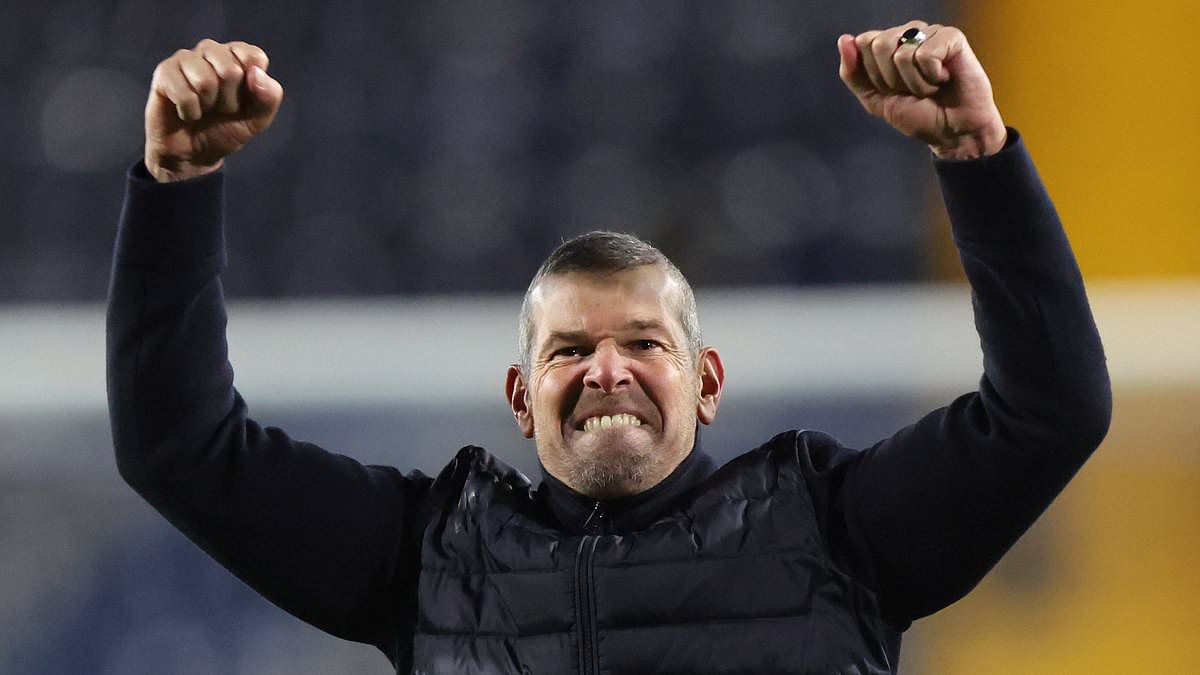
Mario Frick celebrates after a 4-2 win over Kilmarnock in his first game as Aberdeen manager
Ante Palaversa is back in the Aberdeen team after becoming the forgotten man of Pittodrie
Aberdeen striker Kevin Nisbet rediscovered the feelgood factor by scoring twice at Rugby Park
In the space of only 90 minutes, Frick did more to send a wave of positivity through supporters than Robinson ever managed to do in his eight months at the helm.
The shift in mood has been as profound as it has been instantaneous, with Frick's so-called heavy metal football music to the fans' ears.
Headlines of Super Mario were always likely to follow, but Frick and his players will face an altogether tougher examination when they take on Rangers at Ibrox tomorrow.
It is an intriguing contest on various levels, with Rangers unbeaten in 13 matches as Derek McInnes goes up against his former club once again.
Given that these teams met in the Premier Sports Cup only a few weeks ago, perhaps the greatest barometer of Frick's impact will be whether Aberdeen can pose more of a threat than they did at Hampden.
But what has changed? After such a turgid run of form that left players looking completely bereft of any confidence and cohesion, how was Frick able to generate an immediate improvement?
Speaking after the win at Killie, Frick was asked what sort of message he had given to the players given that time together on the training pitch had been fairly limited.
'I told them they should play like they did when they were young. In those days they didn't think about mistakes.
'They didn't think about anything negative. They played only to win, for fun.'
It was simple but refreshing. In an age of increasingly complex coaching jargon, Frick's message was intended to liberate his players – and it worked a treat.
Aberdeen went 2-0 up inside 12 minutes, with Kevin Nisbet scoring twice. The team looked free from the trauma of the Robinson era.
Even when Kilmarnock fought back and the game became more chaotic, Aberdeen retained enough attacking threat and collective belief to close it out.
It was a huge result. A defeat would have dropped Aberdeen to the foot of the table. Instead, they climbed five places and, more importantly, rediscovered a feelgood factor.
In his previous utterances, Frick was clear that goalscoring has been the central problem.
His previous teams at Vaduz and Luzern were known for their attacking output. At Luzern last season they scored 76 goals.
Aberdeen had managed only 12 in 12 league matches before his arrival. The early evidence suggests the players have absorbed the message quickly.
Frick's insistence on the basics – aggression, willingness to work, positive body language – appears to have cut through more effectively than more elaborate instructions might have done.
This is consistent with the picture painted by those who worked with him in Switzerland. Frick is not a rigid systems coach wedded to a single formation.
He has most often used a 4-4-2 diamond, but the shape is secondary to the mentality. High pressing to force turnovers, rapid counter-attacks, and a sense of freedom imbued to his players.
All of which makes tomorrow's clash at Ibrox all the more compelling. Aberdeen have lost their last eight meetings with Rangers in all competitions.
The previous two encounters this season, one in the Premiership and one in the Premier Sports Cup, were both settled by late Rangers goals.
The contrast in styles will be stark. Rangers are likely to control territory and force Aberdeen to defend for longer periods than they did at Rugby Park.
Frick's side will need to show that the freedom he has granted them does not dissolve into naivety when the opponent is stronger and more experienced.
The high press that worked so effectively against a struggling Killie side will have to be timed with greater precision.
The attacking play will require clinical decision-making in the final third. And the defensive structure, which Frick identified as the main area for improvement after Saturday, will be examined under more sustained pressure.
Frick has already spoken of aiming higher than mere survival. In a league which is always extremely tight in the mid-table, top six should be the minimum target.
That may have sounded optimistic a fortnight ago. But the win at Kilmarnock suggested Aberdeen have enough about themselves to be looking up rather than over their shoulders.
The squad still needs greater consistency and, in certain areas, greater quality.
But there is already evidence to suggest he can get a tune out of some players who either under-performed under Robinson or, in some cases, those who had been totally discarded.
Ante Palaversa would surely be chief among them. The Croatian midfielder hardly kicked a ball under Robinson and had become the forgotten man at Pittodrie.
Brought in to make his first league start of the season, his performance at Killie and the way he controlled things in midfield made his exclusion under Robinson look all the more bizarre.
None of this is to say that Aberdeen are suddenly a top-class football team. At best, they remain very much a work in progress.
Yet, crucially, Frick immediately has the supporters onboard in a way that Robinson never managed to do.
Frick and his players could yet be given a major reality check if they were to suffer a hefty defeat to a Rangers side unbeaten in 13 matches.
But there is belief and positivity in the camp at Pittodrie. Feelgood factors in football can often be fragile and often short-lived, but they are also real.
When players begin to play with freedom and confidence, results usually tend to take care of themselves.
Frick has not yet transformed Aberdeen. He has, however, given the players and the fans a reason to believe that a brighter future could lie ahead.